
By A O News Service
NAHARLAGUN, Jan 06: Considering the commonness of languages, practices, rituals of Tani tribes, including Mishings of Assam, Mishing Autonomous Council (MAC) chief executive member Paramananda Chayengia made a fervent call to unite all of them as Tani group for global identify.

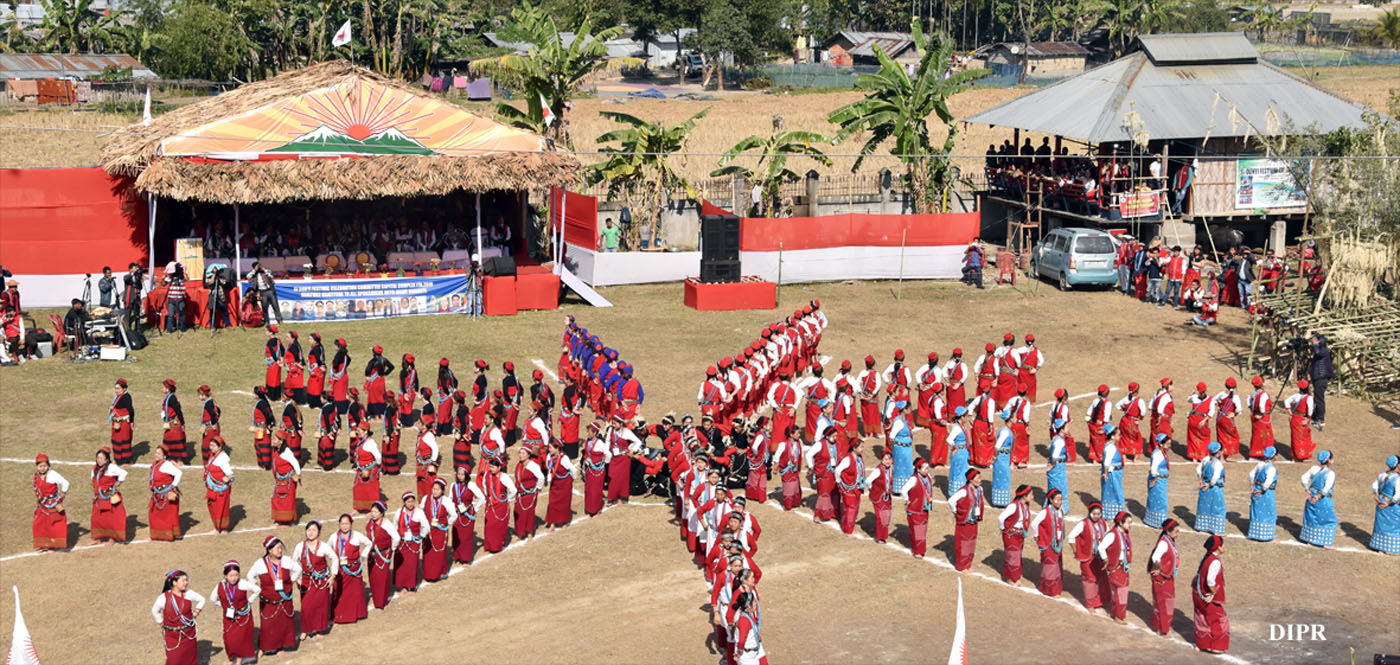
Addressing huge gathering of Si-Donyi Festival revelers at Si-Donyi Jaaring here on Sunday as chief guest, he said that “we are born from the same root with same blood lineage with full faith in Donyi-Polo though separated due to social or political reasons.
Their common language could be developed as a modern one for our global identity,” he said without mincing any words to the thunderous applause of the gathering and lauded large participation of younger generation which, he said, proves that “there is no threat to our identity”.
“Respecting me during this festival by Tagins amounts to respecting Mishing community”, he said while recalling that he was born, educated in Arunachal Pradesh as his father and mothers were serving in this state during 1960s for which he is physically and mentally inked to this Himalayan state.
Though alien cultures had posed a serious threat to age-old cultures, language and practices of Mishing community, but they realized soon that they would lose their identity soon if bold steps are not taken to conserve and preserve their identity, he said.
He recalled that during a meeting at the initiative of MAC at Itanagar in December last attended by representatives of various local indigenous communities, a coordinate committee was formed with Tonyi Pertin as convenor to unite all Tani groups.
The indigenous people of Arunachal Pradesh would continue to face threat to their identity until and unless they strengthen their cultures and religions, said department of indigenous affairs chairman Nabam Atum as guest of honour.
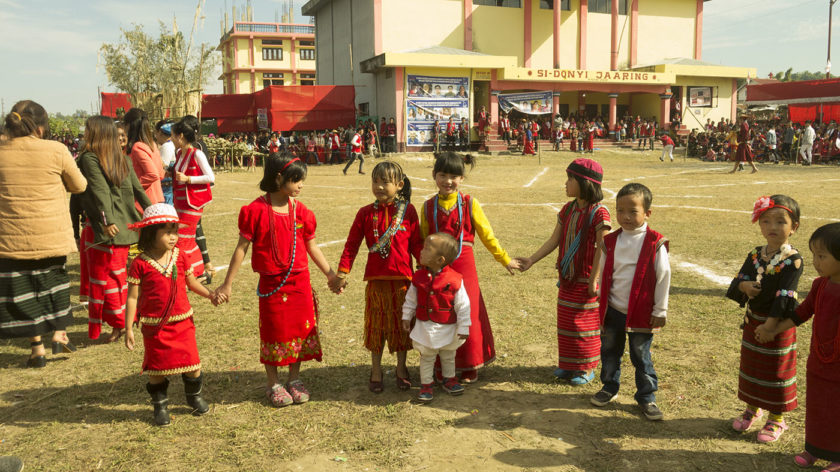
Younger generation adopting culture – AONS
He apprehended that the younger generations are turning their back towards the rituals and concentrating on entertainment aspects only for which the rituals are slowly diminishing. He stressed on immediate documentation of all age-old rituals of all tribes of the state before the senior priests leave this mortal world with their invaluable knowledge.
Earlier, Si-Donyi Festival Celebration Committee Capital Complex (SDFCCCC)-2019 secretary Tameng Kamsar, while highlighting the mythology of the festival celebrated since time immemorial, said that the belief, faith, cultural fabric and philosophy of Tagin life, handed down by forefathers through folklore hymns, by priests in oral form from generation to generation which forms the spiritual knowledge base of the community.
Young and old in their best attires performed traditional dances to appease Si-Donyi which was repeated to the tune of noted singer Vijay Nalo to draw the curtain while local brew did the round.
Vice chairman Turter Dulom was visibly active when the guests were served local cuisines by young damsels led by Api Nima Dutta while chief priest Hotom Mara with other priests was busy in performing rituals for ceremonial sacrifice.
Mitákuye Oyás’iŋ (All are related)
By Pradeep Kumar
It is not known that if MAC chief executive was aware that he was reverberating a global view about Donyi-Polo believers.
Donyi-Poloism, a religion that makes no distinction, is more relevant in the present day context as its believers pray for the greater welfare of the entire humanity while practicing the much needed tolerance towards other cultures. Indigenous faith is the mother of all religions as has been proved across the world.
In fact, Mitákuye Oyás’iŋ was the outcome of the International Conference of World Elders of Ancient Traditions and Culture conducted at Jaipur during February 5 to 10, 2006. Fulbright scholar Vijay Swami, Tashi Tom from Tawang and Willa Namchoom from Chowkham from Arunachal who were among the 250 delegates from 42 countries spread across five continents and representing 257 traditions were astonished to find the striking similarities in dresses, ornaments, food habits and rituals.
“Yes, we belong to the world community as nature worshippers despite the geographical barriers are the same across the world,” was the admiring comment of Donyi-Polo believer Dr Joram Begi.
Mitákuye Oyás’iŋ (All are related) is a phrase from Lakota language which reflects the world view of interconnectedness held by the Lokata people of North America.
Swami, in his article ‘Continuing traditions in developed nation’ wrote that there are about three billon people, called Native Americans, who live in a typical traditional style in the high-tech, tip-top, eye-catching modern America. Their lifestyle has been uniquely blended with the modern world without affecting in any way their age old culture, value system and sometimes even their dress and hairstyle. They have great pride and respect for what they are and the White Americans too appreciate them with dignity. This has been well projected in various museums in Philadelphia and Washington DC through displays, pictures and documentaries.
Jolene Rickrd, guest curator, has rightly put it in 2004 and displayed in National Museum of American Indians that “Claiming our future on our own terms-that is self determination. Self determination means control of our lives and our land, knowing our traditions and understanding our relationships to each other, insisting on our right to be who we are. We know that our future depends on integrating traditional knowledge with the modern world. One without the other is a world out of balance.”
Arunachalee communities as such do not need any interference from outside in any way in their faith, traditions, customs and practices. If Native Americans, living in America itself, could keep their traditions intact today in spite of displacement and intimidation, it is not too late for the Arunachalees, believes Swami.
Since Rukbo represented Donyi-Polo Mission at the Interventional Association for Religious Freedom meetings in 1984 and 1985 and at its Bangalore meeting in 1986 and pleaded for recognition of Donyi-Poloism as a full-fledged religion, the indigenous renaissance has reached the length and breadth of the state and there are about 400 Kargu Gamgis, and if Rang-Fra faith is added, the number stands at 528. The multi-ethnic tribes live in this Himalayan state rich with bio-diversity, flora and fauna and the unique culture.
Interestingly, RGU’s cultural fusion in March 2006 had set the unification process in motion. It was a unique attempt—A Unity Festival by Rajiv Gandhi University—aptly called Arunachal Panorama held in March 2006 to showcase the rich cultural diversity of this tribal land that reemphasized:
Better with the learned dwell,
Even though it be in hell
Than with the vulgar spirits roam
Palaces that gods call home. – Panchatantra
The event was conceived by then RGU Vice Chancellor Prof. Atul Sarma, which had pricked the psyche of all those who matter and desired such a move to develop a pan-Arunachalee identity for the people, who should have deep-rooted link with their cultures while flying across the globe. It was a novel idea propagated by then CM Gegong Apang, who had stressed the importance of “Roots and Wings”, while addressing the 63rd annual conference of Indian Public Schools’ Conference (IPSC) at Dehradun in 2002. Apang’s visionary deliberation had resulted in “Blossom & Fruits”, the theme for the next IPSC conference in Rajasthan.
Then state chief secretary Tabom Bam, a tribal himself, gad given a new thrust by his clarion call at Palin on 26.02.06 for unification of all Abo-Tani descendants having same cultural affinities in all respects, but geographically separated.


 20

