
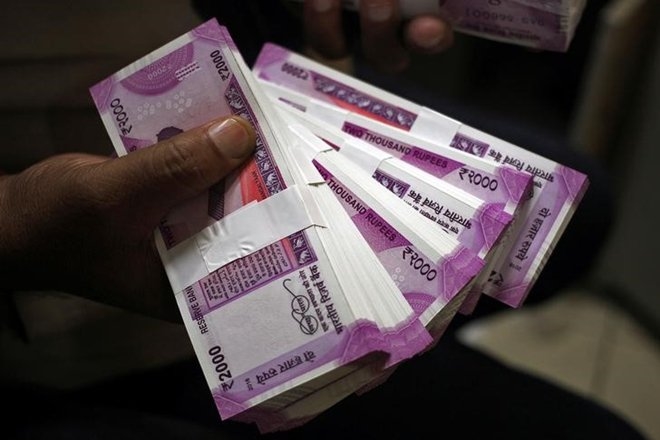
The ATMs in Capital Complex have not only been going dry but is a national phenomenon as reported in the media, while Rs 2,000 currency notes have also disappeared from markets too.
Rs 2000 notes were introduced after demonitising Rs 500 and Rs 1000 currency notes, announced by Prime Minister Narendra Modi on 08.11.16 as a surgical strike against black money and corruption. The rhetoric changed tune several times since then.
Trinamool Congress Rajya Sabha MP Derek O’Brien had put out a tweet with the list of 105 people who had died during 45-day demonitisation period, saying “We don’t know about good times,” Shilpa Shaji had reported on 22.12.16 in Narada News. When the people who died were not hoarders or black marketers, was then the demonitisation not a trial and method though the PM had declared that “good times were sure to dawn upon us”?
Today’s Indian Express report – SBI Research punches a hole in GoI claim, pegs cash shortfall at Rs 70,000 crore – clears all doubts.
SBI Research (SBIR) today from Mumbai dropped a bombshell saying the shortfall in currency with public stood at a staggering Rs 70,000 crore. The fresh data point at odds with the GoI and RBI’s assertions that there is no cash shortage whatsoever. According to Finance Ministry, the GoI has reserves worth Rs 1.75 lakh crore or 1/6thof the currency in circulation and the prevailing cash crunch is due to the unusual demand for cash since February.
However, SBIR’s data hints that the shortage is partly due to shortfall in annual cash supply. Based on the nominal GDP growth of 10.8% and 9.8%t in FY17 and FY18, SBIR estimates that currency with public should have been Rs 19.4 lakh crore by March 2018 against current figure of Rs 17.5 lakh crore, indicating a gap of Rs 1.9 lakh crore. “The shift to digital modes could be about Rs 1.2 lakh crore. The apparent shortfall thus could be around Rs 70,000 crore or even less,” SBIR chief economist Sowmya Kanti Ghosh said.
Responding to reports of ATMs running short of cash, the GoI on Tuesday said the current crisis is a temporary one caused by an ‘unusual’ spurt in cash withdrawals and that there’s no shortage of cash. From an average Rs 20,000 crore a month, demand doubled in the past two months, which market watchers attribute to the upcoming elections in Karnataka and hoarding of Rs 2,000 notes. ATM withdrawals had shot up 12.2% in 2nd half of FY18 compared to the first. This is higher than the five-year average of 8.2%. “Cash withdrawals in H2 are always more than H1 due to many reasons like festivals, but in FY18 such a large increase is still not explanatory,” Ghosh said.
According to him, the reason for the dramatic change in demand for cash was a ‘forced shift’ in currency composition with more smaller denomination notes in circulation now. The currency in circulation surpassed the pre-demonetisation level of Rs 17.98 lakh crore to reach Rs 18.29 lakh crore last month. Ghosh reasoned the income velocity declined in FY18, especially during the second half, possibly indicating that higher denominations like Rs 2,000 notes aren’t getting adequately circulated in the economy. “SBIR’s internal estimates suggest that in states like Bihar, Gujarat and southern states, the income velocity is far less than the national average,” he explained.
The RBI had stopped printing the Rs 2,000 currency notes and will not be bringing new notes of that denomination in the current financial year, Livemint report on 25.07.17. RBI officials had reportedly told media persons that the RBI had also accelerated the process of printing the Rs 200 currency notes.
“About 3.7 billion Rs 2,000 notes, amounting to Rs 7.4 lakh crore, have been printed; more than compensates for the 6.3 billion Rs 1,000 notes that were withdrawn after demonetization on 08.11.16,” Livemint had said, citing an RBI source.
A SBI report even had said the introduction of Rs 200 notes will fill in the “missing middle” even as the new currency in circulation (CIC) has already reached 84% of the pre-demonitisation level. “Here in lies the paradox. Notes of Rs 2,000 denomination in ATMs may find few takers because of the missing middle/Rs 200 note,” the report said.
Business Standard had earlier this month reported that RBI would issue the new Rs 200 notes to tide over the shortage of low-denomeination notes, in some parts of the country. “It will also help in bigger transactions. You can give change for Rs 2,000 in 10 Rs 200 notes rather than 20 Rs 100 notes,” said an official.


 20
