
- Will Arunachal benefit?
By Pradeep Kumar
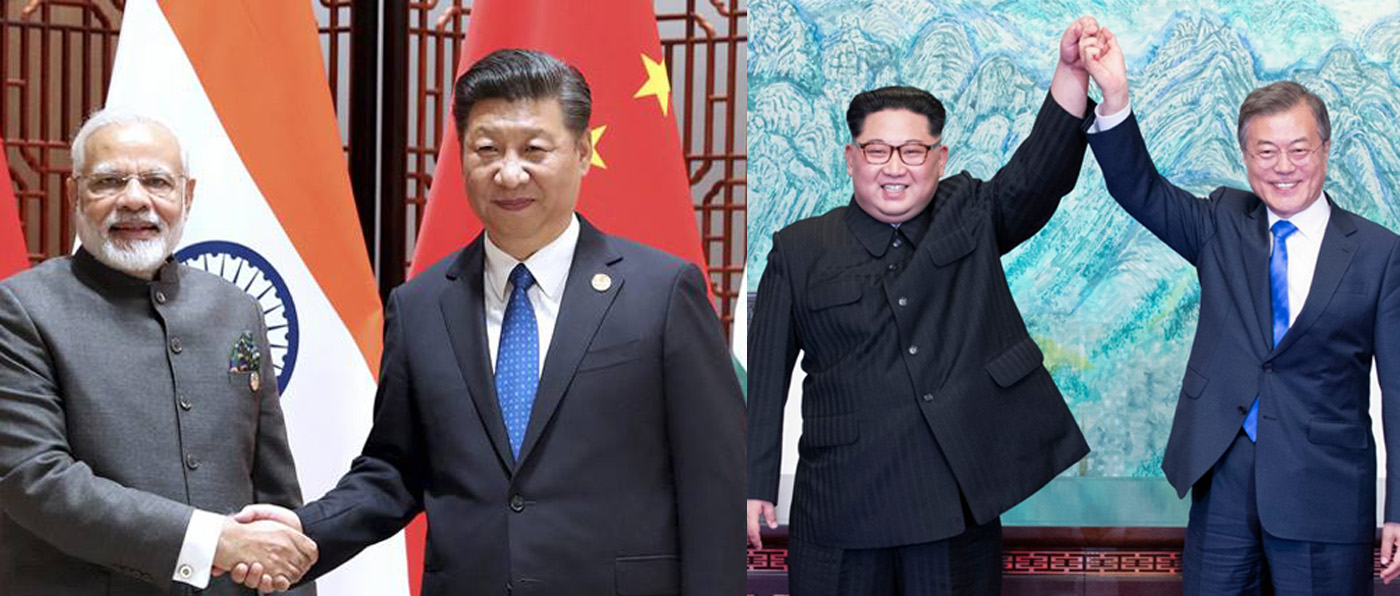
ITANAGAR | May 03 | April 27 would go down the annals of history as Indian PM Narendra Modi and Chinese President Xi Jinping representing 270 crore people, 1/3rd of global population, had informal meeting at Wuhan city when simultaneously North Korean leader Kim Jong Un and South’s President Moon Jae-in burying 68-year-old enmity shook hands to pave the way for a new ear.
History seems to have taken a turn after the World War -II to form a new world order amidst threat by large scale production of weapons of mass destruction – nuclear, radiological, chemical, biological or other weapons that can kill and bring significant harm to a large number of humans or cause great damage to human-made structures or the biosphere.
In fact, most significant decision of PM Modi and President Xi to issue strategic guidance to their respective militaries to strengthen communications and to build trust and understanding was described by Chinese Vice Foreign Minister Kong Xuanyou as a milestone in India-China bilateral relations.
China and India have concrete differences but the summit was not aimed at addressing these specific issues, he said while “President Xi said the problems between China and India are of a limited and temporary nature.”
Can China be taken for granted as PLA’s repeatedly intrusion into Indian Territory in Arunachal Pradesh is afresh in mind? Thus, I wrote “Indian PM Narendra Modi and Chinese President Xi Jinping consent to maintain peace along Indo-China border would undoubtedly put the border row on global radar.”
Because, President Xi on 30.07.17 had said that the PLA was capable of defeating all its enemies in response to Indian Army chief General Bipin Rawat’s remark in January “time had come for India to shift its focus from its borders with Pakistan to frontier with China, reflecting the seriousness of the situation”.
However, PM Modi in an interview to Z News had said: new world order should not be limited to select subjects but continue to look into everything with a positive attitude. “On one hand, we should connect with the entire world. On the other hand, we should keep in mind our values.”
“Every time I stand beside world leaders such as Vladimir Putin or Donald Trump, all I remember is that I am the representative of 1.15 crore citizens. They have given me the mandate to be here.”
India-China relationship as delicately poised towards positivity, said BJP general secretary Ram Madhav and expressed hope that the two Asian giants could together influence the new world order for which peace at border is essential.
“India will not compromise on Indo-China border issue but we will work on improving bilateral relations between the two countries,” he said at Fourth Rumtum Kamgo Memorial Lecture in Itanagar.
“The present dispensation in New Delhi is pushing for speedy resolution of boundary issues based on mutual understanding and concession”, he said, adding the India-China relationship is “precariously poised towards positivity”. “Sooner than later, people of Arunachal Pradesh will travel to China just like any other Indian citizens,” Madhav predicted.
Tracing the root cause of China’s claim over Arunachal Pradesh, he said, such claims of the Chinese gained momentum only after accession of Sikkim to India. Madhav further hinted at “work-in-progress” towards “water-sharing agreement” with China.
We have water-sharing agreement with downstream riparian nations without knowing how much water we shall receive from an upstream nation like China,” he said.
Explaining difference in mindset between the two nations, Madhav, an expert on Indo-China affairs, cited ancient history: “Chinese and Indians are culturally different, we think differently”, he said underscoring that the Chinese followed Sun Tzu’s teaching in “Art of War” but Indians failed to learn from Chankaya’s teachings.
Meanwhile, Korean War was formally declared over after 68 years, the North and South Korans leaders said in the inter-Korean summit, hailed as a “historic meeting” which paved the way for the start of a new era, Pyongyang’s state media said.
The official KCNA news agency said it was a “historic meeting that has opened a new era for national reconciliation and unity, peace and prosperity”, and carried the text of the leaders’ Panmunjom Declaration in full.
The two leaders “confirmed common goal of realising, through complete denuclearisation, a nuclear-free Korean Peninsula”. Report of denuclearization in North Korean media is unprecedented due to official propaganda which has always presented its nuclear program as a national pride and fundamental to the survival of the regime. Denuclearization was one of the key issues in joint declaration, but without mentioning concrete steps to achieve it.
Two neighbouring nations also agreed to work towards peace on the peninsula with a formal end to their conflicts to be announced later this year. The duo agreed to bring both nations together and establish a “peace zone” on the contested border.
For years, Pyongyang insisted it would never give up the “treasured sword” of its nuclear arsenal, which it says it needs to defend itself against a possible US invasion. But it has offered to put it up for negotiation in exchange for security guarantees, according to Seoul – although Kim made no public reference to doing so at the summit.
When Kim stepped over the military demarcation line that divides the peninsula, he became the first North Korean leader to set foot in the South since the Korean War hostilities ceased in 1953 with an armistice rather than a peace treaty. He then persuaded Moon to step into the North, and the two leaders shared a day of smiles, intimate moments, and a half-hour-long one-on-one conversation.
Rodong Sinmun, nation`s main newspaper, featured 15 photographs from different moments of the summit in front page and another 20 on the second, reports Efe news. Three photos showed both holding hands, the moment when the North Korean leader crossed over to the South. The newspaper also published the full text of Panmunjom Declaration signed by both leaders.
The media in Pyongyang also covered the summit in full. State-owned KCNA agency published the declaration having common goal to denuclearize Korean peninsula.


 20
