
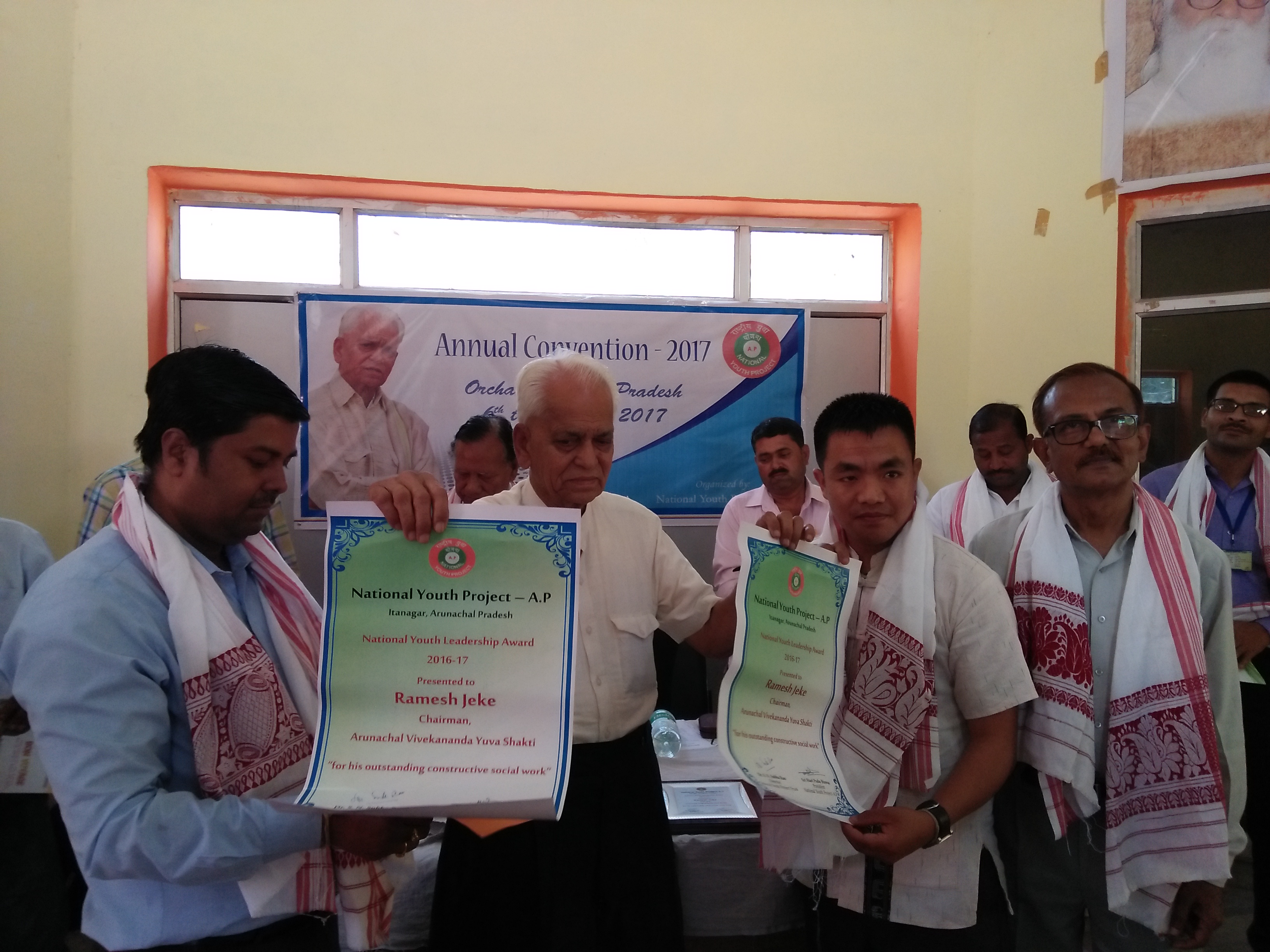
*Ramesh Jeke holds 41 time blood donation record
ORCHA | Apr 06 | Life saver Ramesh Jeke, founder-chairman of Arunachal Vivekananda Yuva Shakti (AVYS), was today conferred National Youth Award-2017 for his pioneering works in saving life.
National Youth Project founder-chairman Dr S N Subba Rao conferred the Award on him along with a citation, memento and Rs 10,000, during the inaugural function of Arunachal Pradesh NYP convened three-day national conference here in Madhya Pradesh.
Of the numerous entries, Jeke was found most worthy for the honour, Dr Rao, lovingly called Bhaiji, said to the applause of the gathering.
Arunachal NYP president H P Biswas, convenor AK Sharan lauded the AVYS which with committed 350 young male and female volunteers and senior journalist Pradeep Kumar as advisor had made many a milestones to its credit.
With consistent support of RKM Hospital secretary Swami Visheswananada, Sate Blood Transfusion deputy director Dr Nabam Budh, state AIDS Control Society project director Dr Riken Rina, AVYS launched its ‘Save life mission’ with financial help from good Samaritans. This helped Arunachal Pradesh to win national Award of Excellence-2015 from Union Health Minister J P Nadda for cent percent voluntary blood donation.
Arunachal needs 15,000 blood units against annual average collection of 5,000 units, thus AVYS had intensified its ‘save life’ mass awareness campaign throughout the state with NRHM project director P N Thungon support to ensure none dies due to shortage of blood, Jeke said in reciprocating speech.
AVYS has conducted 57 blood donation camps since its inception in 2011, collected around 47,856 blood units voluntarily and saved 62,866 lives including 1,886 on calls from Capital Complex hospitals mostly during odd hours, he informed.
Jeke, who himself has donated blood 41 times, facilitated affiliation of the AVYS to Federations of India Blood Donor Organisation (FIBDO) and was instrumental in saved six aged and diseased abandoned mothers of whom two died of cancer while four others are leading normal life.
Jeke was approached for arranging two A+ blood units in view of proposed visit of Union Home Minister Rajnath Singh to attend Statehood Day celebration on 20.02.17.
Jeke is scheduled to address Arunachalee students in New Delhi tomorrow and in Dehradun on Saturday next on the benefits of voluntary blood donation.
Blood donation: India has come a long way in making safe blood available throughout the year, but much remains to be done before we reach the cherished goal of 100% voluntary donation and the availability of safe blood across the country at all times, The Hindu reported on 14.06.16.
Voluntary donation comprises only about 70% of the demand in India, with the rest being met by replacement donation. Replacement donors are friends and relatives of a patient who donate blood as replacement for the blood given to the patient. However, the Supreme Court had banned paid blood donation in January 1998.
That professional donors pass off as replacement donors at blood banks and hospitals is rather a norm in the case of patients who have been admitted to hospitals.
At times, these replacement donors (friends and relatives) are more likely to harm the recipients by hiding or overlooking the many don’ts of donation. Compounding this is the fact that many hospitals and banks often never care to study their elaborate medical history and carry out behavioural screening.
Though voluntary self-deferral to donate without citing reasons is widely accepted, replacement donors rarely resort to it either to hide their high-risk behaviour or due to pressure to meet immediate demand for blood. As a result, the prevalence of HIV, hepatitis B, and hepatitis C is much higher among family donors when compared to voluntary donors, as a 2012 study published in the Asian Journal of Transfusion Science found.
Though donated blood is screened for transfusion transmitted infections (TTI) such as HIV, hepatitis B, hepatitis C, syphilis and malaria, the tests fail to detect the diseases in the window period of infection. Thus, the risk of replacement donors having TTIs is 1.5-2.5 times higher than for voluntary donors, a September 2015 study in The Indian Journal of Medical Research notes.
India needs 35 tankers of blood
India is 35 tanker-trucks (if a blood unit is 350 ml unit, a standard tanker-truck capacity if 11,000 litre) short of the blood it requires for medical procedures, according to an IndiaSpend analysis of government data, published on 03.09.16.
The shortage was estimated at 1.1 million units (a unit is either 350 ml or 450 ml) as was told by health and family welfare minister told the Lok Sabha in July 2016.
In percentage terms, India is 9% short of its needs, reduced from 17% in 2013-2014.
Bihar tops in the shortage list with 84% short, followed by Chhattisgarh (66%) and Arunachal Pradesh (64%). Chandigarh had almost nine times the blood it needed, Delhi three times, Dadra and Nagar Haveli, Mizoram, and Pondicherry twice, according to Govt data.
India has 2,708 blood banks, but 81 districts still lack one, according to GoI data. Chhattisgarh has the most districts without a blood bank (11), followed by Assam and Arunachal Pradesh.


 20
