
By Pradeep Kumar
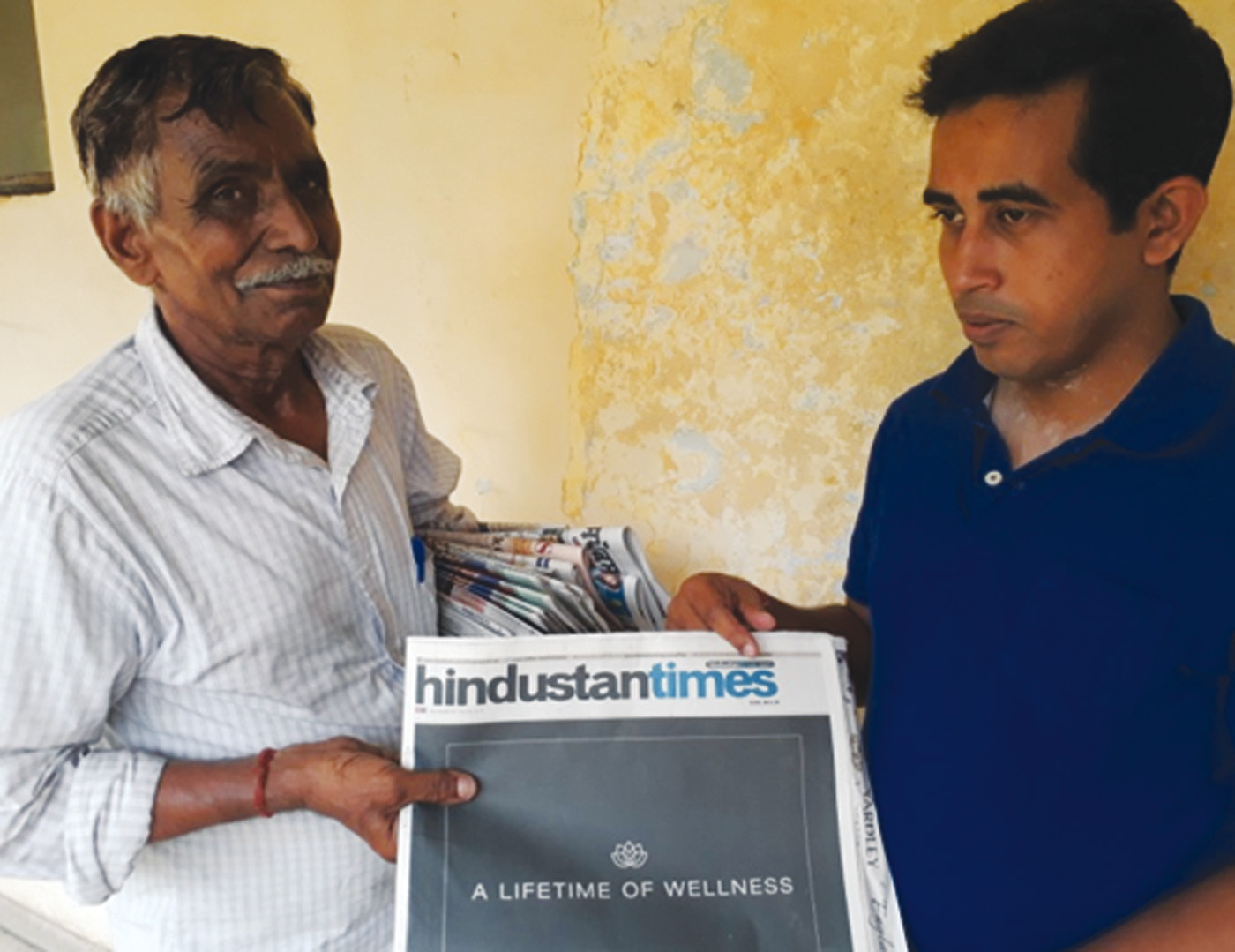
NEW DELHI, June 09: “Sir, do you want paper (Babuji paper logey)”, offer drew my attention that prompted me to buy a copy of Hindu morning for Rs 10 in Gandhi Peace Foundation here early Saturday morning.
As elderly person, Ram Praksh Shukla despite 67-year-old went round to various rooms to sell English and Hindi newspapers to draw my attention again. But, interaction with him unfolded a never known story as he termed the newspapers as Bhagya bidhata (destiny) for him to leave me dumbfounded.
A hawker since 1970, but leading a satiated life, he disclosed that hawkership is an inherited family business which he had inherited from his father Ram Surat Shukla, who had begun his business at Karachi Haat during British period. The family shifted to Dariagnaj in New Delhi after independence in 1947but continued the same business.
Describing the business challenging but rewarding, he pointed out that enough commission @ 25% could be earned as livelihood if the number of newspapers sold is considerably large. However, a newspaper distributor demands Rs 2,000 PM for an hour-long service.
He has his own house at Buradi, about 15-km from ITO, and shuttle downs daily to supply newspapers to his clients. Of his seven children, two each daughters and sons are married off, three sons are in service that has been helping them to lead a happy family life, Shukla said with satisfaction.
It is not Shukla but lakhs like him across India who might be earning their livelihood by selling newspapers. Their exact numbers may not be know but could be guessed. But the report of Liju Joseph in The Quint (25.05.17) had some satisfactory reply.
Newspaper circulation in India has grown from 39.1 million copies in 2006 to 62.8 million in 2016 – a 60% increase. Comparable data for the most recent year available, 2015, show that while newspaper circulation grew by 12% in India, it fell in almost every other major media market: by 12% in the UK, 7% in the US and 3% in Germany and France, parliamentarian Shashi Tharoor said this recently.
Spurt in literacy levels in last two decades, rising disposable income and perceived credibility of written words are some of the reasons why this has happened. Noted media commentator Vinita Kohli-Khandekar observes: Print media has always performed well in India. There are two main reasons for it – primacy of the written word and the home delivery of the newspaper. The reason newspapers in their physical form started declining in the West is because volition was involved – you have to go to a newsstand and buy a copy. In India we get it at our doorstep.
The consumption of printed words is not confined to the generation of older die-hard readers. Young India too is quite keen to rely on multiple platforms. The perceived credibility of the printed word may have also contributed to the growth in circulation of newspapers.
Also we often talk about ‘young India’ and forget that 50% of the country is middle-aged and older. If you look at the readership growth of Hindi and other languages, a lot of it is coming from young people. They turn to it either because it is a status symbol or because they take the written word more seriously.
However, what needs further elaboration is wide variation in growth rates of Indian language newspapers vis-a-vis English newspapers. English newspapers used to have total domination in the 1960s, with nearly 27% market share in overall circulation.
Hindi and Tamil newspapers used to be distant second and third respectively. The situation began to change rather dramatically after the 1990s.
According to an An Audit Bureau Circulation (ABC) report (May 2017), India has bucked the global trend of declining readership of print media and the trend continues till date.
What is even more noticeable is the exponential rise in the demand for Hindi dailies. An ABC report (Dec 2016) points out that in 2016, two of the top three circulated newspapers were Dainik Jagran and Dainik Bhaskar, both Hindi dailies, followed by The Times of India in English.
Media researcher Sandeep Bhushan, however, has a slightly different take: Print media continues to buck global trends of declining revenues and plummeting sales. Some caution though has to be exercised. Figures are often ‘sexed’ up by newspapers for better ad rates.
Alleged artificial spikes aside, credibility of newspaper brands and less-than-satisfactory offerings of television news may have also contributed to the growth of newspapers.
Television has ceased to be any source of news. Newspapers are direct beneficiaries of the crisis in news content in television. It, however, has to be said that even in the more developed markets, newspapers have always been the source of news.
But why have Hindi dailies seen the kind of growth they have over the last few years?
The growth in circulation of Hindi dailies has been as swift as the rise in literacy levels in predominantly Hindi speaking states. While literacy rates have gone up from 52 to 74% (a growth of 42%) at the national level between 1991 and 2011, the rise has been rather swift – from 42 to 69 percent, which means a growth of 65% – in Empowered Action Group (EAG) states. States like Bihar, Jharkhand, Uttar Pradesh, Uttarakhand, Madhya Pradesh, Chattisgarh, Rajasthan and Odisha are part of EAG states.
Growing urbanisation too may have played its part. A UN World Urbanisation Prospects report (2014) states that the annual rate of urbanisation in India between 2010 to 2015 was 1.1%, the highest among major global economies. India is expected to add over 400 million people to its urban population between 2014 and 2050. More people in the cities meant more readers for newspapers.
Incidentally, between 2001-2011, growth in size of urban population – at 91 million – was more than that of rural population. (Phots/The Quint)


 20
