
By Pradeep Kumar
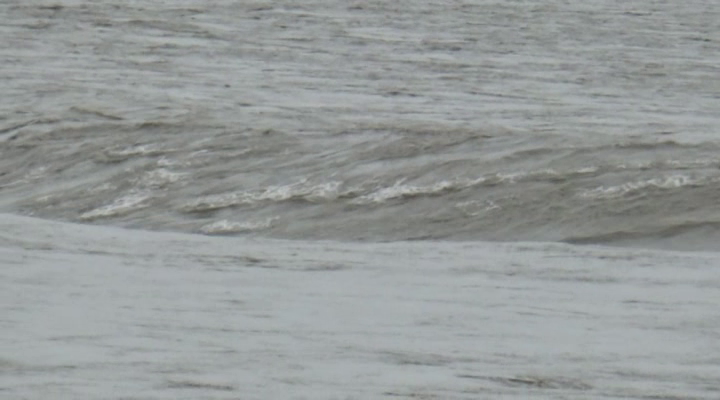
ITANAGAR, Aug 06: Witnessing of unbelievable high waves in mighty Siang at centurion town of Pasighat, HQS of East Siang, for the last 15 days has spread fear among the inhabitants.
Many residents who spoke were not sure of the reasons behind such phenomenon. “Nothing is known or could be told about this very unpredictable mighty river,” most of them said. It may be recalled that its water had turned muddy in November 2017 and got cleaned by April 2018.
Aged Arunachalees recall that November 17, 1950 earthquake measuring between 6.4 and 6.9 on the Richter scale in Nyingchi, just upstream of Arunachal Pradesh in Tibetan region, Brahmaputra water had turned muddy.
The high waves of Siang remind it inhabitants of June 2000 midnight when 30-feet high wave of Siang had submerged the historic township killing at least 30 people and more than 100 had gone missing. People were fast asleep and none expected flood as there was no rain.
Then SP Robin Hibu, present IGP and chief security officer of Rashtrapati Bhawan, with the help of IAF helicopter had rescued many people who had survived by luck while a mother and her two kids stuck on a tree top could not be rescued due to approaching evening around 4.30 pm and their bodies were recovered later.
It was reported later that a huge landslide had blocked Yarlung-Tsangfo in Tibet which got breached because of water forces and huge volume of water had raised Siang water level leaving a trail of devastation.
Siang is a tributary of 6,380 km long Yangtze River, the longest river in Asia and the third longest in the world. The river is the longest in the world to flow entirely within one country but 6th largest river in the world by it discharge volume.
Siang, originating from Mansarovar Lake region located on northern side of the Himalayas, flows through Bhutan as Yarlung-Tsangfo and enters India atJogigjopa in India’s Arunachal Pradesh, giving its name to districts of East Siang, West Siang and Upper Siang district. Numerous tributaries join before it enters Assam as Brahmaputra.
Brahmaputra, a trans-boundary river, one of the major rivers of Asia, flows through China, India and Bangladesh as Padma to merge with Meghna before emptying into the Bay of Bengal. It is the ninth largest river in the world with 19,800 m3/s by discharge and the 15th longest is also one of the few rivers in the world that exhibit a tidal bore. (with inputs and picture form Minut Tamuli)


 20
