
By A O News Service
ITANAGAR, Sept 28: Arunachalees use their indigenous technologies to supply water to different locations in far-flung areas where GoAP schemes are not viable, said Public Health & Water Supply Minister Wangki Lowang, adding efforts would be made to popularize such technologies to benefit larger sections of the society.
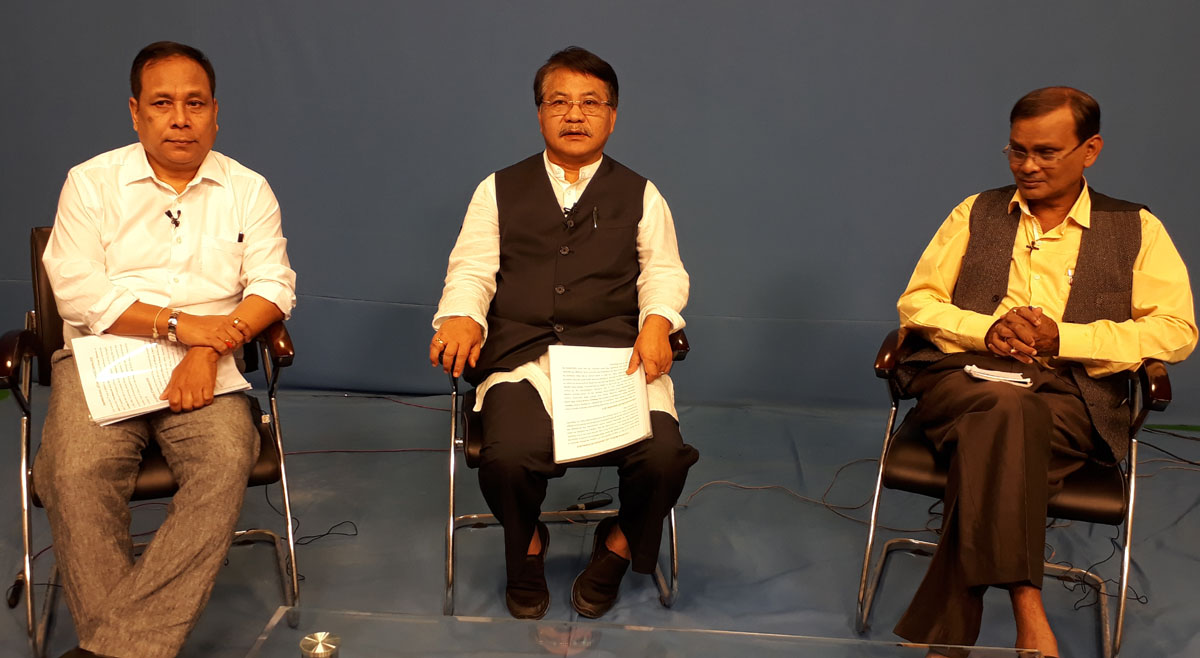
Swachha Bharat Mission (SBM) launched by Prime Minister Narendra Modi on 02.10.14 is being implemented on priority successfully in Arunachal Pradesh, he said in response to a question from anchor Pradeep Kumar during a discussion on – Swachhta Bharat Mission – Swachh Desh – garbit deshwashi in DDK here on Friday.
The achievement of open defecation free (ODF) indicated commitment of GoAP, he said, when SBM state coordinator Joi Angu pitched in to add that the achievement was 22 months ahead of its target.
There are three components of SBM – individual house hold latrines (IHHL), community latrines and solid & liquid waste management (SWLM) and Arunachal Pradesh has almost achieved two components while the last one would be achieved by 2019 end, Angu said and credited the willing masses, committed officers and GoI appointed workers for the success despite topographical challenges.
When pointed out the a bag of cement costs Rs 6,500 at Vijoynagar in Changlang district for which the fund given for a IHHL including GoAP addition was insufficient, Angu nodded in affirmative. He said that National Youth Project team entrusted to assess ODF status in Changlang and Longding districts have documentary proof of willing support of the indigenous residents and commitment of officers. The achievement covers villages in last border, he added.
Lowang, however, said that SBM has turned into a people’s movement in the state with the involvement of state governor, the law makers led by the chief ministers and officers. The youth, particularly students are involved by conducting essay and painting competitions besides awareness programmes across the state by his department.
However, Angu pointed out that PH&WS Yupia division JE RC Tiwari’s model on rural latrine using locally available materials (bamboo and plastic bottle) had topped in national level competition. Moreover, the SWLM is being converted into solid waste and liquid resources management by involving the community, he said, adding attempts are being made to use them as bio degradable resources.
Pointing out that if cleanliness is next to godliness and jaal hi jivan (water is life) what PH&WS department was trying to ensure supply edible water to people, Lowang said that besides awareness programmes, testing labs are available in all district and people are encouraged to test local water before consumption. The media has a vital role to play to bring mass awareness among the masses on the issue, he added.
The anchor pitched to add: Paani re paani tera rang kaisa, jisamein mila do lage us jaisa (O water! O water, what colour do you have? It’s the same colour in which you are mixed) to conclude the discussion.


 20
