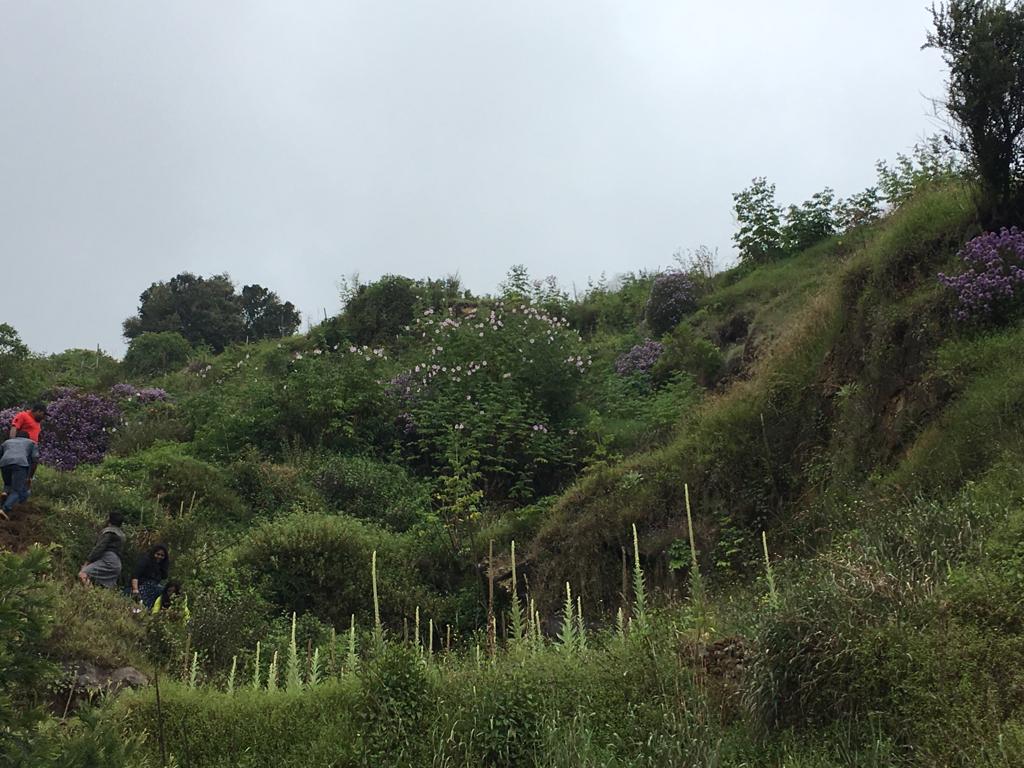
Blomming once in twelve years the plietesialneelakurinji, Strobilantheskunthianus (family Acanthaceae) with its rhythm specific bloom is wide spread in Munnar (Kerala), Ooty, Shevroys hills in Salem,Kodaikanal, Palani hills (Tamil Nadu) andSandur in Karnataka’s mine zone of Ballari.Major tourist destinations and hill stations at higher altitudes above sea level in the Decca Plateau. Tourists have started thronging Munnar coping from the recent devastations caused due to floods. The species name kunthiana has been derived from the River Kunthipuzha which flows through the Silent Valley National Park in Kerala. The flowering at different sites may have different calendars, last year in Sandur and now in the rest of the southern patches with the 12 year length of the cycle. Having known that the flowering will end by October, we set on our ‘expeditionneelakurinji’from Bengaluruto Ooty. An idly sambar breakfast booster and entry through the Bandipur tiger reserve open for vehicular movement between 6 am to 8 pm. Of different notes and tunes bird diversity chirruped, a mighty tusker mulching rain dripping grass blades, peacocks dripping in drizzle, a wild boar running to cover as the drizzle advanced to a heavy shower, a lone hanuman langur and a mighty troop of bonnet macaques everything to listen and gaze them in their natural habitat. Neither photography nor feeding animals through this protected area. Huge herds of spotted deer can be spotted in most stretches along the road traversing the reserve. A thank you arch at the Karnataka boundary and a welcome arch with forest inspectors at the Tamil Nadu entrance, both keep vigil of illegal activities and elements. The inspecting forest officials guided us to the spot near Kalhati where kurinji is in bloom. Left of the elephant camp at Theppakadu leads to the tiny settlement of Masinagudi at the foothills of Ooty. At the onset of the twisty curves of 36 hairpin turns from MasinagudiuphillOoty,curiosity bubbled through our vocal cords enquiring every passer-by as to where is the abode of neelakurinji in full and wide bloom. Two enthusiastic teenagers on their bicycle quenched our curious thirst indicating a spot in one of the turns with 5-6 plants in bloom. Little in number for a journey from Bengaluru up throughtwo prominent and contiguous tiger reserves Bandipur and Mudumalai of Karnataka and Tamil Nadu respectively.Very soon did the mirage of blues turned true at hair pin turn 21, a spotting of kurinjiblossom. A quest to witness the once in 12 year purplish blue bloom of the neelakurinjiwas accomplished-for the moment. The story of dense blooms in the first hairpin turn uphill kept us in high spirits to drive up traversing the loopy 20turns. Clouds soaring casting a shadow of misty cool breeze gave us the ‘cloud 9’ excitement. Local residents guided us to the spot right of the first hair pin turn where people bee lined to climb up the blue hills to immerse in the blue lagoon of sorts- blue neelakurinji bushes. Such spectacular events could boost ecotourism to a renowned hill station like Ooty(Udagamandalam) seated in the niligiris/neelgiris meaning Blue Mountains after the purplish bloom of neelakurinji.
Irrespective of the age groups people huddled helping each other climb the sloppy and rain soaked slippery path. They descended with dresses mud smeared but faces lit with joy of sighting the flowers and memory to cherish forever. The blossoms were visited by pollinators mainly bees a source for theKurunji honey. This rare biological rhythm is one of the survival mechanisms evolved to escape complete destruction of the population by predators that mulch on seed and flowers.The three month flowering season with the plants mass seeding is coming to an end this October only to be witnessed after 12 years!in 2030. Incidentally, in symbolism, twelve is the number of what is completed, which forms a whole, a perfect and harmonious unit.
Martin Paul A, Botany assistant professor, M.Jayashankar, Zoology assistant professor and St.Joseph’s College (Autonomous), Bengaluru, Karnataka.


 20