
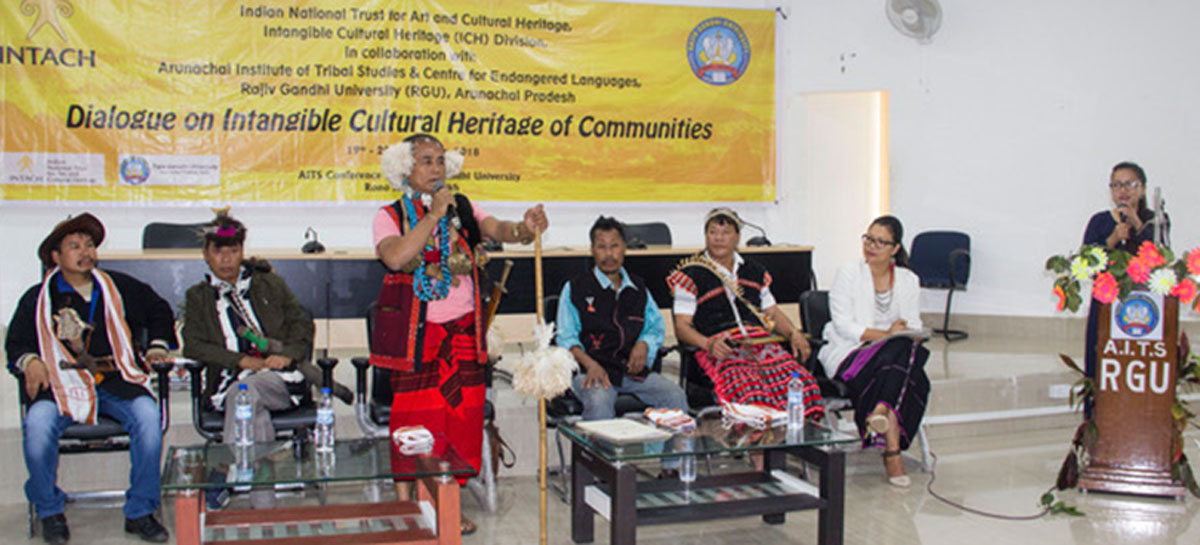
RONO HILLS, Nov 19: A two-day colloquium – ‘Dialogue on Intangible Cultural Heritage of Communities- begun at in RGU’s Arunachal Institute of Tribal Studies (AITS) here on Monday.
The colloquium, organized by AITS in collaboration with Indian National Trust for Art and Cultural Heritage (INTACH), Intangible Culture Heritage Division, New Delhi, aims at discussing various intangible cultural heritages and exploring methodologies for documenting them.
In his inaugural address, VC in-charge Prof. A. Mitra stressed that in addition to its role as a provider of quality higher education, the RGU is also mandated in its charter to document and assist in promoting rich culture of state’s tribes. He underscored the importance of organising such events along with academic works and research, saying how collaborations with the communities are essential to bring out more constructive output.
INTACH ICH division director Nerupama Y. Modwel, in her address, spoke on how maintenance of heritage and community memories are essential and steps to preserve and understand them should be taken seriously.
Renowned poet and DU professor Sukrita Paul Kumar, in her keynote address “Unseen but Felt: This Continuum of Culture”, encouraged all community members to embrace their traditions & appreciate their cultural heritage. She spoke about how the skills & knowledge of tangible cultures is an asset for any community to bridge the emerging cultural disconnect and ensure continuity.
AITS director Prof. Simon John earlier said that having the dialogue was to engage with the communities and explore ways by which the intangible heritage can be protected and promoted.
Assam chapter INTACH convener Dr. Shiela Bora termed Arunachal as an anthropological museum and stressed on integrating modernity with tradition to keep cultural heritage alive and preserved in its beautiful and unique form.
A book titled “Change and Continuity Among Tribes: The Idu Mishmis of Eastern Himalayas”, edited by AITS Asst. Prof. Dr Tarun Mene and Bhopal-bsed Indira Gandhi Rashtriya Manav Sangrahalaya director Prof. S.K. Chaudhuri, was released jointly by Prof. Mitra and Idu Mishi Igu (traditional priest) Ache Mimi. The book provides a comprehensive understanding about the post-colonial research trends on state’s Idu Mishmi community and covers issues relating to daily life, socio-cultural aspects and resource mobilization.
Filmmaker Moji Riba conducted Monday’s interaction, 1st session moderated by AITS Prof Jumyir Basa followed by ritual performances by shamans of various communities – Ache Mimi (Idu Mishmi), Tahor Muang (Adi), Geli Ete (Galo), Namgram Tama (Nyishi) and Khoangam Suyang (Nocte) who also shared their personal histories as well as deliberated on the challenges faced by the traditional priests today.
Interactive sessions and demonstration by artisans (wood carving & basketry) and Nyishi folk artists were moderated by AITS faculties Dr. Wanglit Mongchan and Lisa Lomdak, where participants spoke at length on the difficulties that they face in pursuing these dying traditional art forms. Aninstallation, demonstration and display of Opo (traditional knowledge of brewing) was followed by Kit Laam Dance of Rongmei Naga by Ragailong Cultural Songs and Dramatic Union, Imphal.
The demonstration and interactive sessions with weavers, indigenous chiropractors, bead workers and a Galo folk performance would be showcased on the second day. A crafts and weaves display was also a part of the event.
A key feature of the colloqium is discussion on ‘way forward’ for retention of indigenous culture; interaction amongst all the CRPs on learning from each other and suggestions on overcoming the challenges that will take place on the second day.


 20
