
From Our Special Correspondent
SHILLONG, Jan 29: New Delhi-based Vishwa Yuvak Kendra (VYK) has been working for greater interest of youth in the country, VYK programme officer Rajeev Nirmal told participants of a three-day state level training on agriculture entrepreneurship development (AED) here on Tuesday.
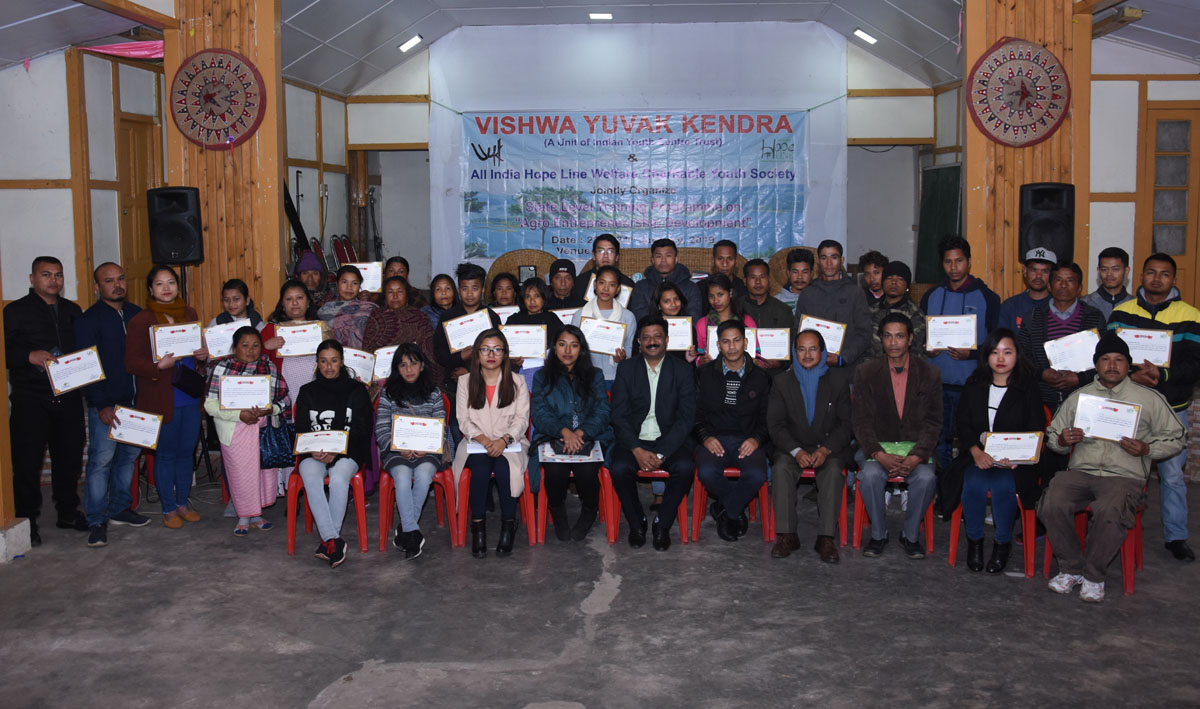
Highlighting objectives of the training, he lauded participants from Arunachal Pradesh, Assam, Tripura, Manipur and various parts of Meghalaya. VYK and All India Hopeline Welfare Charitable Youth Society have organized the training at Assam Club here.
The training was inaugurated by Centre of Learning Knowledge and Service Mawble Mandantrip director Dr H. Shylla and attended by Terence I Paswett of Barapani SOS Children’s, Bethany Society’s Priyanggkshi Dutta, livelihood practitioner Anand Barua.
In technical session, Ninam Rekhung and Leena Lollen presented paper on gricultural scenario of NE sates and Barua while interacting cleared doubts of the participants. He mainly focused on agro-based activities, saying production is not the only output for economic growth but it catapults other near-farm and non-farm economic activities for both in rural and urban population. It covers horticulture, fisheries, livestock, sericulture and dairy farming. However, agro based activities is going to play vital role to ensure food security while generating employment through entrepreneurship development. It would contribute to sustainable development goals of eradicating poverty to achieve zero hunger, good health & well-being besides economic growth through decent work, Barua added.
The resource persons revealed that agriculture is very important in Indian economy and any positive or negative change in this sector exerts a significant effect on the economy. “India is making a significant progress as food grain production went up from 50.8 MT in 1950-51 to 275.7 MT in 2016-17, cereals production rose by six times and pulses by three times,” said Dr. H.L. Sharma.
India tops the list of milk production; nearly 19% of the world total milk production is contributed by India. According to 19th Livestock census (2012) only cattle are contributing 37.28% of total livestock population in the country. Agri & allied sector, like dairy forestry and fisheries, accounts to 18% of the total GDP. 57% of total work force is directly or indirectly engaged in agriculture or related profession. India is not only self-sufficient in food grains but also exports agricultural commodities, such as rice ,pulses, fruits, vegetables, tea, coffee, tobacco, spices , sugar & molasses, cashew, raw cotton, fish, meat, and processed food. The main focus of Union Budget for 2018-19 financial year would be strengthening and reviving agriculture and allied sector in rural economy. The GoI is keen on doubling farmers’ income by 2022. There is total focus in improving institutional credit, quality seed, food processing, setting up of marketing network and involving technology, a resource person said.
Recognizing the significance of allied sector farmers as well entrepreneurs’ income can be enhanced apart from, Green revolution, White revolution, but stress could be given to Organic revolution, Water revolution, Blue revolution and Sweet revolution to increase the income of the farmers. There are ample opportunities to include technology in enhancing productivity which would play significant role in employment generation. GoI has taken several initiatives to increase production and employment to achieve strong socio-economic development of the country. Apart from production enhancement, there are several sectors where agro based activity can create employment and create entrepreneur which would contribute reduce the pressure in jobs sector. The interdependence between agriculture and industry both small and large scale can be strengthened through appropriation and generation of various production and demand linkages. Demand for one sector’s product pulls demand for another sector in an upward direction. Agriculture, industry and trade can very well mutually support one another. With the growing population and the pressure on the employment generation agro-based activities is one of the major potentials sector. The opportunities are not only in production but in transportation, trading, processing & advertising.
India which is soon going to surpass China in terms population at the same time has the world’s highest number of 10 to 24 year olds. According to World Bank, about 13 million people enter the working age every year but only 3 million new jobs are created every year. The demographic advantage being predominantly in the rural areas, the need of the hour is to improve the skills set of the human force such that they are productively engaged in the jobs emerging from various sectors. Employment opportunity can be created through various sector which are as, Agriculture, Horticulture, Fisheries, Animal Husbandry& Livestock, Silk farming, Bee Farming, Dairy farming, Floriculture, Organic farming-this includes biological & nature farming, Regenerative & alternate agriculture, pharmaceutical, low input sustainable agriculture. In the modern age of competition and expectation for better livelihood well-being, there has to be sufficient skills and knowledge to produce results. There has to be ample understanding on the type of trade one is engaged in, incorporate both traditional and modern knowledge, skills of the trade, application of technology.
Six papers will be presented on Wednesday while the participants would go for field visit and exposure trip on the concluding day.


 20
