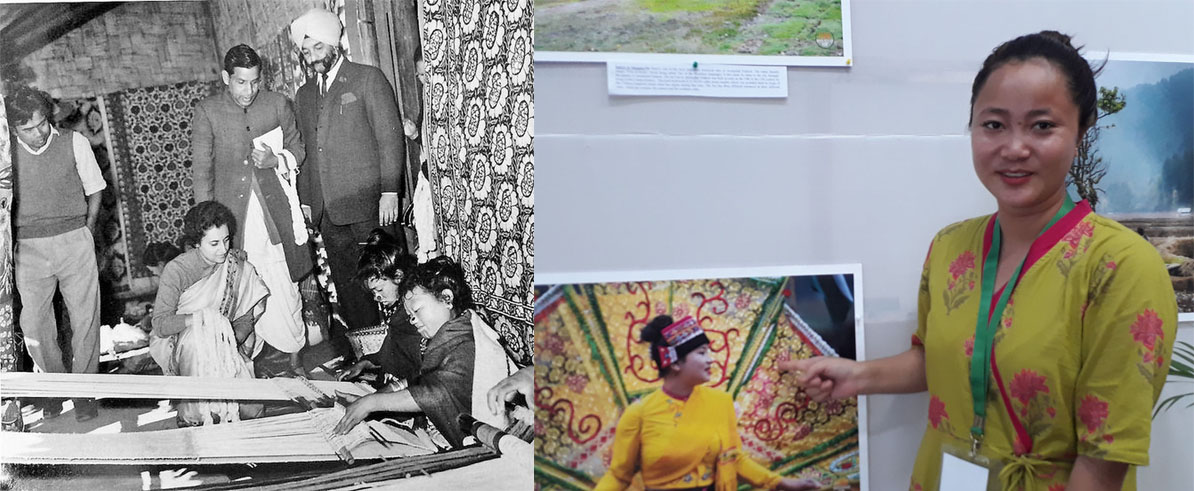
Former PM India Gandhi in Ziro in 1959,Arunachal Photography Club member Tadar Anu indicating an exhibited photo on 19.08.19
Beyond the Horizon
By Pradeep Kumar
The word “photography” was created from the Greek roots “light” and “representation by means of lines” or “drawing”, together meaning “drawing with light”. The first use of the word by Franco-Brazilian inventor became widely known after the research of Boris Kossoy in 1980.
Inventors Nicephore Niepce, Henry Fox Talbot and Louis Daguerre seem not to have known or used the word “photography. German newspaper Vossische Zeitung of 25.02.1839 contained an article entitled Photographie, discussing several priority claims.
The oldest known record of camera obscura principle is a description by Han Chinese philosopher Mozi (ca. 470 to ca. 391 BC). Mozi correctly asserted the camera obscura image is inverted because light travels inside the camera straight lines from its source.
Aristotle discovered that the smaller the hole, the clearer the image is when displayed.] In addition, he is also known for the fact that when light passes through a small hole, the image being displayed will appear opposite on the wall or background.
The first permanent photograph of a camera image was made in 1822 by Joseph Nicephore Niepce using a sliding wooden box camera made by Charles and Vincent Chevalier in Paris. Niépce had been experimenting with ways to fix the images of a camera obscura since 1816. The photograph Niépce succeeded in creating shows the view from his window. It was made using an 8-hour exposure on pewter coated with bitumen. Niépce called his process “heliography”.
In 1891, Gabriel Lippmann introduced a process for making natural-color photographs based on the optical phenomenon of the interference of light waves. His scientifically elegant and important but ultimately impractical invention earned him 1908 Nobel Prize in Physics.
Sony unveiled the first consumer camera in 1981 to use a charge-coupled device for imaging, eliminating the need for film: the Sony Mavica. In 1991, Kodak unveiled the DCS 100, the first commercially available digital single lens reflex camera. Although its high cost precluded uses other than photo journalism and professional photography, commercial digital photography was born.
The photographs clearly indicate how with time technology and professionalism has changed to suit the time and remote Arunachal Pradesh has not been left behind.


 20