
Beyond the Horizon
By Pradeep Kumar
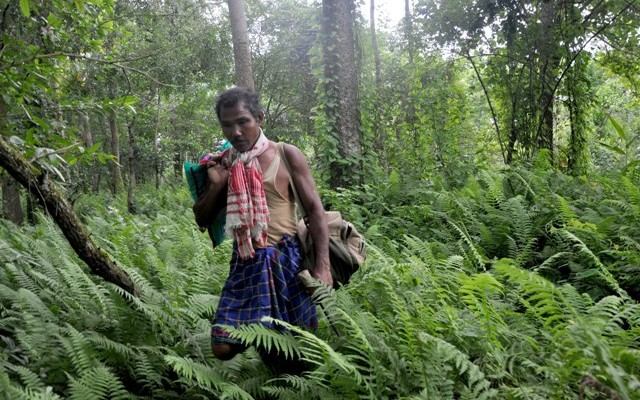
Arunachal Pradesh should take a cue from Forest Man of India. He has planted and tended trees on a sandbar of the Brahmaputr River during last several decades, turning it into a reserve forest. The forest named after him as Molai forest covering an area of about 1,360 acres is located near Kokilamukh of Jorhat.
In 1979, Payeng, then 16, encountered a large number of snakes that had died due to excessive heat after floods washed them onto the tree-less sandbar. That is when he planted around 20 bamboo seedlings on the sandbar. He started working on the forest in 1979 when the social forestry division of Golaghat district launched a scheme of tree plantation on 200 hectares at Aruna Chapori situated at a distance of 5-km from Kokilamukh. Molai was one of the labourers who worked in that project which was completed after five years. He chose to stay back after the completion of the project even after other workers left. He not only looked after the plants, but continued to plant more trees on his own, in an effort to transform the area into a forest.
The forest is now home to Begla Tigers, Indian rhinoceros and over 100 deer & rabbits besides monkeys, several varieties of birds, including vultures living in the lap of several thousand of trees while bamboo covers an area of over 300 hectares. A herd of around 100 elephants visits the forest annually and stay for around six months. They have given birth to 10 calves there in recent years.
Authorities learnt about his efforts in 2008, when forest department officials went in search of a herd of 115 elephants that had retreated into the forest after damaging property in Aruna Chapori village, about 1.5-km away. The officials were surprised to see such a large and dense forest. Poachers tried to kill rhinos living there but failed as Molai alerted department officials to act. Molai is ready to manage the forest in a better way and to go to other places of the state to start a similar venture. Now his aim is to spread his forest to another sand bar of Brahmaputra.
He has cattle and buffalo ion his farm and sells the milk for earning his livelihood. He had revealed during an interview in 2012 that he had lost around 100 of his cows and buffaloes to the tigers, but attributed large scale encroachment and destruction of forests by the people as the root cause of the plight of wild animals.
Honours: Payeng, a Misign, received many awards for his unparallel feat: JNU School of Environmental Sciences honoured him at a public function on 22.04.12, Indian Institute of Forest Management during its annual event Coalescence in October 2013, honorary doctorate degree conferred by Assam Agriculture University & Kaziranga University and GoI awarded Padma Shri in 2015.
Films: A documentary film by Jitu Kalita in 2012, The Molai Forest, was screened at the JNU. Kalita, who lives near Payeng’s house, has also been featured and given recognition for good reporting by projecting life of Payeng through his documentary. The 2013 documentary film Foresting Life, directed by documentary filmmaker Aarti Srivastava, celebrates the life and work of Payeng in Molai forest. These are also the focus of William Douglas McMaster’s 2013 documentary film Forest Man. With 8,327 USD pledged on its kickstarter campaign, the film was brought to completion and taken to a number of film festivals. It was awarded Best Documentary prize at the Emerging Filmmaker Showcase in American Pavilion at 2014 Cannes Film Festival.
Payeng is also the subject of the children’s book Jadav and the Tree-Place, written and illustrated by Vinayak Varma. The book was published by open-source children’s publishing platform Story Weaver and its production was funded by a grant from the Oracle Giving Initiative.


 20

