

Beyond the Horizon
By Pradeep Kumar
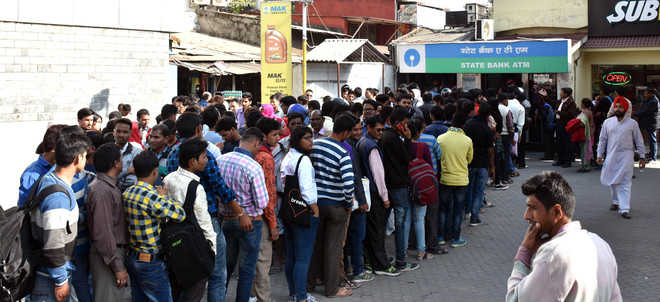
On this day in 2016, Prime Minister Narendra Modi had announced that Rs 500 and Rs 1,000 currency notes would cease to be ‘legal tender’ (promissory notes). Total 86% of all currency notes in circulation were made trash but failed stated objectives to unearth black money, clean-up counterfeit currency and end terror financing.
The RBI, on 30.08.017 in its report on demonetisation report, said 99% of banned notes came back into the banking system which trashes all claims of PM Modi that the move will flush out the black money and counterfeit currency. Failure of demonetization hinted at two things, either the black money held in cash was very low or the GoI failed to implement the demonetization efficiently and all black money laundered back to the banking system.
India’s 1.37 billion people (2019 population as per most recent UN data, 2nd most populous nation in the world with 1 of every 6 people on the planet living in India) are watching the dance of Demonetisation even after three years.
Every India has been bearing the tall tell impacts of such disastrous act.
RBI loan: Present BJP-led NDA Govt became first in India on 26.08.18 to take Rs 1.76 lakh crore from the RBI reserve to check dwindling economy. Congress termed it “catastrophic” and accused it of thrusting India’s economy towards bankruptcy and an economic emergency.
But, the negative impacts are still visible. Thus, the GoI has decided new bank charges were made effective since 01.10.19, though GST was automatically charged since 20.01.18. Revised rates of banks are:
1)
- ATM withdrawal rules: Free 8-10 free monthly ATM transactions with average monthly balance (AMB) of up to Rs 25,000 savings bank A/C, unlimited transactions in own ATMs for customers with AMB above Rs 25,000, above free transactions limit charge Rs 5 plus GST to Rs 20 plus GST, cardless cash withdrawals from ATM charge Rs 22 plus GST, but SBI salary account holders will continue to enjoy unlimited free transations in all ATMs.
- Cash withdrawal: Savings bank (SB) account holders with AMB of up to Rs 25,000 are allowed two free cash withdrawals int bank branches. Those with AMB between Rs 25,000 and Rs 50,000 will get 10 free cash withdrawals, above Rs 50,000 and up to Rs 1,00,000 AMB 15 free withdrawals, those with above Rs 1,00,000 AMB unlimited withdrawals and transactions beyond free limit charge Rs 50 plus GST per transaction).
- Non-maintenance of average monthly balance charges: Fine for non-maintenance of AMB will depend on category of bank branch- metro & urban centre branches (AMB Rs 3,000) — shortfall over 50% – Rs 10+GST, shortfall between 50 and 75% -: Rs 12+GST & shortfall more than 75% – Rs 15+GST; semi-urban centre branches (AMB 2000) –shortfall over 50% -Rs 7.50+GST, shortfall between 50 and 75% – Rs 10 +GST & shortfall more than 75% – Rs 12+GST; rural centre branches (AMB Rs 1000) — shortfall over 50% -: Rs 5+GST & shortfall between 50 and 75% – Rs 7.50+GST
2) While NEFT or RTGS transactions through digital means though free but fees is imposed. NEFT transaction up to Rs 10,000 – charge Rs 2 plus GST, above Rs 2 lakh – charge Rs 20 +GST for every transaction. RTGS transfer between Rs 2 lakh to Rs 5 lakh – charge Rs 20+GST & above Rs 5 lakh – charg Rs 40+ GST.
3) Deposits and withdrawals: Cash deposits in SB A/C free 3 transactions in a month, after that every transaction charge – Rs 50+GST. Maximum limit for deposit of cash at non-home branch is Rs 2 lakh per day, after which non-home branch manager to decide its acceptance. SB A/Cs with AMBof Rs 25,000 allowed free cash withdrawal twice a month, those with AMB between Rs 25,000 to Rs 50,000 – 10 free cash withdrawal, beyond free limit – charge Rs 50+GST per transaction.
The above are revised service charges of State Bank of India, India’s largest bank and ranked as 236th in Fortune Global 500 list of world’s biggest corporations of 2019:
4) Current A/C (cash credit or overdraft account (CC/OD)]: Cash deposit of maximum Rs. 2 lakh per day free; excess of Rs. 25,000 charge – Rs. 2.50 per thousand or part thereof, excess of Rs. 50,000 minimum charge Rs. 50; 5) Passbook updation Rs. 10 for once; 4) Balance statement Rs. 25 for once; 5) cheque book Rs. 25 per request; 6) signature verification/photo attestation Rs. 50 per request; 7) Issue of DD/PO/ECS Rs. 25 per request; 8) Cheque deposit Rs. 10 per cheque plus speed clearing charges; 9) Fund transfer (NEFT, RTGS, etc) Rs. 25 per request upto Rs. 2 lakh and Rs. 50 for above Rs. 2 lakh; 10) Interest certificate Rs. 50 per certificate, 11) Communication address/mobile number updation Rs. 25 per request; 12) KYC updation Rs. 25 per request; 13) Duplicate passbook/FDR receipt Rs. 50 per request; 14) Request for internet/mobile banking/Insta PIN/star token/password unblocking Rs. 25 per request for internet/mobile banking and Rs. 10 per request for Insta PIN/other requests; 15) Debit card request Rs. 25 per request; 16) Stop payment instruction and standing instruction no charge.
Unfortunately common man will be paying for all small services which otherwise were free. Is it not a cunning strategy to loot the masses?
The Indian Express data on impacts of demonitisation:
The GDP: Slowest pace economy growth in over six years lowering the GDP to 5% in the first quarter of FY20.
Jobs lost: Five million lost jobs between 2016 and 2018 and urban and rural labour force participation started declining suddenly between September and December 2016 without any recovery. Country’s unemployment rate in 2017-18 stood at a 45-year-high of 6.1% (National Sample Survey Office (NSO)’s periodic labour force survey.
IT payers: 8.80 million taxpayers did not file tax returns in 2016-17 fiscal-year, the year of demonetization. But, in 2017-18, IT department added 1.07 crore new taxpayers while the number of dropped filers’ reduced to 25.22 lakh.
Real Estate: Total number of developers in top nine Indian cities shrunk by over 50% by 2017-18, Gurugram recorded 76.8% decline from 82 in 2011-12 to 19 in 2017-18 & Noida saw a plunge of 73.2% from 41 to 11. Mumbai, Pune, Thane, Kolkata, Bengaluru & Hyderabad saw a decline while large number of fly-by-night developers were forced to leave the market.
Farm & wages: Both farmers’ incomes from crop cultivation and wages of farm labourers contracted in 2016-17 despite above-normal monsoon season.
Factory investment: Factories contracted 10.3% over 2016-17, showing their worst performance since 2002-03.
Spending on milk & milk products (M&MP) dropped by 10% in 2017-18. Households, hotels, and halwai shops spent Rs 6 trillion on M&MP in 2016-17, consumption expenditure reduced to Rs 5.4 trillion in 2017-18 (NSO data).
Digitisation: The GoI adopted digital payments system whose collective transactions registered 440% hike since demonetization.


 20
