
By Pradeep Kumar
ITANAGAR, Feb 02: Arunachal Pradesh a hub of natural resources need to take bold steps to ensure its agri-horticulture products get remunerative prices through forward market linkage to boom state economy.
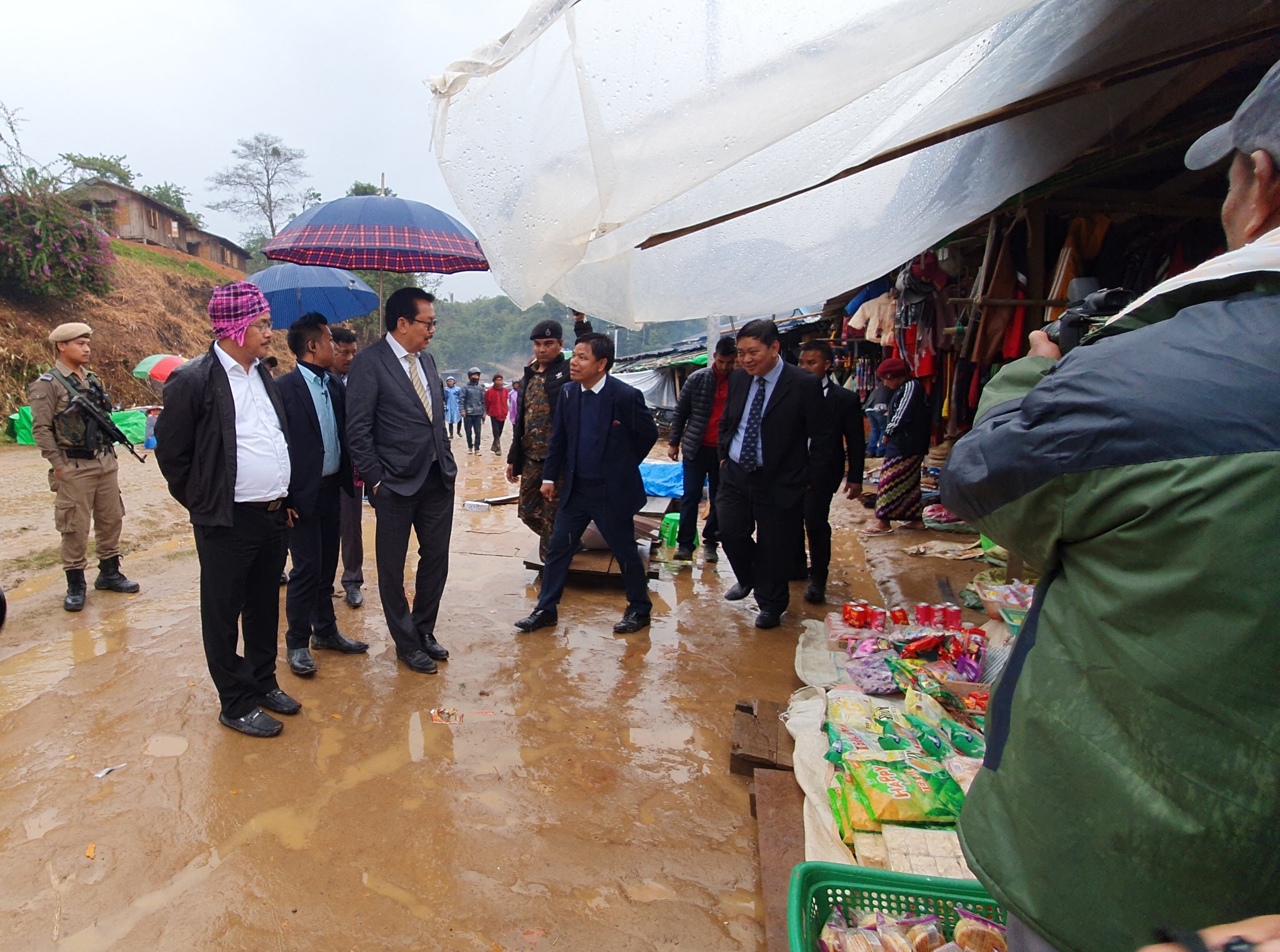
Border-trade with Myanmar drew global attention during recently held three-day Pangsau Pass International Festival (PPIF) at Nampong, located along historic 1726-km Stillwell Road – from Ledo in Assam to Kunming in China.
The vision of former speaker-cum-Nampong MLA Setong Sena was proved right by the PPIF when Deputy Chief Minister Chowna Mein as guest of honour on Jan 21 had said: “This festival would bring light to the world, South East Asia (SEA) nations in particular. We have tremendous tourism potential, historic Stilwell Road, World War-II Cemetery, the Border bazaar, The Lake of No Return & The Hell Gate etc, the embodiment of this area. Both countries are putting thrust to link this road to SEA to promote trade and culture”.
Trade & commerce director Tokong Pertin was happy as he was witness to inauguration of this BTC on 14.11.07 by then Union MoS (Commerce) Jairam Ramesh. It was an initiative of then chief minister Gegong Apang who had projected this state as India’s gateway to SEA in March 2006 and planned to improve Jairampur-Pangsu road and open the BTC to boost trade potentials with those developed nation and had also flagged off two-day Pangsu Pass Expedition-2006 from Chowkham, organized by Sena, who had pursued the Centre to set up BTC.
“This historic PPIF would bring a strong bond between India and Myanmar having close cultural, traditional and religious affinity”, Myanmar Ambassador Moe Kyaw Aung had said as chief guest while Nampong MLA Laisum Simai had said: “PPIF is not only a platform to unravel secret tribal world but also Nampong is gateway of shrouded paradise of Arunachal Pradesh to SEA.”
“Our youth should be trained on rich handloom and handicraft to boost textile industry. This easy and short international route to SEA should be used to heighten the trade of both the countries,” Trade & Commerce Minister Tumke Bagra had said and suggested to learn each others’ languages to ease of border trade.
India and Myanmar had inked an agreement on 26.09.1950 exempting passport requirement for indigenous hill tribes of both nations living within 40-km of the border for trade. “India-Myanmar bilateral trade has increased from US $ 1.3 billion to US$ 2 billion during 2010-2014. Of total US $ 2 billion trade, US$ 1.2 billion were India’s imports from Myanmar and US$ 0.77 billion were India’s exports to Myanmar. It is also noticed that India’s exports have registered a higher growth rate of approximately 140% than the imports; the latter increased only by 21% during 2010-14. Even when India’s imports are greater than exports, it is the latter which is showing an upswing, whereas imports appear to be on a continued decline since 2012. In 2014, the top 25 commodities that India exported to Myanmar accounted for 60% of the total exports to Myanmar. On the other hand, the top 25 imported commodities from Myanmar accounted for almost 100% of imports from Myanmar. This shows that India’s import basket is more concentrated than the export,” records economist-author Dr. Ram Upendra Das.
Thus, a team of officials and MLAs led by Deputy Speaker Tesam Pongte was on a four-day trip to Moreh BTC in Manipur in October last to study infrastructure facilities and functioning to set up BTCs in the state.
I recall my write-up – Nampong eyes to be India’s trade hub for SEA nations – published in this daily on 21.01.19: “This fast growing town surrounded by lush green hills, located along historic Stillwell Road, about 11-km away from Myanmar border Pagsau Pass in Changlang district, eyes to become India’s trade hub for SEA nations, where world’s 50% rich live. DyCM Mein for his close link with SEA nations often highlight vast scope this nature trove state offers because of its proximity to SEA.
“The visitors from aboard has to be welcomed as guests and a friends so that they return to their own countries and carry back with them happy memories of their visit to India”, – written by India’s first Prime Minister Jawaharlal Nehru on 23.07.59 to Nampong base superintendent which was received on 27.02.60,” – reads an imprint of Nampong inspection bungalow.
There is no denying that the age-old border trade with China was halted by 1962 Chinese aggression. Chief Minister Pema Khandu has advocated increased cross-border trade with China and Myanmar using the Stillwell Road. He had raised the issue in presence of then Defence Minister Nirmala Sitharaman on 14.11.18 at Itanagar. Sitharaman had called for strengthening Sino-Indian rapprochement ahead of Chinese Defence Minister’s visit to India, adding, “We need to compete, but it should never end up in conflict.”
Assam Chief Minister Sarbananda Sonowal had also pitched for opening Stillwell Road for cross-border trade with China and Myanmar three months ago.
China has been receptive to using this highway and another land route used during Bangladesh-China-India-Myanmar (BCIM) car rally that goes into the lower parts of NE India through Myanmar. Kolkata Chinese consul general Ma Jhanwu had even told the media his country was keen to start a bullet train to connect Kunming in Yunnan to Kolkata. Durin Wuhan informal summit in 2018, Prime Minister Narendra Modi and Chinese president Xi Jinping agreed to energize BCIM process.
This paves the way to try for opening border trade with China through 1) Khinzemane, located in Pancham Valley, 13-km from circle HQs Zemithang of Tawang district, though which His Holiness the 14th Dalai Lama had entered India on 31.03.1959 after fleeing from Tibet; 2) Bumla, 37-km from Tawang and 22-km from Y-junction as China side terrain is far better than Indian side with China’s Shyo is 3-km, Kachin (5-km), Dengding (6-km) and Nyagdo (8-km) and major Chinese town Tsonajong is 43-km from Bumla border post. District HQs Tsonajong with a Brigade HQ connects Gordung-Lhasa-Beijing trunk highway is linked by all weather road to Tsethang (Tibet district HQs in China) and 508-km from Bumla which offer vast scope for border trade; 3) Gelling BTC in Kepangla Pass is located 4-km away from Gelling circle HQs under Tuting sub- division of Upper Siang district. Barter trade between local people of both sides was flourishing through this BTC before 1962 Sino-India conflict; 4) Lolla Pass, 35-km away from Mechuka & 14-km from Yorlung located in Shi-Yomi district and linked by black topped all weather road condition, was also a BTC before 1962 conflict; 5) Dumla Pass, located 45-km away from Monigong Mechuka sub-division & 45-km from Tibet, is feasible for border trade as Saplegong, a major Tibet town is about 45-km from this Pass; 6) Kibithoo, a remotest circle HQs of Anjaw district, linked by all weather road from Lohit district HQs Tezu, is 7-km away from Line of Control (LOC). Kibithoo before 1962 was one of the most flourishing BTCs along Indo-China border.
During 1958 to 1960, 702 Indian traders had gone to China and 874 Chinese traders me to India. Indian traders had traded merchandise worth Rs 17,937 and their counterpart Rs 22,311. But, huge merchandise traded in small scale goes unrecorded, as per trade & commerce department record.


 20

