
By Prof. S.K.Nayak
As per article 280 of Indian Constitution, Finance Commission (FC) is constituted by President of India in every five years. The first FC was constituted in 1951. Fifteen FCs have been formed till date. The 15th FC formed on 27.11.17 under chairmanship of Dr. N.K. Singh and its recommendations would be applicable for the period of 01.04.20 to 31.03.25.
The 15th FC interim recommendations submitted to President of India are applicable for fiscal-year 2020-21. It is important to analyse FC recommendations in NE context, Arunachal Pradesh in particular.
The FC as per Constitution’s Article 280 (3) is mandated to devise a formula for vertical devolution of centrally collected taxes, i.e. division of centrally collected tax between the union and state Govts besides horizontal devolution to distribute states’ share among Indian states. Under vertical devolution, 11th, 12th, 13th and 14th FC gave a share of 29.5%, 30.5%, 32% and 42% to all states together. Since, Jammu Kashmir and Ladakh are carved out of erstwhile J-K as union territories; the 15th FC has recommended 41% to all states under vertical devolution.
Under the same provision of the Constitution, the FC is also mandated to recommend distribution of centrally collected taxes, known as horizontal devolution. The FC also devises a formula for inter-se distribution of resources. Various FCs have devised different formula for horizontal devolution while weighing various indicators differently. The indicators are: population, area, forest cover, infrastructure, income distance, fiscal capacities, income distance, tax effort and fiscal discipline.
Of the above indicators, 11th FC took population (1971) , area, infrastructure index, income distance and tax effort with weights 10%, 7.5%, 7.5%, 62.5%, 5% and 7.5% respectively; 12FC took population, area, income distance, tax effort and fiscal discipline with 25%, 10%, 50%, 7.5% and 7.5% weightage respectively; 13FC took only four indicators – population, area, fiscal capacities, income distance and fiscal discipline with 25%, 10%, 47.5%, and 17.5% weightage respectively; 14FC introduced for the first time forest cover as an indicators for horizontal devolution with 7.5% weightage. The other indicators considered by 14FC are population (1971) and population 2011 with 17.5 and 10% weightage respectively. Area and forest cover got the 15% and 7.5% respectively and income distance got 50% weightage respectively.
The horizontal devolution formula of 15FC has given 15% weightage to population and 12.5% to demographic performance. Area and forest cover got 15% and 10% a weightage respectively. Income distance and tax effort got 45% and 2.5% of weightage respectively. Thus, 15th FC has changed the devolution formula by giving area and forest cover total 25% weightage which is for the first time in India’s fiscal devolution history.
In the context of area and forest cover being given substantial important, it is worthwhile to mention the background behind inclusion of same in the FC devolution formula. Up to 12FC, climate change was never mandated to any FC as an indicator of devolution. The 13FC, was mandated by President of India for the first time to recommend on climate change and 13FC gave some grants to different states with better forest cover. However, 14FC put forest cover in the devolution formula with 7.5% a weightage which is increased to 10% by 15th FC in its interim recommendations.
Thus, the devolution formula as devised by 14 and 15 FC has significantly changed the share of different states in central taxes. Given below the share of central taxes of different NE states as per FC’s interim report.
Table -1
Inter se share of NE states for Central taxes under different FCs

(Source: Reports of different FCs)
The table reveals that there has been a consistent rise in the share of NE states (taking together) in the horizontal devolution of centrally collected taxes under various Finance Commissions. The 15FC has given highest share of 8.55% for financial year 2020-21, seen never before. However, share of Assam has declined marginally by 0.18% point from 14FC to 15FC recommendations.
However, maximum gainer is Arunachal Pradesh. Arunachal Pradesh during 12 and 13FC had a share hovering around 0.30%, but introduction of area and forest cover gave a substantial jump to its share by the 14FC recommendation. It is because of higher weightage assigned to area and forest cover, Aruanachal Pradesh share has risen to 1.760% in 15FC recommendation, comparable with Punjab share.
Implications for Arunachal Pradesh: Since, 15th FC interim report is meant for financial year 2020-21, it is important to analyse in detail the implications for Arunachal Pradesh. .
Table-2
Fund flow to Arunachal Pradesh under ‘Share in central Taxes’ head
Source: Self computed
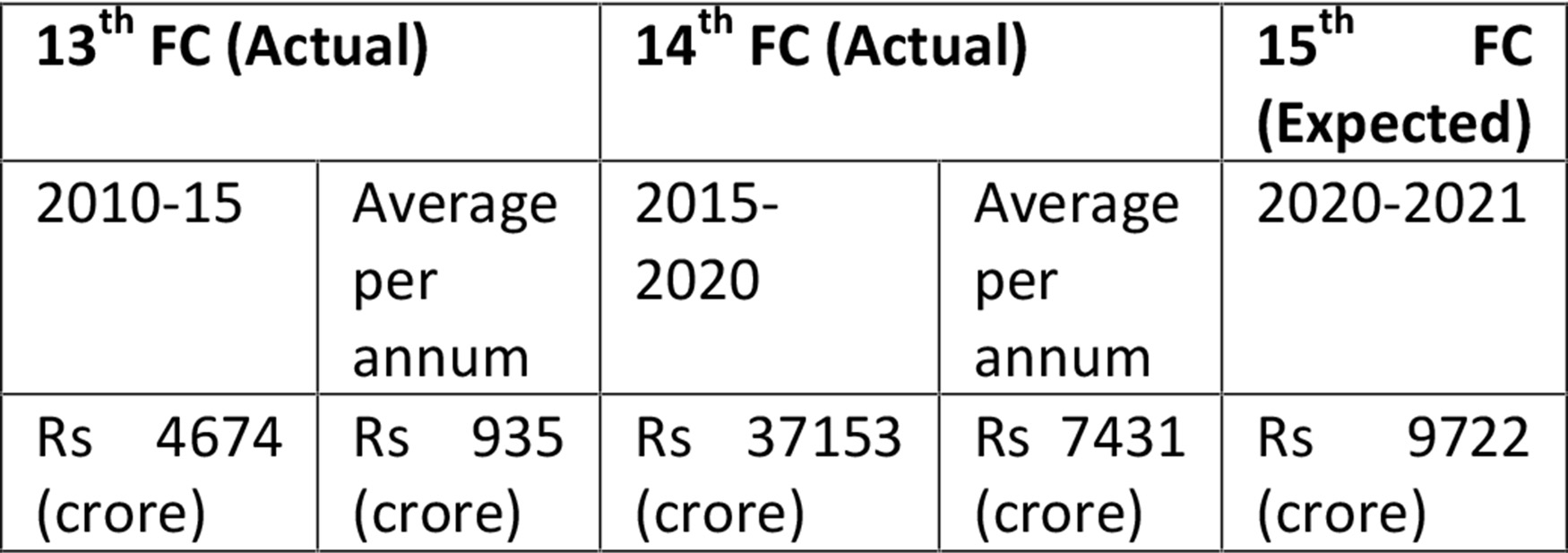
During 13th FC period (2010-15) Arunachal Pradesh got a total amount of Rs. 4674 crores under share in central taxes, averaging Rs 935 crore per year. After introduction of new devolution formula by taking area and forest cover, 14FC gave total Rs. 37,153 crore i.e. Rs. 7,431 crore annually. With the introduction of new weight to area and forest cover, the estimated inflow of central taxes to Arunachal Pradesh in financial year 2020-21 is estimated to be Rs 9,722 crore, i.e., around Rs.2291 crore, which is more in comparison to 14FC average figure.
Apart from the horizontal devolution, 15FC has also given some grants to different states under different heads. Grants for nutrition, urban local bodies, rural local bodies and disaster management for Arunachal Pradesh is Rs 19, Rs 111, Rs 231 and Rs 250 crore respectively (2020-21).
Thus, 15FC recommendations are boon to Aruanachal Pradesh. However, this boon should not be considered permanent. Inducting forest cover into the devolution formula should be seen carefully. As per India State of Forest Report 2019, a decline of 276.22 sqkm of forest area is reported in Arunachal Pradesh. If the trend continues, the state might lose heavily from future FCs. Thus, it is quite important to preserve the forest area of the state for the future generation. The state Govt and the people should think how to protect the forest cover. Thus, the additional resource the sate received from 14 and 15FCs can be termed as Green Bonous. (The author is professor of Economics, Rajiv Gandhi University)


 20
