
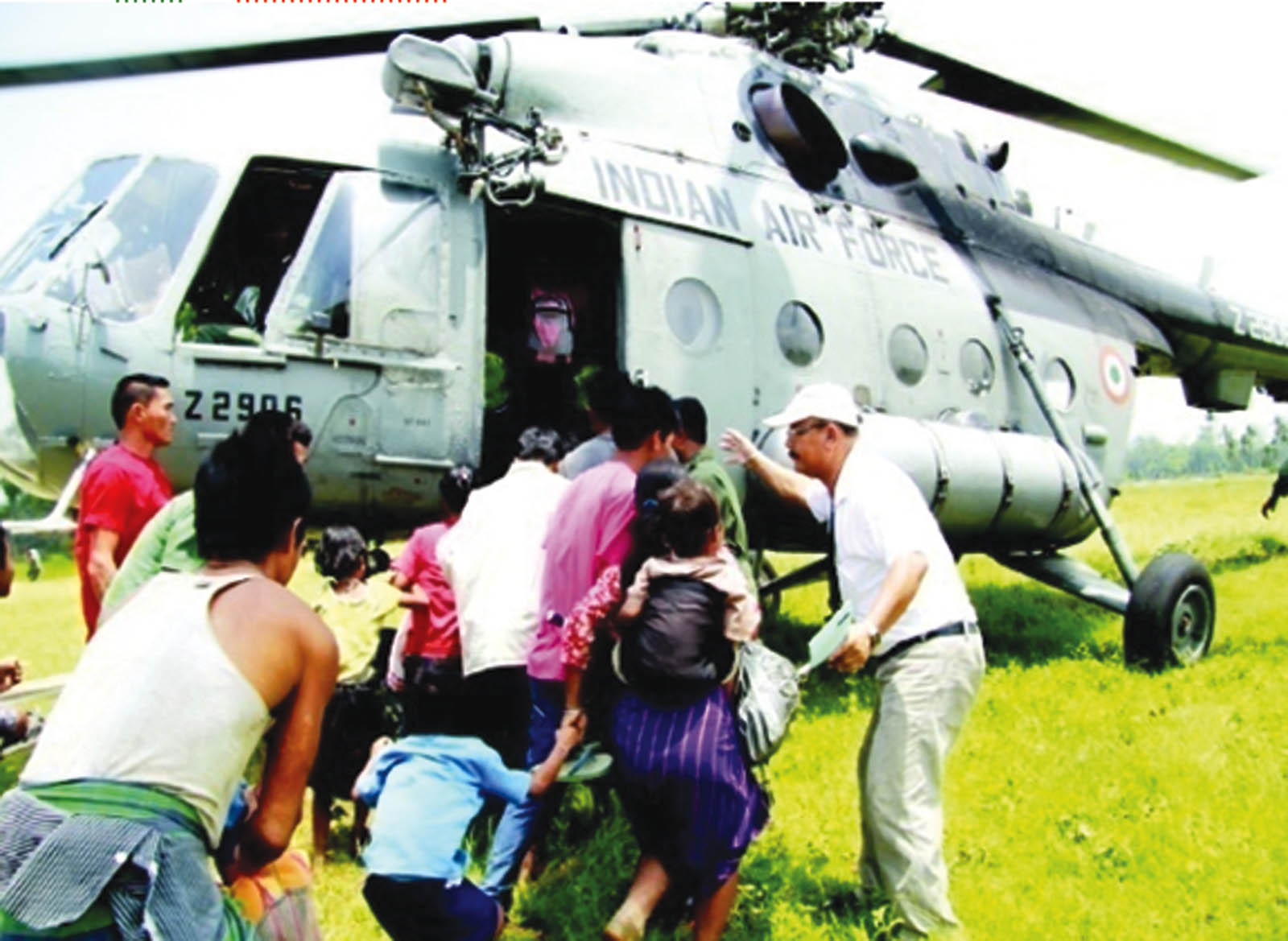
GoAP requisitioned IAF choppers on 29-06-12 evacuate 185 Chakama-Hajong refugees from Vijaynagar-III marooned by swollen Noa-Dehing
Introspecting refugee imbroglio smacking solution
‘Segregating AAPSU from
all-party unwarranted’
Claiming to have learnt from reliable sources that the GoAP has scheduled all-party meeting and AAPSU at different time on June 19, AAPSU president Hawa Bagang and GS Tobom Dai, in a release, termed it unwarranted
Welcoming the GoAP decision to hold all-party meeting as follow up on the vexed Chakma-Hajong issue, AAPSU described it as a positive gesture and reciprocal to its appeal and urged all participants of all political parties to come prepared with best ideas to hammer out a permanent solution to the issue lingering for decades.
AAPSU being the one to moot the all-party meeting should be included in the meeting during the same time, rather than segregating AAPSU team from other invited invitees. The meeting should be inclusive, otherwise keeping away AAPSU will defeat its very purpose, it said and demanded the GoAP to amend its agenda to include AAPSU with all parties.
By Pradeep Kumar
ITANAGAR | Jun 17 | The Supreme Court on 17.09.17 directed the GoI and the GoAP to settle Chakma-Hajong Chakma-Hajong refugees within three months that agitated Arunachalees again.
Chief Minister Pema Khandu has convened an all-party meeting here on June 19 to discuss the issue. This would be 2nd after such a meeting was held here on 25.11.15, chaired by then CM Nabam Tuki and attended by APCC, BJP, Peoples Party of Arunachal (PPA) and NCP representatives to unanimously decide that the GoAP should file a curative petition in the SC and move the union MoHA, respondent number one, for filing a separate curative petition.
Massive protest: Widespread reactions evoked with mostly young students in an AAPSU organised rally here on 29.09.15 were unanimous: “If GoI and SC insist on granting Indian citizenship to Chakma-Hajong refugees and try to dilute ILP system, then Arunachalees will have no option but to seek separate statehood”.
No ST status: Union MoS (Home Affairs) Kiren Rijiju while attending state BJP executive meeting here on 28.04.17 had said that Chakma-Hajong communities cannot be granted ST status in Aunachal Pradesh, adding: “I have also filed an affidavit in SC on the very sensitive issue.”
Background: Pakistan’s policy was discriminatory against the Chakmas in jobs, business and education and had amended the 1900 Act several times, against the wishes of Jumma people in Jummaland. The Govt then built a dam on Borgang River at Kaptai in East Pakistan (now Bangladesh) inundating 1,036 sqkms of land including the Royal Palace of Chakma King that displaced more than 1,40,000 Chakmas, Hajongs and Hindu Bengalis, who had migrated to Assam between 1964 and 1969 and about 30,000 of them to Arunachal Pradesh via Mizoram and Assam in 1964. The GoI rehabilitated them in Chowkham, Miao, Bordumsa and Diyun in Changlang and Balijan (Papum Pare district) in North East Frontier Agency (NEFA), now Arunachal Pradesh.
White Paper: While their population as per 1979 census was 21,494 and 30,064 (1991 census, a growth of over 400% in three decades), it swelled to about 65,000 by 1996, according to a White Paper on the Chakma and Hajong refugee issue, prepared by then CM’s secretary K D Singh recording chronological status of the contentious issue, as issued by the GoAP in 1996.
An unprecedented people’s referendum rally attended by all parties, NGOs and All Arunachal Pradesh Students’ Union (AAPSU) at Rajiv Gandhi stadium on 20.09.95, had passed a six-point resolution inter alia demanding the GoI to remove Chakmas-Hajongs from the state by 31.12.95, while the ruling Congress, led by Chief Minister Gegong Apang, quit the party on 08.09.95 because of his difference with then PM P V Narasimha Rao on the issue to form Arunachal Congress.
Citizenship & ST status: Union MoS (Home Affairs) M.M. Jacob on 27.02.92 had answered in Lok Sabha that in terms of Assam Accord, all persons, who came and settled prior to 01.01.66 were given Indian citizenship. On the basis of Assam Accord, all those who migrated prior to 1.1.1966 are deemed to be Indian citizens and those who came after 25.3.1971 are not to be accorded Indian citizenship. Chakmas-Hajongs living in Assam, Tripura and Mizoram on this basis have been recognized as Indian citizen as well as Scheduled Tribes, Jacob had reiterated.
SC verdicts: The SC judgment after hearing petition of National Human Rights Commission directed the GoAP on 09.01.96 “not to evict Chakmas except in accordance with the law, all the applications of Chakmas for citizenship be forwarded to the GoI, among others. In its final order, after concluding that there was indeed an imminent threat to the lives and property of Chakmas-Hajongs (an issue which will be dealt with below), the SC distinguished the case at bar from that of State of Arunachal Pradesh V Khudiram Chakma.
In the State of Arunachal Pradesh Vs Khudiram Chakma case, the SC ruled in favour of the GoAP in a dispute over land rights between the state and 57 Chakma families. The question of Chakmas’ citizenship was a salient feature of this dispute because only citizens were permitted to purchase land in protected areas under the Foreigners Order of 1948.
As Arunachal Pradesh was declared a protected area under the Government of India Act, 1935, the Chakma families’ acquisition of lands outside the Chakma Allotment Areas would be valid only if they were found to be citizens of India. Under the Assam Accord, codified at Section 6-A of the Citizenship Act, the Chakmas were found to be non-citizens as they were not ordinarily resident in Assam, but rather in Arunachal Pradesh.
In the NHRC Vs State of Arunachal Pradesh case, the SC stated that the question of citizenship by registration under Section 5(1) a of the Act was based upon considerations which were “entirely different” from those operative in the State of Arunachal Pradesh Vs Khudiram Chakma.
While the terms of the Assam Accord limited its application to a small number of persons, Section 5(1)a was found to be a provision with general application. As the Chakmas and Hajongs clearly met the requirements of the Act, the Court affirmed their right to apply for citizenship under Section 5(1)a and ordered the state government to take steps to facilitate their registration.
The Citizenship Rules of 1956 define the process by which an individual may become a citizen of India under Section 5(1)a of the Act. The rules describe the form that any citizenship application must take as well as creating the office of the collector, who is responsible for collecting and transmitting citizenship applications to the central government. Rule 8 reads, in its entirety: “The authority to register a person as a citizen of India under these rules shall be the Central Government.”
In Shamin Bano Vs Union of India case, the SC indicated that questions of citizenship are the exclusive domain of the central Govt and that no other body, not even the Court itself, could constitutionally interfere with the Govt’s determinations in this area.
Reiterating this position and clarifying the role of the collector in the NHRC Vs State of Arunachal Pradesh, the SC stated: 41. The Committee feels that the spirit of the Indira-Mujib Accord as well as the judgement of the SC in the matter may be made applicable to all the affected states for the solution of the problem. As per the Accord, all those Chakmas who came to India prior to 25.03.1971 are to be granted Indian citizenship.
Residentship: The issue of granting citizenship to the refugees resulted in a tussle between New Delhi and Itanagar and intensification of democratic movement by the AAPSU, demanding removal of the refugees from the state. Arunachalees have been opposing residentship of the refugees, the basis for granting citizenship as Arunachal was known as ‘tribal area’ under para 20 of the 6th Schedule, thereby granting special status to maintain its ethnicity.
The Bengal Eastern Frontier Regulation 1873 provides that no person other than the local natives shall pass through the tract without pass (innerline permit) and that no person who is not a native of the district shall acquire any interest in a land or the produce of the land. The area was declared ‘Scheduled District’ under the Scheduled District Act, 1874. Therefore, grant of residentship to the Chakma-Hajong refugees was a violation of the Constitution. AAPSU in August, 1994 demanded the expulsion of all foreigners including the Chakma-Hajong refugees from the state.
A High Level Committee (HLC) was constituted on 29.12.95 under the Home Minister with state CM as a member to decide and find out what needs to be done. The HLC could not come to the state till the review petition was disposed of by the SC. The GoAP contended that they had not been consulted while settling the refugees, who should be granted citizenship but settled outside his state.
The National Human Rights Commission (NHRC) responding to complaint of economic blockade of Chakma settlements by the refugees in October, 1994 had asked the GoAP to submit a status report. The SC heard the case of complaint and passed an interim order on 2.11.95 that the refugees were not citizens as no citizenship had been granted but they were entitled to citizenship under a Citizenship Act section.
The SC directed in the order that even if they were not citizens, their lives and limbs must be protected as they are entitled to their lives and limbs and that they cannot be evicted from their own places. On 9.1.96, a final order was passed directing to state Govt (i) not to take any action to evict them except under due process of law (ii) application for registration as citizen of India by Chakmas-Hajongs shall be forwarded by the collector or DC who receives then under the relevant Rule with or without enquiry, as the case may be to the Central Govt for its consideration in accordance with law (iii) to give police force, Central Police for the protection of those people on the demand of state Govt.
Voters’ right: Election Commission of India notified on 31.03.03 special revision of electoral roll for enrolment of Chakmas-Hajongs into the voter lists, in which 1,497 Chakmas-Hajongs were registered in state’s electoral rolls.
The refugee issue remained unsolved though it has been a launch pad for various political parties. After remaining dormant for many years, Lok Sabha member Takam Sanjoy on 13.11.09 had advocated constituting a four-party committee with two representatives each of AAPSU, the Chakma organization and central Govt to hammer out a lasting solution within two years.
Influx & encroachment: Continuous influx of Bangladeshi immigrants and their related illegal activities went beyond their notified settlement areas in Changlang district as they had reportedly encroached upon around 2649.47 hectares of reserve forest. While 512.87 and 946.81 hectares of reserve forest land were forcefully occupied near the settlement areas earlier to turn them into cultivable lands, sources reported, adding reserve forest areas encroached were located in Mudaka Sukha Nallah (1105.58 ha), Dangoria Mandir area (174.21 ha) and Sillong Pahar area (10 ha). Chakmas are mostly engaged in jhooming cultivation.
A nine-member High Powered Committee (HPC) headed by MoHA joint secretary Sambhu Singh was constituted by GoAP in June 2009 to study Chakma-Hajong settlement areas, the forest department updated its data on illegal encroachment of reserve forest areas, illegal activities of the refugees and other relevant information for the HPC.
The refugees population had swollen to approximately 60,000 as against the 57 families originally settled in 1966 in Diyun, AAPSU had claimed, quoting 1991 census figures – indigenous tribal population of Lohit and Changlang districts, where the Chakmas and Hajongs were residing, was only 74,000 out of total 202,523 population including other Indians when state’s total population was 8,58,392. AAPSU had feared rapid demographic changes in three districts with the refugees outnumbering local populace. The refugee population had grown by 110% in 1991-2001 against 25% local population, indicating rate of influx by local media
Conduct survey: While addressing a meeting of public leaders in presence of DC in-charge L Borang, EAC D Riba, police officers and Chakma leaders at Diyun, then Home Minister Tako Dabi on 11.08.10 11 had called for a survey of refugees’ settlement areas, their encroachment areas, and proper identification to check influx of huge number of refugees from within India while Chakma leaders vouched influx from outside India. Chakmas had attacked AAPSU members at Diyun on 09.08.10.
CoCO: State’s indigenous people perceiving danger to their identity and culture poised by ever-increasing concentration of Chakmas-Hajongs that led to formation of a 15-member core committee (CoCO) to suggest how to rein in the unruly elements among the refugees, check their further influx and even consider applicable of ILP, like other Indians.
“Why are you arguing? Suggest a solution,” quipped then Union Home Minister P Chidambaram, a lawyer by profession, when on 12.0512at Itanagar, responding to my question: Was granting citizenship with Arunachal residentship not violation of the Constitution?


 20
