
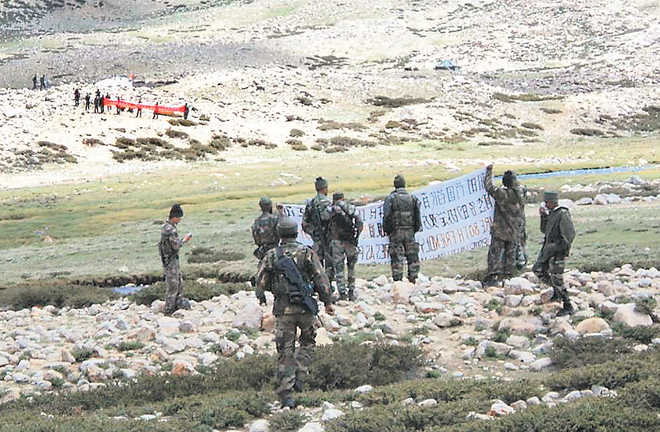
Galwan Valley in Ladakh
By Pradeep Kumar
ITANAGAR, Jul 02: Of 213 countries and territories around and two international conveyances affected novel Coronavirus (COVID-19) pandemic that infected 10,849,244 people and killed 5,19,963 till Thursday though 6,067,22 had recovered, according to UNO Worldometer.
Interestingly, after five decades many nations have united to corner China’s attempted political and financial hegemony across the world.
On May 19 last, China had agreed to a probe into the source of COVID-19 with certain conditions. On first day of 73rd World Health Assembly, Chinese President Xi Jinping, during a video-conference from Beijing, had said his country was ready for a “comprehensive review” of the origin of the virus but only after the pandemic was brought under control.
With tensions continuing to boil between China and the West over a host of security and economic issues, the latter has decided to ramp up the confrontation to a new level.
“Contemporary global order is rapidly adjusting to the ‘new normal’ defined by Covid-19 and new equations are forming with a speed that a few months back would have been unthinkable. Democratic values are becoming an integral part of this global order rejig. Early this month an Inter-Parliamentary Alliance of senior lawmakers from eight democracies, including the US, Germany, the UK, Japan, Australia, Canada, Sweden and Norway, was set up to “construct appropriate and coordinated responses, and to help craft a proactive and strategic approach on issues related to the People’s Republic of China”, Harsh Pant wrote in June.
With the global order rapidly transitioning into a new phase where contestation between the democratic world and China is going to be the major faultline, Indian policymakers will have to come to terms with this democracy dynamic. Even though New Delhi might find it difficult to articulate it, the choice is quite clear, Pant added.
Moreover, China has been targeting Indian territories that had seen 1962 Chinese aggression. The naked aggression in Galwan Valley of eastern Ladakh in May-June last saw death of 20 Indian soldiers including a colonel is a continuation of President Xi’s bid to further Mao Zedong’s expansionist agenda.
This amply exposes China’s long-term strategy targeting India for several years, but India has failed to understand Chinese psyche to take preventive measures. Delhi should realise that Ladakh standoff followed by encroachment of 36 hectares Nepal territory in June, are part of a multi-front Chinese plan.
It is very clear from Ladakh intrusion as India had demanded that “April 2020 line be restored”. If, the reports are any indication, China intruded 6-km deep inside Indian side of Line of Actual Control and retreated less than that making a huge gain for Beijing and corresponding loss of land for India.
Lok Sabha member Tapir Gao has been repeated voicing against Chinese intrusion into Indian Territory.
The People’s Liberation Army (PLA) had reached close to McMahon line in Asapila sector under Nacho assembly constituency of Upper Subansiri district for two days in June last, All Arunachal Pradesh Panchayati Parishad president Sushil Nalo had informed which was confirmed by a senior officer of PHQ.
The PLA had “abducted” one Togley Singkam, 21, from Asapila sector on March 19 last while he had gone to collect traditional herbs from the land belonging to Naa clan of Tagin community and for fishing with his friends.
Tagin Cultural Society (TCS) had approached state governor’s office which had taken up the matter with Army’s Eastern Command HQs in Kolkata and Singkam was handed over to Indian Army personnel on April 7 last as informed by defence PRO Lt Col P Khongsai.
The String of Pearls, a geopolitical theory on potential Chinese intention in Indian Ocean region (IOR) as a network of Chinese military and commercial facilities along its sea lines of communication, beginning from Chinese mainland to Port of Sudan in the Horn of Africa. Indian analysts believe this plan, with China-Pakistan Economic Corridor and China’s Belt & Road initiative under Xi Jinping is a threat to India’s national security. It aims at encircling India to threaten its power projection, trade and potentially territorial integrity. China’s support to Pakistan, India’s traditional enemy and its Gwadar Port is also viewed as a threat, compounded by fears that China may develop an overseas naval military base in Gwadar to allow China to conduct expeditionary warfare in the IOR.
The emergence of String of Pearls is indicative of China’s growing geopolitical influence through concerted efforts to increase access to ports and airfields, expand and modernise military forces, and foster stronger diplomatic relationships with trading partners.
Though India has been making moves of various types to counter the perceived threat, but Galwan Valley incident has crossed all limits for India to arise, awake and act. Thus, BJP general secretary Ram Madhab, considered party’s think-tank, had written on June 18 – China has changed tactics, not goals. India must demonstrate strong national power.


 20
