
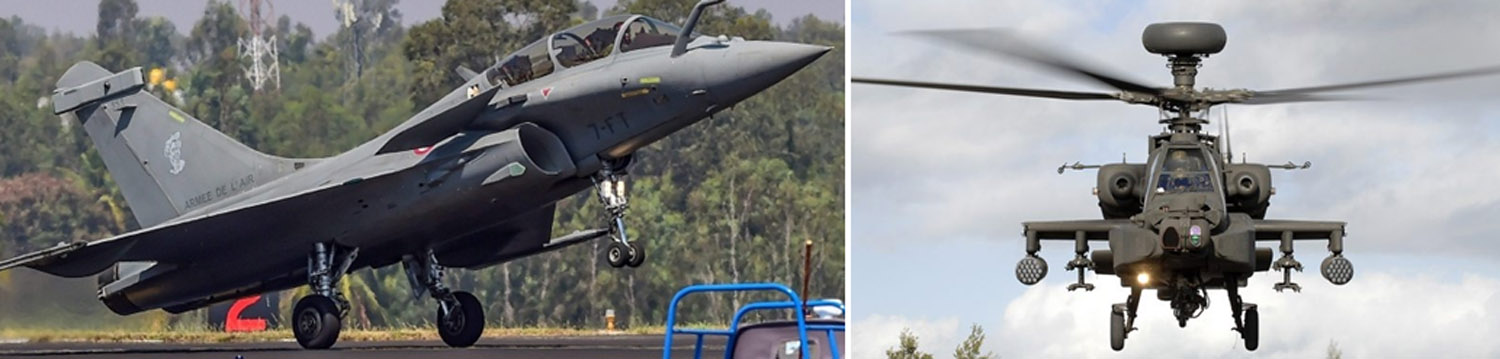
Rafale fighter jet Apache chopper
Beyond the Horizon
By Pradeep Kumar
Poor road connectivity and non-use of airpower was the greatest factor for humiliating defeat of Indian Army in 1962 Chinese aggression. But after 58 years also, the People’s Liberation Army (PLA) of China took advantage of New Delhi’s policy of peaceful co-existence that led to killing of 20 Indian soldiers including their commanding officer Col Suresh Babu during clash with PLA jawans in Galwan Valley on June 4-5 night.
The PLA was fully prepared as its jawans and officers were trained by 20 martial art trainers of Tibet’s local clubs besides equipped with life threatening nail-studded iron rods. Reports indicated that 7,000 Chinese soldiers had reached close to the Line of Actual Control (LAC) in Ladakh, who had resorted to hand-to-hand fighting with their Indian counterparts in north bank of Pangong Lake.
The Indo-China bilateral agreement for de-escalation is at thaw while China has been deploying more jawans and fighter jets in that sector.
Images, exclusively sourced from intelligence expert detresfa, an analyst with ShadowBreak Intl, saw four fighter jets (either J-11 or J-16 of Chinese Air Force) parked in Ngari Gunsa Airport (NGA), located at 14,022 feet and among the highest in the world. The J-11/J-16s are advanced, domestically produced variants of Russian Sukhoi 27 and broadly match capabilities of the IAF’s 30 MKIs.
Highlighting importance of the NGA airport, noted journalist Calude Arpi, had referred to it as a dual-use military and civil airport serving Shiquanhe town in Ngari Prefecture in southwest of Tibet. It started operations on 01.05.10 to become 4th civil airport in Tibet after Lhasa, Nyingch and Chamdo.
Situated at 14,022-ft above sea level, it is the third highest airports in the world after Qamdo Bangda Airport (elevation 14,219-ft)) and Kangding Airport (elevation 14,042-ft)). Its construction began in May 2007 at an estimated cost of an (U.S $ 241.22 million) and with 4,500-meter runway, it is expected to handle 120,000 passengers by 2020, he had said.
The advantage gained by its location close to the LAC is balanced by the reality that fighter jets deployed at such an altitude can only carry limited war-loads and fuels.
”The useful endurance of Chinese J-11 or J-16 fighters deployed at such altitudes will not be more than an hour,” said squadron leader Sameer Joshi (Rtd), a former IAF fighter pilot and Kargil war veteran. ”The useful endurance of IAF fighters which deploy from multiple air bases in the plains could be more than three to four hours if air to air refuelling tankers are used. This means that IAF fighter jets deployed in the area can fly longer than Chinese fighters deployed at the air base,” he added. .
Indian Navy has deployed Poseidon 8I anti-submarine warfare aircraft and MiG-29K fighter aircrafts for operational roles besides Apache attack helicopters and Mirage 2,000 fighter aircraft in Ladakh for maintaining surveillance and Chinook heavy-weight choppers to help in the movement of men and equipment.
Moreover, India due to receive first batch of six Rafale fighter jets by July 27 which may be deployed in Ladakh sector as part of India’s overarching plan to strengthen its military posture in the region, where Indian and Chinese forces are locked in a tense border confrontation and disengagement has turned out to be challenging.
Moreover, to counter martial arts’ trained PLA jawans , the Indian Army has deployed its Ghatak commandos, who have undergo 43-day specialized commando training course at Belgaum in Karnataka. Besides weapons, the training includes running for 40-km non-stop with a weight of about 35-kg which strengthens them physically, hand-to-hand combat, martial arts training, according to an army officer.


 20
