
By Pradeep Kumar
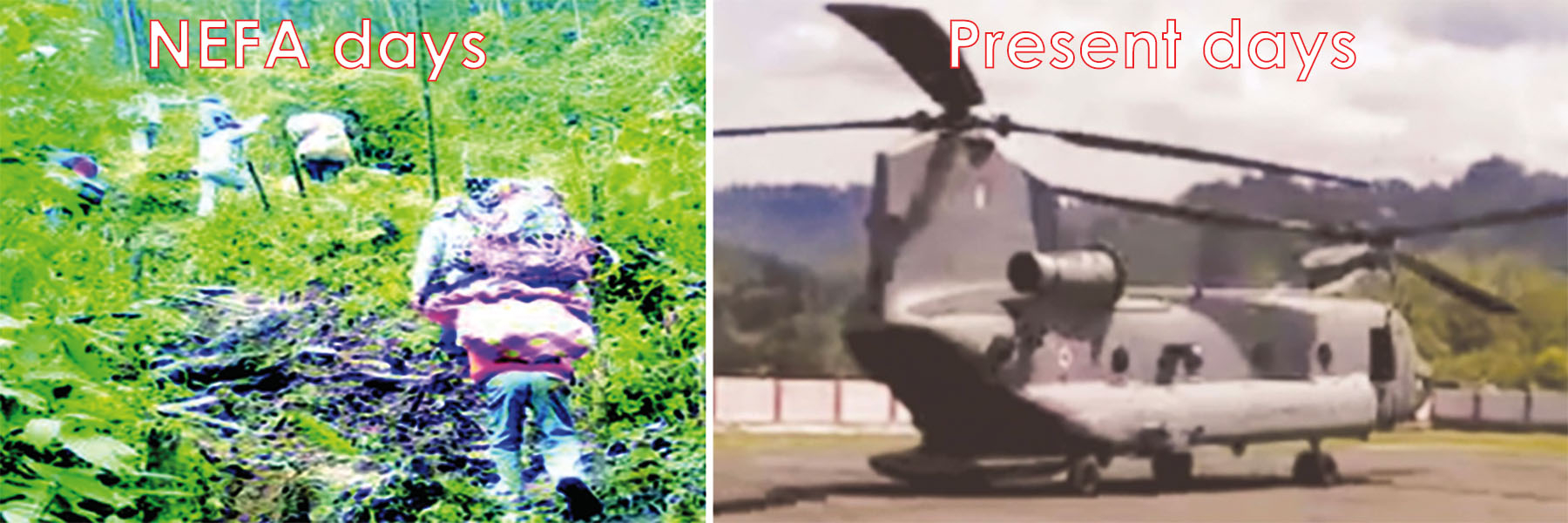
With Chinook heavy-lift helicopters engaged to airdrop ration rice to all air-fed stations, like Damin, Lada, Pip-Sorang, Chambang, Taksing, Sarli, Parsi-Parlo and other remote places where roads are under construction in this land-locked state, the Indian Air force air freight charges have accumulated back log of Rs 337 crore.
Expressing concern over the huge dues, Food & Civil Supplies, Legal Metrology and Consumer Affairs (F&CS, LM&CA) Minister Kamlung Mosang during a review meeting with departmental officers on January 13 last has advised to introduce porterage system to transport food grains to 13 air-fed administrative circles across Arunachal Pradesh to minimize air freight charges.
The system of ALC (Auxiliary Labour Corps) or porters has its advantages and disadvantages too. They used to transport bags and baggage of officers on transfer and postings and during their tours to inaccessible administrative centres during the NEFA (North East Frontier Agency) days.
In those days, the Central Purchase Organization (CPO) used to air drop 24 essential commodities, including rice, K oil, salt, match boxes, dry battery cells, etc in all air-fed centres through the public distribution system (PDS) with Roriah (Jorhat) in Assam as a base depot.
The ALCs were an indivisible part of the administration and at least in every eight km there used to be a temporary OB shelter with utensils along the foot track for the officers/officials to rest for the night where the ALCs used to cook and serve food.
It was in 2003 that the concept of ‘head load’ got popularized with transportation of PDS items by human carriers. A man usually carries a bag of 20 kg rice on his back on the hilly track. If a group of a dozen porters are transporting rice, one load is free for their consumption on the way, which was the practice. Dorjee Khandu Govt deserves appreciation in recognizing their services by enhancing their wage and regularizing their services.
I would like to recall the ‘Ha anna’ situation in Taksing under Upper Suabansiri district bordering China where 1,000 local people used to depend upon on PDS supply through porters, totally subject to vagaries of nature and used to take a week. This I wrote on 5ht August 2013. But the situation has changed now with the BRO building motorable road up to Taksing.
Roads have been built to many such inhabited and remote areas, but still 13-air fed locations need air lifting. Moreover, temporary OB shelters with utensils along the foot track are passé now.
The tell-all fact is that those innocent tribals are serving as sentinels of India’s eastern most frontier and it is the responsibility of the state Govt to ensure food grains supply to them under the National Food Security Act, 2013, which legally entitles rural population (upto 75%) and urban population (upto 50%) to receive subsidized foodgrains under Targeted Public Distribution System.


 20
