
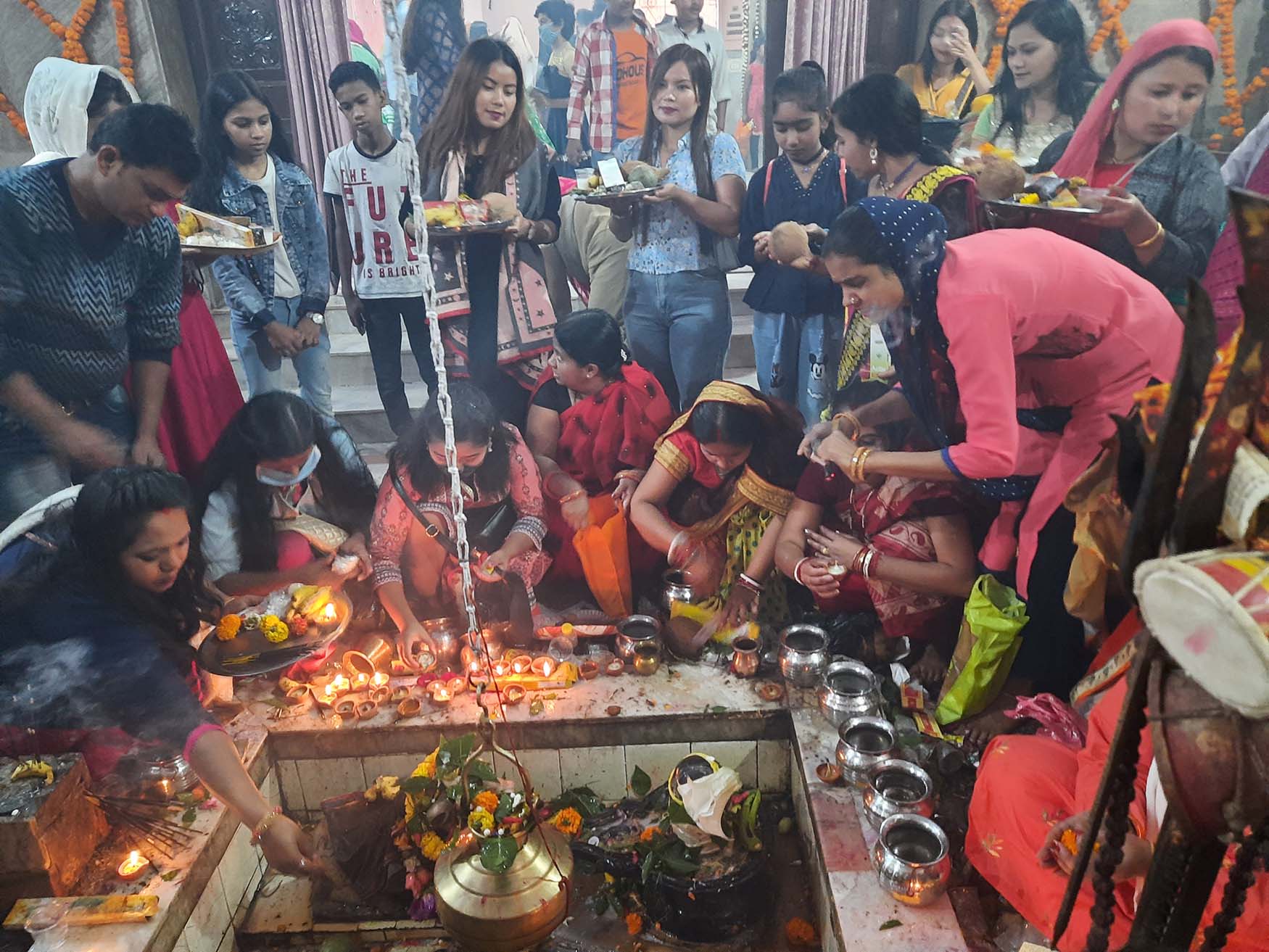
Sisters Baby Tasi & Topi Tasi, both graduates, waiting to worship
By Pradeep Kumar
NAHARLAGUN, Mar 11: Thousands of Shiva devotees, large number of indigenous Arunachalees made a beeline to E-sector Shiva temple here to seek blessing of the lord on Maha Shivaratri on Thursday.
Pundits Ram Avtar Sharma and Nand Kishore Upadhya offered prasad to all devotees after they worshipped in the temple while a group of volunteers were distributing sweets.
A make-shift market cropped up to offer various worshipping items while two snake charmers with snakes were entertaining the devotees.
Maha Shivaratri, celebrated annually in honour of Lord Shiva, the name also refers to the night when Shiva performs the heavenly dance, which means “the Great Night of Shiva”.
This festival is solemn and marks a remembrance of “overcoming darkness and ignorance” in life and the world. It is observed by remembering Shiva and chanting prayers, fasting and meditating on ethics and virtues such as honesty, non-injury to others, charity, forgiveness, and the discovery of Shiva. The ardent devotees keep awake all night. Others visit Shiva temples or go on pilgrimage. This is an ancient Hindu festival whose origin is unknown.
The Maha Shivaratri is mentioned in several puranas, particularly Skanda Purana, inga Purana & Padma Purana. These medieval era Shaiva texts present different versions associated with this festival, & mention fasting, reverence for icons of Shiva such as the Lingam.
Different legends describe the significance of Maha Shivaratri. According to one legend in the Shaivism tradition, this is the night when Shiva performs the heavenly dance of creation, preservation and destruction. The chanting of hymns, the reading of Shiva scriptures and the chorus of devotees joins this cosmic dance and remembers Shiva’s presence everywhere. According to another legend, this is the night when Shiva and Parvati got married. A different legend states that the offering to Shiva icons such as the linga is an annual occasion to get over past sins if any, to restart on a virtuous path and thereby reach Mount Kailasha and liberation.
The significance of dance tradition to this festival has historical roots. The Maha Shivaratri has served as a historic confluence of artists for annual dance festivals at major Hindu temples such as at Konark, Khajuraho, Pattadakal, Modhera and Chidambaram. This event is called Natyanjali, literally “worship through dance”, at the Chidambaram temple which is famous for its sculpture depicting all dance mudras in the ancient Hindu text of performance arts called Natya Shastra. Similarly, at Khajuraho Shiva temples, a major fair and dance festival on Maha Shivaratri, involving Shaiva pilgrims camped over miles around the temple complex, was documented by Alexander Cunningham in 1864.
Maha Shivaratri is considered the day when adiyogi or the first guru awakened his consciousness at the material level of existence. According to Tantra, at this stage of consciousness, no objective experience takes place and the mind is transcended. The meditator transcends time, space and causation. It symbolizes the brightest night of yogic enlightenment of the soul, when the yogi attains Mokshya , the final fructification of samadhi or illumination.
“What growth of virtue we need to encourage. Shiva is not only outside of us but within us.To unite ourselves with the One Self is to recognize the Shiva in us” – The Theosophical Movement, Volume 7.
Lord Shiva is worshipped across South Asia, particularly in Nepal at Pashupatinath Temple while Hindus in Pakistan visit Shiva temples during three-day Shivratri festival, The Umarkot Shiv Mandir is one of the biggest religious festivals and attended by around 250,000 people with all expenses borne by Pakistan Hindu Panchayat besides in Churrio Jabal Durga Mata Temple which records 200,000 pilgrims. Hindus cremate the dead and ashes are preserved till Shivratri for immersion into the holy water in Durga Mata Temple. In Mauritius, Hindus go on pilgrimage to Ganga Talao, a crater-lake.


 20
