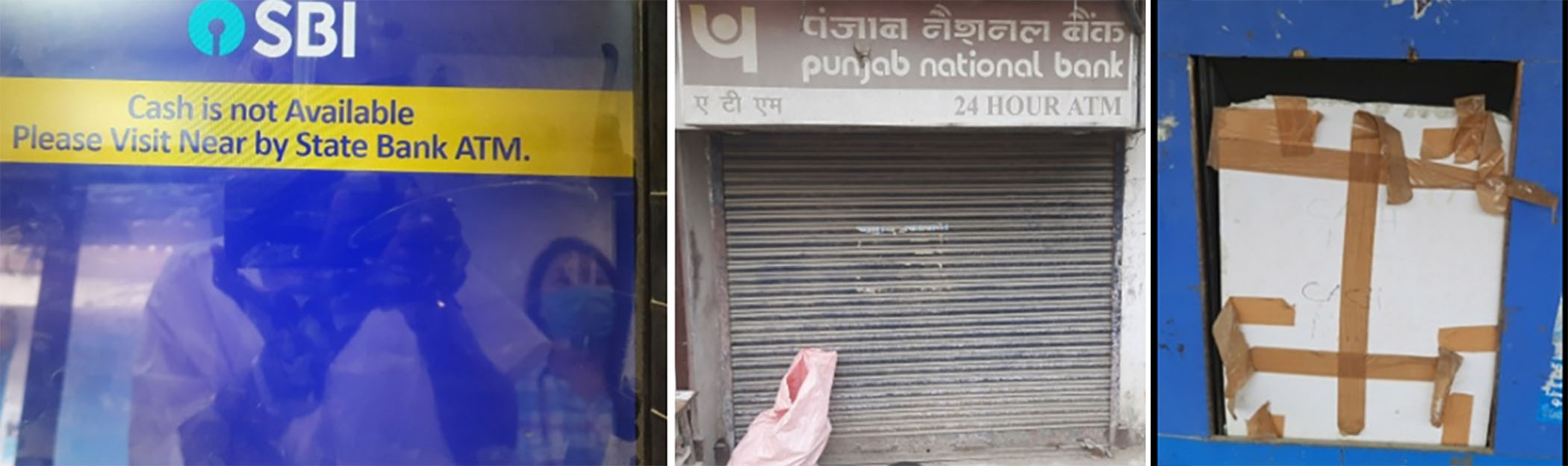
SBI PNB Bank of Maharashtra
By Pradeep Kumar
ITANAGAR, Apr 11: Arunachal Pradesh, predominately a tribal dominated society, has remained mostly a cash-based economy as proved by daily refilling of 75 ATMs (automated teller machines) of state’s lead bank State Bank of India (SBI) with Rs four to five crores in Capital Complex alone.
However, one could imagine the sufferings of people when most of the ATMs remain either defunct or without cash while poor internet connectivity pose hurdles to switch over to online transaction.
Most of the ATMs in Capital Complex, particularly in Naharlagun, were either defunct or showing no-cash to leave the depositors disillusioned on Sunday.
This senior journalist to his surprise found ATMs SBI’s near Naharlagun Maruti showroom and G-Extension main branch without cash, Central Bank of India’s near Legi Complex, Punjab National Bank’s & Canara Bank’s in G-Extension closed, Axis Bank’s inside closed complex, while Bank of Maharashtra’s Itanagar main branch ATM reportedly damaged by miscreants a year ago still inoperative.
Though second Saturday and Sunday are bank holidays, but such status of ATMs proved total lackadaisical attitude of bankers for which state chief secretary Naresh Kumar while chairing state level bankers’ committee (SLBC) meeting on Friday last had reprimanded all banks for their poor performances.
Thus, the chief secretary and finance secretary Y.W. Ring should explanation from the banks about such whimsical functioning of ATMs.
The banks engage agencies to replenish their ATMs during day time as per Union MoHA directive: “No ATM will be replenished with cash after 9 pm in cities and 6 pm in rural areas from next year even as two armed guards will accompany crisp notes in transit.
Interestingly, India’s largest lender, the SBI had revised its ATM cash withdrawal rules as reported on 05.02.21 and uploaded to its website. It charges a fee of: Rs 20 plus GST each time a transaction fails due to insufficient balance; Rs 10 plus GST to Rs 20 plus GST for “any additional financial transactions beyond the set limit”.
The SBI customers can withdraw cash free from ATMs eight times (5 SBI ATMs and 3 other bank ATMs) for in a month in metro cities.
The SBI offers 24×7 one-time password (OTP)-based cash withdrawal for ₹10,000 and above from all its ATMs in India since 18.09.20. If one fails to do so, the transaction will get cancelled.
The Reserve Bank of India (RBI) by 25.02.21 order had imposed a penalty of ₹2 crore on Bank of Maharashtra for “non-compliance of certain provisions of its directions (Frauds classification and reporting by commercial banks and select FIs, 2016) and Concurrent Audit System in Commercial Banks – Revision of RBI’s guidelines, disclosure of customer complaints and unreconciled balances of ATM transactions, and MSME sector – restructuring of Advances”. The RBI also imposed penalty of ₹1 lakh on Arvind Sahakari Bank Limited on 18.03.21 for non-compliance of its directions issued on installing off-site ATMs.
Interestingly, cash withdrawals from ATMs in India increased over the past five years and are only next to China. However, the percentage of cash withdrawals to GDP has been constant in India at around 17%, the RBI had reported on 25.02.20 quoting its ‘Assessment of progress of digitisation from cash to electronic’ report.
The demand for high-value denominated currency has outpaced low-value denominated currency and this phenomenon may indicate that cash is increasingly used as a store of value and less for making payments.
“Debt and credit card-based payments registered a CAGR of 44% and 40% in terms of volume and value, respectively. The adoption of card payments has been supported by innovations in form of contactless payments and tokenisation technologies, contributing to the growth. In addition, the use of cards for payments is increasing vis-a-vis their use for withdrawing cash,” the report said.
The ‘JP Morgan 2019 Global Payments Trends Report – India Country Insights’ observed that Indian payments market, historically dominated by cash, is evolving to meet the demands of smartphone led online shopping culture, with cards and digital wallets rising in prominence.
However, cash withdrawal (ATMs) infrastructures have grown at a much slower pace (CAGR 4%) over the past five years. About 72% of India’s consumer transact in cash, double that of Chinese, RBI says quoting Credit Suisse report, adding many traders, especially in rural areas, remain unable to accept digital transactions due to issues around network connectivity and a reluctance to pay charges for what are often low-value transactions.


 20