
Beyond the Horizon
By Pradeep Kumar
COVID-19 pandemic surfaced in its deadliest form in second wave across India. The country reported its highest-ever single-day spike of 261,500 coronavirus cases in last 24 hours on Sunday morning and highest 1,501 deaths in 24=houray.” With this, India’s overall tally reached 14,788,109 cases and 18,01,316 active cases while death toll jumped to 177,150, as per Union Ministry for Health and Family Welfare.
Why this wave has been ripping through cities? Public health expert-cum-All India Drug Action Network co-convenor Malini Aisola says: “There is full-blown panic. India has only to blame itself. The steep drop in cases towards by 2020 end bought complacency, the central and state Govts lowered their guard as did the public. Permitting massive public gatherings like Kumbh Mela in Haridwar and election rallies in poll-bound states were best exmaoled.
The COVID-19 protocol enforcement and restrictions were relaxed following reports of cases receding. With a collective relief visible, people threw all caution to the wind and dropped their masks, and their guard, as if the pandemic had been vanquished though the 2nd and 3rd wave of the virus were hitting the US and UK harder than the first. In India, the virus seemingly has mutated into a stronger and deadlier strain during the current surge. The National Institute of Virology (NIV), Pune found the double mutant (B.1.617) strain in 61% of the 361 samples taken from Maharashtra during January to March. “These new strains are far more infectious than the ones we dealt with last year,” admits Delhi’s AIIMS director Dr Randeep Guleria.
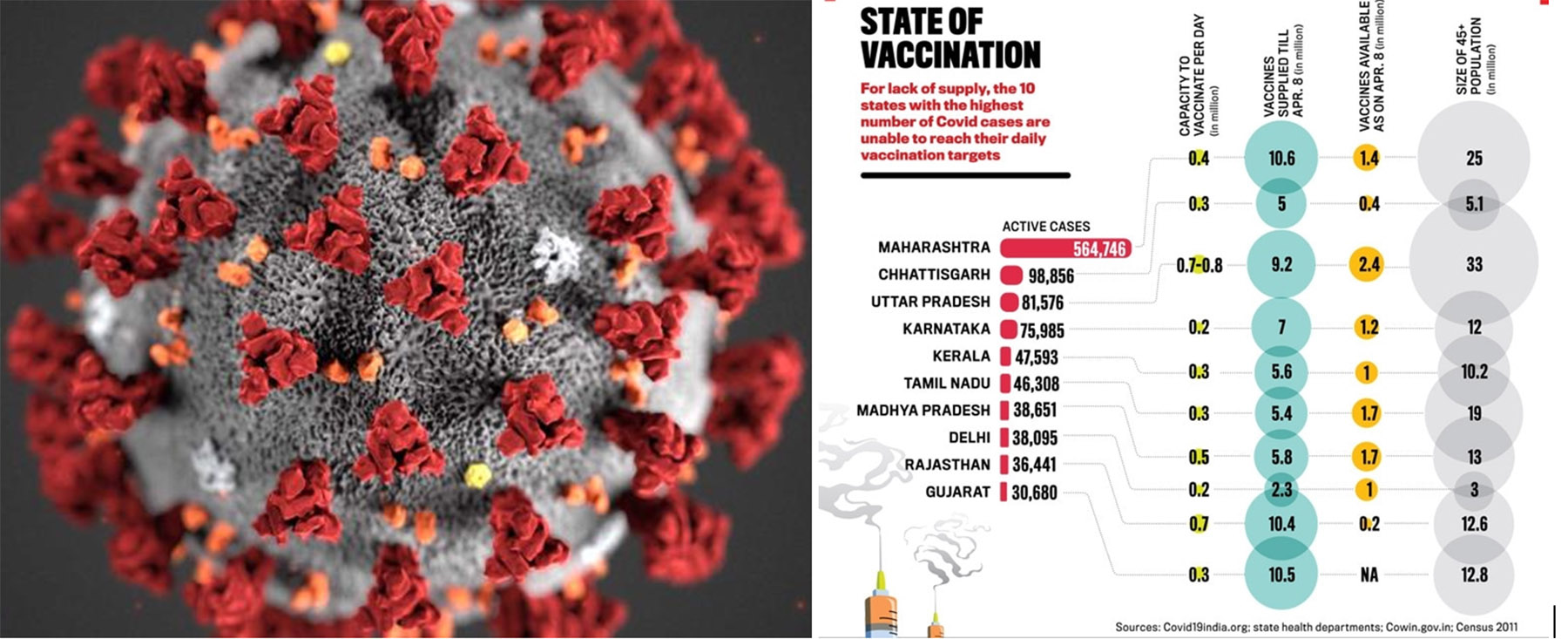
Vaccine crisis: Loopholes in India’s optimistic vaccine strategy exposed. The country is facing vaccine emergency as its 75% of its population has to be vaccinated for which present vaccine drive at present rate may continue till 2022 summer. Thus, the experts advocate increasing current capability of vaccinating 4 million a day to 20 million, or else third wave would be almost a certainty. Why such position from better status few months ago?
What went wrong? : India is the largest producer of vaccines in the world and now running world’s largest immunisation drive with second largest capacity globally, after the US, in producing vaccines and administering them. Of dozen vaccine candidates in 2020 in final clinical trial stages, including India’s Covishield, Covaxin and ZyCov-D.
The GoI had the NIV collaborate with private pharma giant Bharat Biotech to develop Covaxin. Covishield was developed by Oxford University in collaboration with pharma giant AstraZeneca, and they signed up with Serum Institute of India (SII), world’s largest vaccine manufacturer, to initially manufacture a billion doses to supply to nations across the world, including India.
This is where Indian health planners stumbled. The rich nations, representing just 14% of world’s population, bought more than half (53%) of all most promising vaccines, including Covishield, according to People’s Vaccine Alliance, a coalition of 50 organisations.
After Pfizer partnered with BioNTech, the Trump administration paid for 100 million doses and proposed to buy 500 million more if the vaccine succeeded. Today, the US has enough doses to vaccinate its entire population twice over. Israel offered Pfizer access to its citizens’ medical records in return got enough doses to vaccinate its population and now close to achieve 75% coverage.
Indian Govt placed only limited orders with both vaccine manufacturers, SII and Bharat Biotech, 110 million in initial phase. Dr V.K. Paul, Niti Aayog member-cum-National Expert Group on Vaccine Administration for COVID-19 (NEGVAC), co-chair says: “Our priority was to vaccinate vulnerable groups. A target of 300 million – healthcare workers, frontline workers, those above 65 and those with co-morbid conditions – was set for July and private sales disallowed.
So confident was the GoI in meeting its own target, it exported 65 million doses to needy nations across the world as part of Mission Maitri.
However, poor communication led to vaccine hesitancy with only 40% of target group taking their shots in the initial six weeks and reports of vials even going waste.
Some experts acknowledge that the GoI’s target-based approach, considered by some to be reason for present crisis, was initially the best way. “As far as demand-supply, any public health intervention to be successful in India, had to be target-based. It is impossible to cover such a large country with immunisation at one go,” says India director for Medecins Sans Frontieres Leena Menghaney, adding: “India didn’t invest as much as it should have either in research or in manufacturing or in ensuring targeted distribution within the country.” What planners also didn’t anticipate was a massive second wave striking a large percentage of the young, necessitating a rapid change in vaccine strategy to include all age groups.
The biggest oversight, a former health ministry bureaucrat said on condition of anonymity, was with Covaxin manufacturing set-up, where the Got failed to ramp up its production. Bharat Biotech has three manufacturing units in Hyderabad and one in Bengaluru. According to a Rajya Sabha report, it can produce up to 12.5 million doses a month. It is now producing 4-5 million doses a month. After assuming full production since November, it might have produced about 25-30 million doses. Since it was developed in partnership with PSUs, the GoI could have given license to other vaccine manufacturing companies to boost production. But alas…….


 20
