
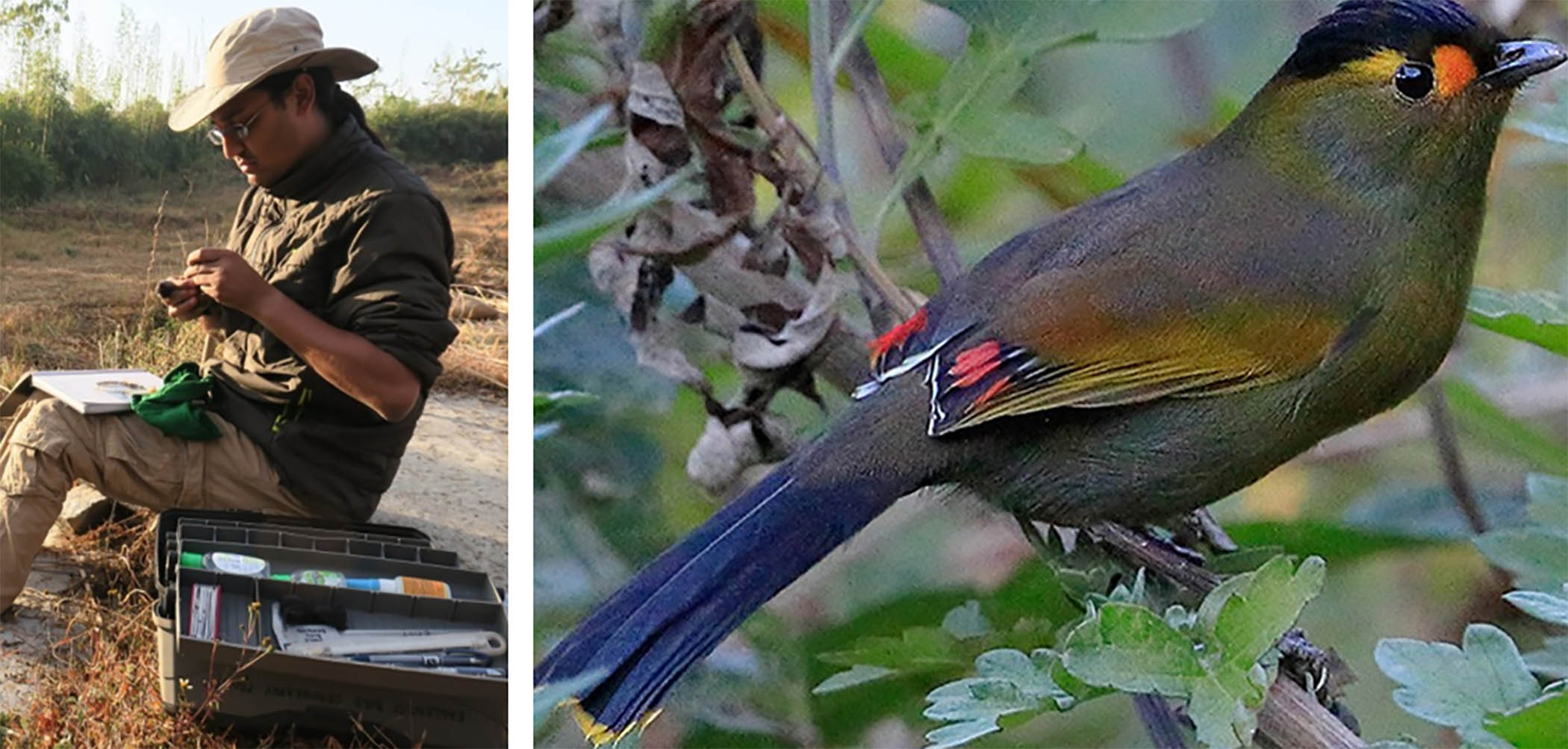
Dr. Srinivasan Bugun Liochicla
Beyond the Horizon
By Pradeep Kumar
Life on Earth is undergoing its sixth ever mass extinction, entirely driven by humans, says Dr. Umesh Srinivasan, who has been conducting studies on the effects of selective logging on birds in Eastern Himalayas, one of the rich regions in the world where most bird species are found.
“Amongst the multitude of “global change” factors causing species’ extinctions, climate change, loss and degradation of natural habitats are major causes. This is especially the case for species in tropical mountain ranges, where most of Earth’s terrestrial biodiversity is concentrated, and where species tend to be thermally sensitive.
Himalayan state of Arunachal Pradesh is one of the 12 biodiversity hotspots of the world, which boasts of about 500 species of birds, and more than a thousand different plants.
“Several much sought-after birds, like Ward’s Trogon, Wedge-Billed and Rufous-Throated wren-babblers, Rufous-Necked, Great and Wreathed hornbills, black-necked crane (winter), beautiful Nuthatch, emerald cuckoo (summer) are standard fare in Pakke Wildlife Sanctuary. Other species which can be seen with some perseverance and knowledge are tree tragopans, blood pheasants, monal, ibisbill, purple cochoa, long-tailed and collared broadbills, blue-naped pitta, vivid niltava, long-billed plover and black-headed shrike-babbler, to name just a few – in fact more than half the species on the 450+ birdlist would qualify as specialties on any birder’s list!
I was awestruck at the magnificent scene of a flock of flying Hornbills (The state bird), perhaps greeting Ta…Ta with their wings in the horizon as the chopper carrying entourage of then Governor JJ Singh was returning after inauguration of Vijoynagar advanced landing ground on 18.11.2012.
Dr. Srinivasan and his team study how forest degradation combines with climate change to impact Himalayan biodiversity at multiple levels, from geographic range shifts to behaviour and demography. Their main ongoing work is in eastern Himalayas of Arunachal Pradesh, where they have been monitoring bird population in primary and logged forests for a decade using mist netting and bird ringing.
They combine this with behavioural observations to understand how climate change and forest loss are altering the composition of mixed-species bird flocks across elevational gradient. In addition to Arunachal long-term project, they work in the field with various institutions to study impacts of global change drivers on Himalayan birds in Uttarakhand, Himachal Pradesh and Sikkim.
He was responding to questions: How do bird species respond to selective logging? What are the changes that you see in birds in logged forests? Has it to do with something that humans always want for their bodies?
Apart from the research, Dr. Srinivasan also works with Bugun community of Singchung village and forest department in Arunachal Pradesh on a range of conservation issues. These initiatives include wildlife and nature education for schoolchildren of Arunachalee communities and management of Singchung Bugun Village Community Reserve, set up to protect the critically endangered Bugun Liocichla.
Before joining IISc, Dr. Srinivasan was a postdoctoral fellow with David Wilcove of Woodrow Wilson School of Public and International Affairs at Princeton University. He did his PhD on demographic impacts of selective logging on birds in Arunachal Pradesh with Suhel Quader of National Centre for Biological Sciences. His MSc was in wildlife biology and conservation from Wildlife Conservation Society-National Centre for Biological Sciences. His undergraduate studies were in medicine at Government Medical College, Mysore.
The “Himalayas are not like a cone” and the contours of forest degradation in the Himalayas is unique and the stretch between 1800 to 2500M is fascinating nuance amongst the Great Barbet. The endangered Bugun Liochicla, with a global population of 20 individual birds, was first in spotted in Singchung village, he said, responding to question: Are birds in this part of the Himalayas are more temperature sensitive than others?
Dr. Ramana Athreya, a birdwatcher and an astronomer of Pune-based Indian Institute of Science Education and Research, in 1995 was first to spot the bird with unusual features – its unique call, a fluty note with distinctive terminal inflections and the multi-coloration. The official recognition and documentation of this tropical beauty found in Eaglesnest, West Kameng district came in 2005. These birds have a black forehead and trademark olive-green toned body with flaming-red tip at the tail end.
Dr Athreya formally described the species as Liocichla bugunorum, where as Liocichla is the genus name and bugunorum after Bugun tribe in whose community forests the species was discovered. It was also first bird species to be described in India in more than 50 years. (With agency inputs)
Majority of Arunachal Pradesh forests are owned by the tribal communities, apart from the “preserved” or “notified” forests identified by the Govt. However, in January 2017, the Bugun community of Singchung village had joined hands with forest department to launch Singchung Bugun Community Reserve (SBVCR) spread in 17 sqkm hotspot for biodiversity. About 10 villagers take turns every week to patrol 17 sqkm area, where the bird was spotted. The SBVCR had won India Biodiversity Award 2018 in “Conservation of wildlife species” category conferred by National Biodiversity Authority (NBA). (With agency inputs)


 20
