
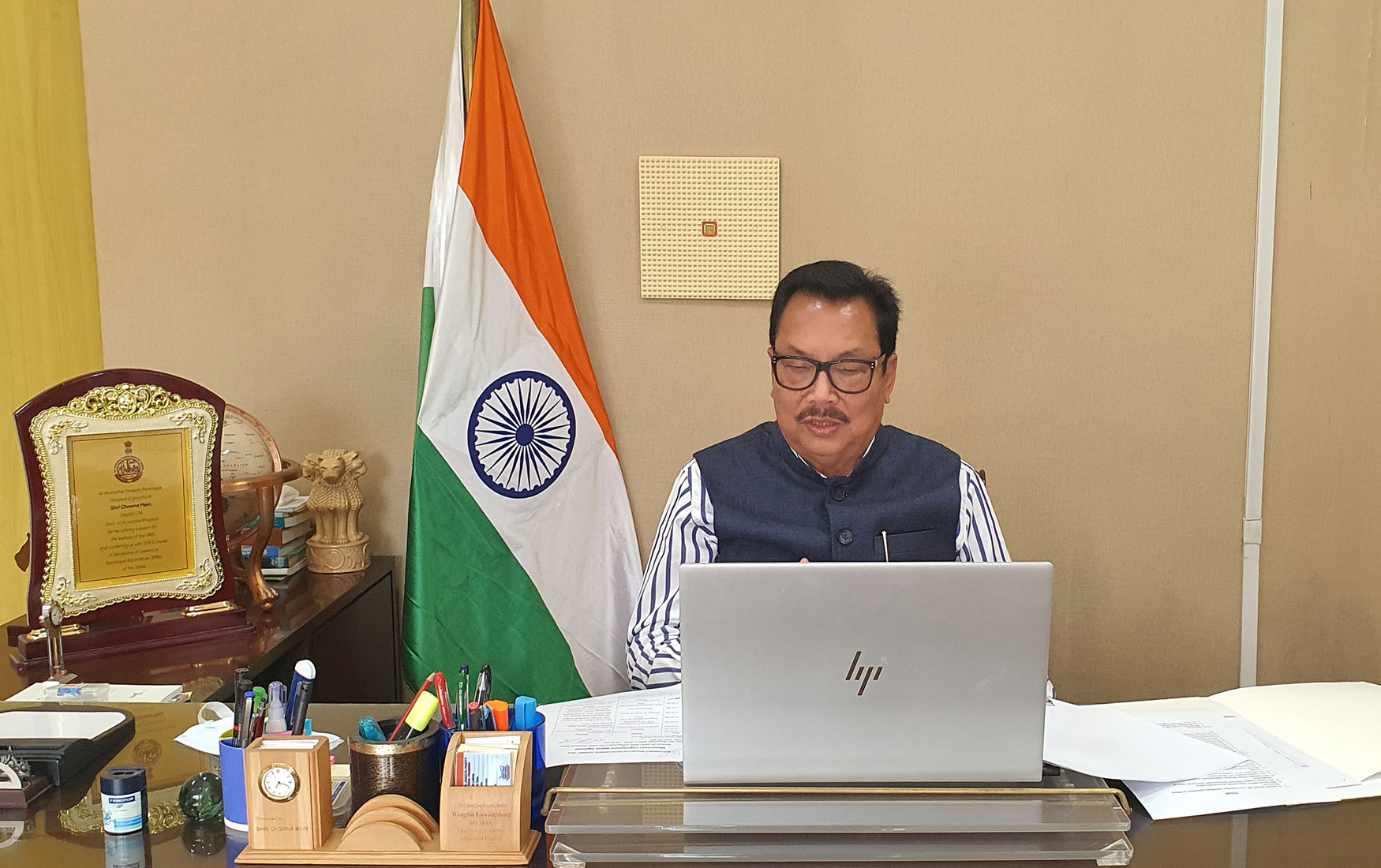
NAMSAI, Nov 20: Deputy Chief Minister Chowna Mein on Saturday emphasised the adverse impact of plastic pollution on the overall health of the people and also highlighted the recent Climate Change Declaration of Arunachal Pradesh on the principles of ‘Panchamrit’.
Participating in the Mountain Legislators’ Meet held on the final day of the 10th Sustainable Mountain Development Summit at Darjeeling virtually, Mein while congratulating the Integrated Mountain Initiative (IMI) for organising the meet, said it was a good time to reflect on the work that has gone in for the past decade and to identify the focus areas for the time to come.
The theme of the meet was ‘Pathways for Plastic Waste Management in the Indian Himalayan Region’, which was organised by IMI, local host Darjeeling Himalaya Initiative and United Nations Environment Program (UNEP).
The legislators deliberated and discussed the issue of the waste crisis in the hill stations of India, especially on the growing plastic pollution and its impact on mountain landscapes.
The members also deliberated on potential solutions and policy mechanisms that can effectively tackle the plastic waste in the mountains.
“Today I am proud to inform that my state has become the first state to adopt a climate change declaration by taking a clue from the guidance given by Prime Minister on the principles of ‘Panchamrit’,” Mein said.
He said on November 13, the council of ministers of the state signed the Pakke Tiger Declaration 2047 on Climate Change Resilient and Responsive Arunachal Pradesh.
Mein added that in the Pakke Declaration, the state government had unanimously agreed to prioritise five broad themes – Panch Dharas – envisaging a multi-sector ‘whole of government and whole of society’ approach towards low emissions and climate-resilient development in five areas. These areas are environment, forest and climate change, health and well-being of all, sustainable and adaptive living, livelihoods and opportunities and evidence generation and collaborative action.
The deputy chief minister added that climate change is a real threat to the entire earth.
“All of our homelands are especially vulnerable due to the fragile ecosystem of the Himalayan mountains. We must then take this issue in all its seriousness and deliver outcomes. I strongly believe that we the mountain states should strive to become world leaders in adopting climate sustainable initiatives,” he said.
He further called to adopt the approach of ‘Start Small and Do Well’ and emphasised inclusion, equity and collaborative actions as the basis to address the challenges at the ground level and to deliver better resource governance.
“Concerning the Pakke Declaration, I suggest IMI can also take up measures from this declaration and suggest to the other Himalayan states to adopt and implement such resolutions. Our conditions and concerns are similar for the protection of the environment and the sustenance of the ecosystem,” he said.
Mein urged upon all the legislators to join hands in taking up the cause, individually at their constituencies and collectively as mountain legislators.
“We are about 25 legislators – imagine if we highlight the menace of plastic pollution in our respective constituencies – we can impact 20 lakh people. Let us make this a core issue. Focus on our young generation, encourage them and facilitate for a better tomorrow,” he added.
In his address, Meghalaya Environment and Forest Minister James Sangma brought to attention various crucial issues on the topic including the need for bringing in nature and economics together for a sustainable, resilient future for the region.
The discussion was chaired by session chair Vincent H. Pala, Lok Sabha member (Shillong) and moderated by P.D. Rai, President IMI and former Sikkim Lok Sabha member.
The meet brought together over 19 elected representatives and former representatives of various bodies from the Indian Himalayan Region and included MPs, MLAs, Chairman of Autonomous District Council, Mayor, and other prominent members.
The meet included a state of affairs presentation on UNEP’s Counter MEASURE II project which aims at informing and influencing national policies, institutions and alliances through the generation and dissemination of scientific knowledge on plastic pollution of rivers in India. The meet also adopted the MLM 2021 declaration. (PRO)


 20
