
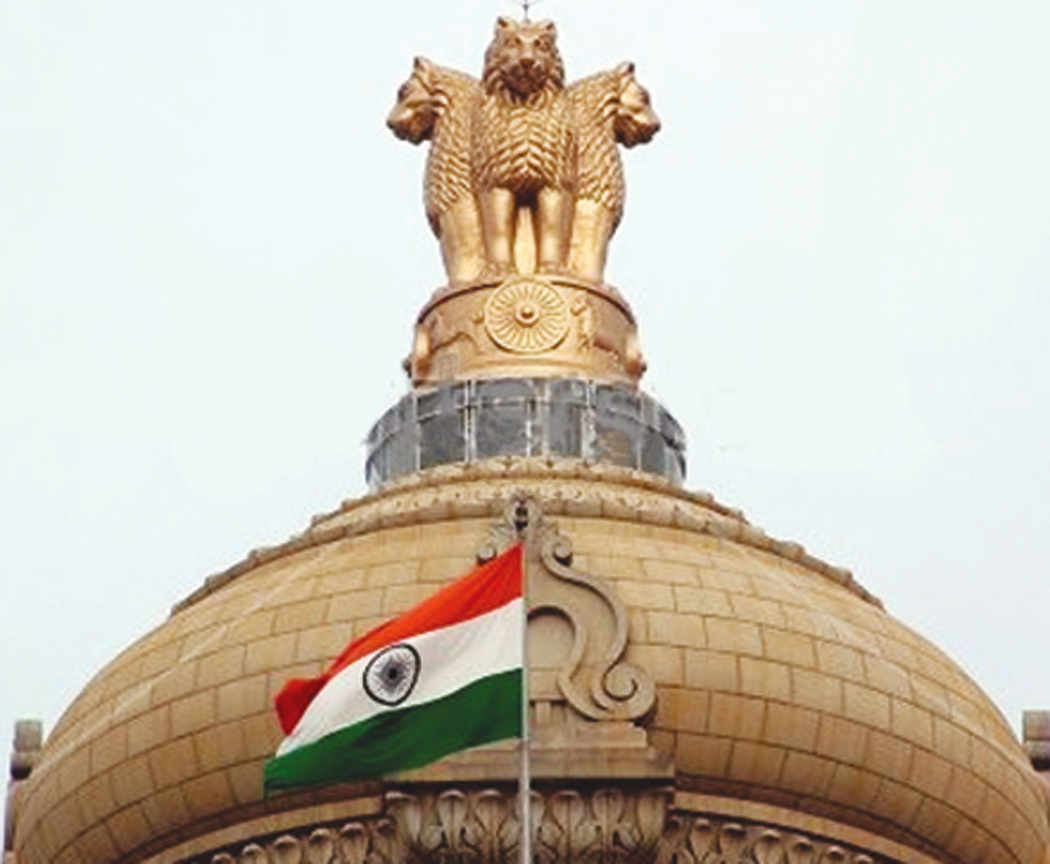
Satyameva Jayate!
By Pradeep Kumar
ITANAGAR | Aug 06 | National Emblem stands as a glowing symbol of identity and sovereignty of independent India, but are performances of its lawmakers justifying their expected role for which they are handsomely paid imposing heavy burden on state exchequer?
The motto ‘Satyameva Jayate’ meaning “The truth alone triumphs” is inscribed below the emblem. It is a quote from Mundaka Upanishad, concluding part of sacred Hindu Vedas. The lawmakers of the golden era deserve credit for this glory. But what about today’s lawmakers?
BJP Lok Sbaha member Feroze Varun Gandhi has explained it lucidly in – Wages of being a legislator – published in The Hindu on 05.08.17, advocating “We need an external, independent body to determine parliamentary salaries”.
Tamil Nadu Assembly recently voted to double the salaries of its legislators against the backdrop of a group of farmers from the state who are still on protest in New Delhi demanding that the Centre announce a drought relief package and loan waiver for farmers from the State. India pays Rs 2.7 lakh a month, which includes salaries and expenses, to every MP in 2015. Maharashtra’s Assembly passed a Bill in 2016 that raised monthly salary of its MLAs to above that of the President (Rs 1.5 lakh PM). Proposals to raise salaries of ministers and MLAs to Rs 3.6 lakh pm & Rs 2.1 lakh pm respectively have been passed by Delhi Assembly.
Skewed compensation: The idea of paying a salary has always been closely linked to remunerating public representatives. However, such remuneration can go overboard sometimes. For example, public representatives in developing countries in Africa and Asia are routinely paid far above per capita GDP. Nigeria, since 2013, pays its lawmakers over $189,500, which is more than 100 times its per capita GDP while in Kenya, its legislators get $74,500, which is 76 times its per capita GDP. Kenya’s lawmakers have, in fact, taken this to an extreme, and in 2010, Prime Minister Raila Odinga was forced to reject the pay increase awarded by the country’s Parliament. Even in developed countries such as Italy, a skewed political culture can result in high cost to the state when it comes to politicians. Italy pays $115 million annually for salaries for 630 representatives in its Lower House. An Independent Parliamentary Standards Authority, 2016 study shows that the gross salary of an Italian lawmaker is the 2nd highest among developed countries after the U.S., at 4.95 times more than the average Italian wage.
A start that faded: India’s initial start was promising. The first cabinet meeting of Jawaharlal Nehru saw the entire Cabinet take a collective decision not to avail of their salaries for six months, given the enormous economic suffering in India then. Other political giants such as Biswanath Das from Orissa (Odisha) chose to draw only Rs 25 a day instead of Rs 45 a day that he was entitled to, by saying that he did not need any more. The erstwhile Madras Assembly saw V.I. Muniswami Pillai move a successful motion in 1949 to impose a voluntary cut of Rs 5 per diem, in recognition of the suffering of farmers.
Today, parliamentary representatives have arrogated the authority to increase their own fiscal compensation by 1,250% over the last two decades — a case of questionable moral rectitude. Ideally, such allowances should be in proportion to the services that they have rendered to the nation, but in the past two decades, Parliament has seen less than 50% of Bills being scrutinised by parliamentary committees, defeating the very purpose of a deliberative Parliament. Money Bills, like those associated with Aadhaar, have been passed without being referred to a committee. The rush to pass Bills has been inspired by a priority for politics, not policy.
There are multiple templates for reformation. A survey of parliamentary salaries conducted in 2013 by Inter-Parliamentary Union (IPU) across 104 Parliaments in 138 parliamentary chambers (104 responded, 96 considered) highlighted that salaries in about 55% are linked to a structured scale, typically linked to the civil service (France, Japan) or ministerial salaries. Mature democracies typically have separate independent bodies to decide parliamentary salaries; such as Remuneration Tribunal in Australia or Independent Commission for Remuneration of Public Office Bearers in South Africa. Given the current economic slowdown worldwide, about 23.8% of Parliaments in the IPU have actually seen a reduction in salaries.
The basic annual salary of a member of the House of Commons in the U K is £74,962 with MPs receiving expenses to cover costs of running an office (£23,450–£26,100), employing staff (£141,400–£148,500), accommodation allowance for living in London (£20,610) and in their constituency and travelling between Parliament and their constituency, according to MPs’ Scheme of Business Costs and Expenses, 2016. Given a history of expense scandals, the U.K. has, since May 2010, instituted the Independent Parliamentary Standards Authority (IPSA), which is responsible for regulation and payment of expenses to Members of the House of Commons. Receipts associated with MP claims are regularly released into public record, with June 2009 release leading to a million documents and receipts relating to MP claims between 2005 and 2008 being available for public viewing.
Way forward: Instead of seeking pay in line with private sector, India’s public representatives should be paid a reasonable wage, which offers gratitude for their commitment to life as a public servant. We need an external, independent body to determine parliamentary salaries. Self-regulation is simply not enough. Salary reviews should be conducted through an institutionalised process.
It’s not that MPs should not receive or expect increments, but such increments should be determined through a transparent and accountable process. But one should not expect any salary increases, however large, to tackle the problem of corruption in our Legislative Assemblies and Parliament — an individual’s moral fibre combined with the enforcement of existing regulations and laws determines what level of corruption prevails. Despite calls for performance-linked pay, linking salaries to performance would be difficult given varying interpretations of “performance”. Would a constitutional Bill debate that leads to the Bill being rejected be deemed as non-performance?
The decline in parliamentary sittings (present Rajya Sabha member Sachin Tendulkar is a glittering example) remains a complex problem with no easy answer. This could be partially alleviated by linking salaries to a minimum attendance of parliamentary sessions. Linking lawmaker salaries to the right set of incentives and investing in the relevant institutions remains necessary to raise our parliamentary standards.
I highlighted in – Indian myth: Declining tax payers Vs rising dependants? – in 05.08.17 edition about dependants, quoting a WhatSaap message, which included 544+ MPs and over 4,000 MLAs of states besides jail inmates and illegal migrants. The dependants include the lawmakers who represent the National Emblem, a close replica of Sarnath Lion capital, which was erected by Emperor Ashoka circa 250 B.C. The Lion pillar was adopted as National Emblem of India on 26.01.1950, when nation the day it became a republican.
While income tax payers in India are a small and shrinking breed, ToI reported on 02.02.17: Out of 125 crore Indians only 1.5% (1.9 crore) pay income tax. Even among the few who do pay income tax, the disparities are huge.


 20
