
Beyond the Horizon
By Pradeep Kumar
Ashadha Purnima: each month, according to Lunisolar calendar or Purnimanta Panchang, is named on the full moon date based on the constellation in which the Moon is positioned. It is believed that on the full moon day of Ashadha month, the moon takes position in Purvashada or Uttarashada Nakshtra. If so, then that Purnima is considered very auspicious and fortunate for seeking prosperity and abundance.
According to Hindu texts, the greatest sage and author of epic Mahabharata, Maharishi Krishna Dwaipayana Vyasa or popularly known as Ved Vyas was born on Ashadha Shukla Pakhsa Purnima. That is why the day is also known as Vyas Purnima. However, this sacred day has unique link with the life of Lord Buddah.
Śuddhodana, king of Kapilavastu (present Terai plains of southern Nepal), was a Shakya leader. His Queen Maha Maya, according to Buddhist legend, was asleep in her palace under a full moon night and dreamt that a white elephant with six tusks entered her right side; means she had conceived a child who would become either a world ruler or a Buddha.
Queen Maha Maya’s conception
This was a miraculous conception and after 10 lunar months, realizing that the time of birth was near, she went to Lumbini grove outside Kapilavastu. While she stood upright and held onto the branch of a sal tree, the child came forth from under her right arm on an Ashada Purnima. He was named as Siddhartha Gautam. Seven days after his birth, she died and was reborn again in Heaven of Thirty-three Gods (Tavatimsa Heaven).
Siddhartha was born in 623 BC in Maya Devi Temple, Lumbini, located in Rupendehi district of Nepal as testified by inscription on the pillar erected by Mauryan Emperor Asoka in 249 BC. Lumbini is one of the holiest places of world’s great religion, and its remains contain important evidence about the nature of Buddhist pilgrimage centres from as early as 3rd century BC.
King Śuddhodana went to great lengths to prevent Siddhartha from becoming a sramana. He was leading a very luxurious life confined to the palace by the king; sorrow was unknown to him within the royal palace. But divine providence suddenly brought Siddhartha face to face with the harsh realities of life.
One day Siddhartha went to the royal gardens on his chariot with charioteer Channa. There he saw an old man weakened with age on the last stage of ageing. This was the first shock he received. Next he saw a diseased man, forlorn, and smitten with pest. Then he saw a dead man being carried over for cremation followed by lamenting kinsmen.
These visions brought Siddhartha face to face with the harsh realities of life. The agony of ailing humanity found an echo in his heart throb. Next Siddhartha saw a recluse, calm and serene seeking the truth of life and living a life of purity. Seeing this, thoughts of renunciation flashed in his mind which turned into deep contemplation. This sight gave him hope that he too might be released from the sufferings and resolved to follow ascetic’s example. But, on reaching the palace, he got the message that a son has been born to his wife Yasodhara. As inwardly contemplating to renounce the world, he uttered: “A fetter is set upon me”.
Siddhartha at the age of 29, leaving behind Yasodhara and infant son Rahula, quietly renounced the world in the silence of a full-moon night, which is traditionally called the Great Renunciation (Mahābhiniṣkramaṇa), to seek the truth of life and help humanity go beyond the sorrows and miseries.
Siddhartha first sought guidance of Saints Alara Kalama and Uddaka Ramaputta, and practiced meditation. But he was not satisfied with his meditative attainments knowing deep within that this is not the final truth. Thus paying obeisance to his teachers, Siddhartha left for his quest of the Supreme Truth. He reached Uruvela River Neranjara at Gaya and continued his spiritual quest there. Soon five other ascetics – Kondanna, Bhaddiya, Vappa, Mahanama and Assaji – joined him. Siddhartha started intense penance and self-mortification in the hope of liberating the mind from the shackles of the body.
The struggle continued for six long years and he became extremely weak and emaciated. He realized that self-mortification cannot lead one to truth. Intuitively knowing that Supreme Truth can be found by searching inwards, he realized that self-mortification makes the body and mind so weak that inward search become impossible. Realizing the futility of self-mortification, Siddhartha abandoned his fasts and gradually recovered his health. His five ascetic companions thinking that he has taken to a life of abundance left him.
All alone Siddhartha started his search in complete solitude. When his spiritual pursuit reached the peak, one day Siddhartha sat under a banyan tree for meditation. Sujata, daughter of a rich householder, offered him milk-rice and wished him success. Sitting cross-legged under the tree, Siddhartha made up his mind not to leave the seat till he is enlightened. He turned his mind inwards and reached various stages of meditative absorption. Cutting through all the appearances, he finally came face-to-face with the Supreme Truth. Thus, Siddhartha was enlightened at the age of 35 and became The Buddha, the Enlightened One. The banyan tree came to be known as Bodhi Tree and place as Buddha Gaya.
Lord Budha gave first sermon to Kondanna, Bhaddiya, Vappa, Mahanama and Assaji at Sarnath at a deer park once called Isipatana (now Sarnath) on a full moon day approximately 2500 years ago, setting what Buddhists call the Wheel of Dharma into motion. He had revealed the eightfold path to liberation from suffering, his four noble truths and the doctrine of impermanence of everything, including the Self.
Buddha explained that an aspirant should not follow the two extremes. The first extreme is sense indulgence and the second extreme is self-mortification. Leaving these two extremes, one should follow the Middle Path which leads to calmness and knowledge. The Middle Path consists of the Eightfold Path: right understanding, right thought, right speech, right action, right livelihood, right effort, right mindfulness and right concentration. He explained Four Noble Truths: truth of suffering, truth of arising of suffering, truth of cessation of suffering and truth of the way leading to the cessation of suffering, called Nirvana.
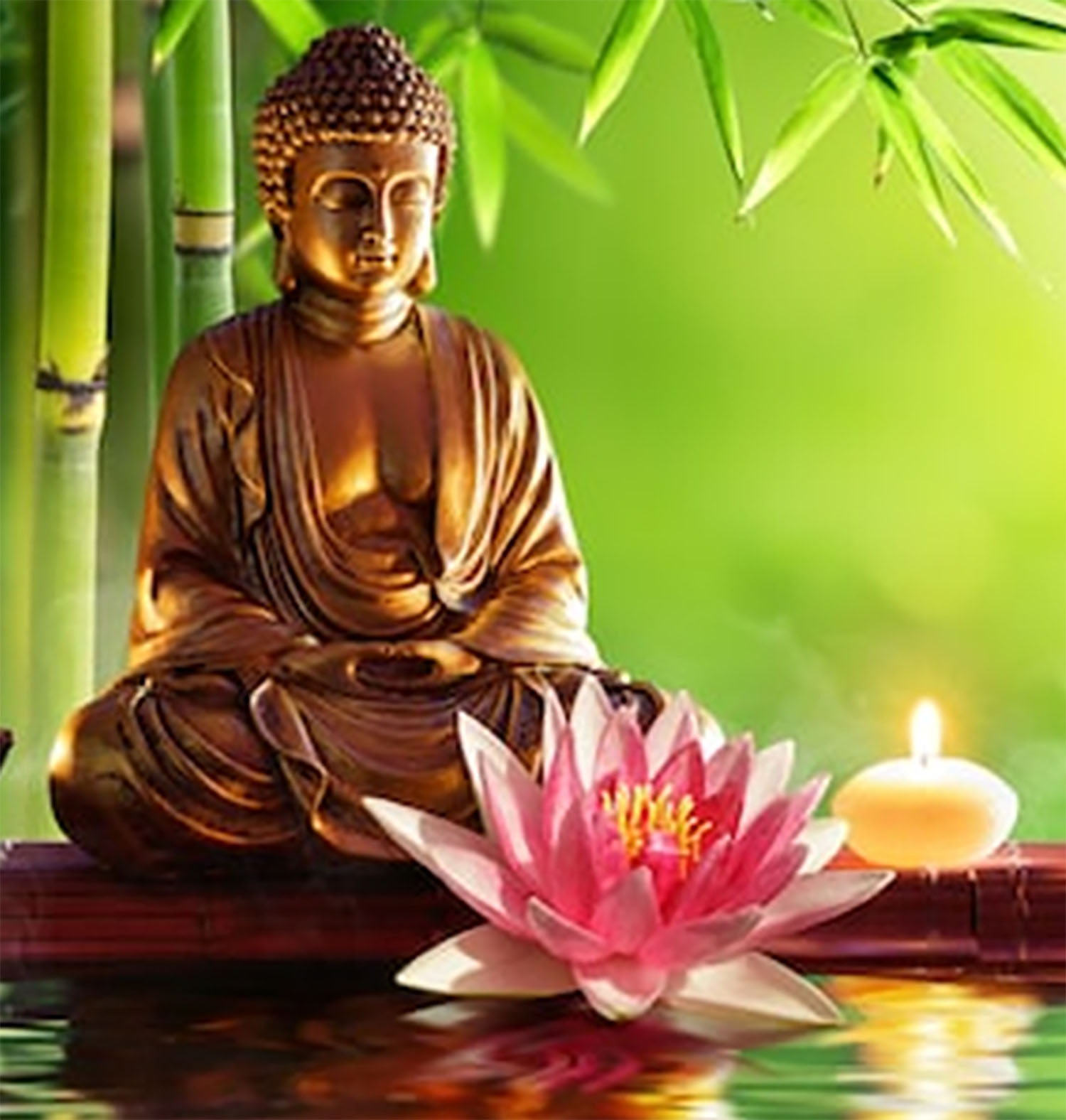
When once asked whether he was a deva or a human, he replied that he had eliminated the deep-rooted unconscious traits that would make him either one, and should instead be called a Buddha; one who had grown up in the world but had now gone beyond it, as a lotus grows from the water but blossoms above it, unsoiled. (to be continued)


 20