
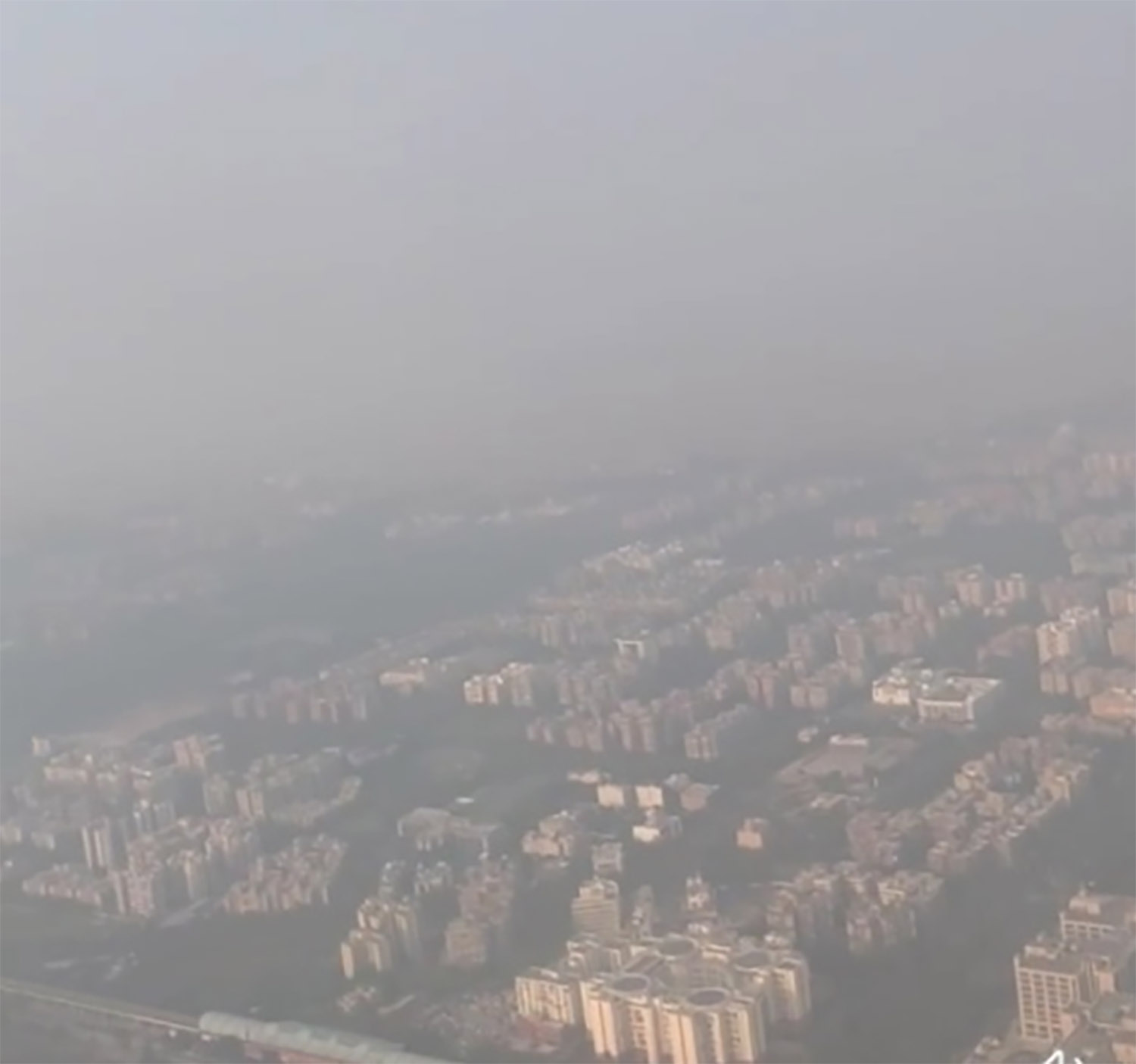
Delhi’s AQI from plane on Tuesday
By Pradeep Kumar
Beyond the Horizon
Compared to the air quality index (AQI) in March and April 2019, the same time period in 2020 saw reduced air pollution levels in many cities in India. However, the union territory of Chandigarh had the lowest average AQI at 39 during March and April 2020.
The nationwide lockdown to contain the coronavirus (COVID-19) pandemic had suspended industrial production across sectors and curbed vehicular movement throughout the country. This brought down pollution levels significantly across Indian cities. Levels of nitrogen dioxide were also reported to have fallen according to satellite imagery.
The country went into lockdown on March 25, 2020, the longest in the world, restricting movement of 1.3 billion people and again extended until May 17, 2020.
The Central Pollution Control Board (CPCB) determines the pollution level as: 51-100 (satisfactory), 101-200 (moderate), 201-300 (poor), 301-400 (very poor) and 401-500 (severe).
The possible health consequences for various categories are: minor breathing discomfort in vulnerable population in satisfactory level; breathing or other health related discomfort in vulnerable population (moderate); breathing discomfort in healthy people on prolonged exposure and breathing or other health reacted discomfort in vulnerable population on short exposure (poor); respiratory illness in health people on prolonged exposure and pronounced respiratory or other illnesses in vulnerable population on short exposure (very poor) and respiratory illness in healthy people on prolonged exposure and serious respiratory or other illnesses in vulnerable population on short exposure (severe).
Interestingly, the CPCB at 6.03 pm on Tuesday recorded AQI pollution data of 136 important cities and towns including of North East sans Arunachal Pradesh. The AQI of Shillong (22-good), Aizwal (30-good), Kohima (73-satisfactory), Guwahati (181-moderate), Agartala (329-very poor), Mumbai (156-moderate), Kolkata (265-poor) and Delhi (390-very poor).
Though Arunachal Pradesh forest cover has been reduced to 79.33% as per India State of Forest Report 2021, but still the state has second largest forest cover area-wise in the country after Madhya Pradesh followed by Chhattisgarh, Odisha and Maharashtra. In terms of forest cover as percentage of total geographical area, the top five States are Mizoram (84.53%), Arunachal Pradesh (79.33%), Meghalaya (76.00%), Manipur (74.34%) and Nagaland (73.90%).
Thus, the air AQI should be satisfactory except Capital Complex Region because of large number of vehicles and few industries. But, Arunachal Pradesh State Pollution Control Board could take up with the CPCB to record and mention the AQI of few important cities of Arunachal, like Tawang, Itanagar, Naharlagun, Pasighat and Namsai for accuracy for the researchers.


 20
