
By A O News Service
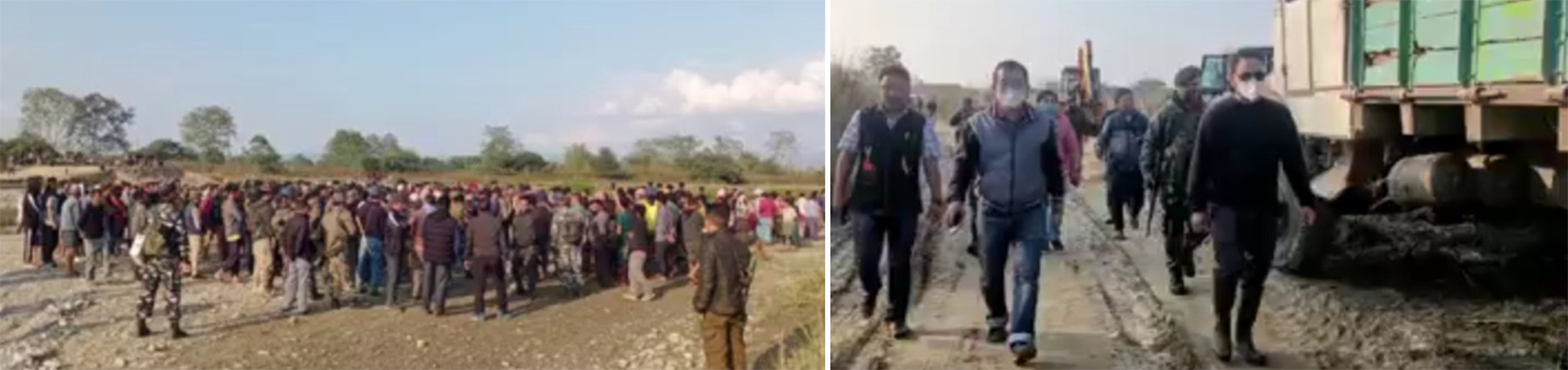
ITANAGAR, Feb 09: Over 100 Chakma refugees halted Changlang district administration on Tuesday from boundary demarcation works between Newton village and Dharamapur, a Chakma settlement area, under Miao sub-division.
The Chakams, who have been encroaching upon land and river areas, gheraoed the administrative and police officers from going forward and obstructed demarcation works, additional deputy commissioner Sunny K Singh said.
Responding to questions from media persons, the ADC said that a complaint was received from Newton villagers led by gaon burah about encroachment by the Chakmas.
“The Chakmas reportedly have been lifting stones from the river bed which has been changing its natural course and building houses on the river bank. Though there is a proposal to build protection wall of the river, but the river course has gone foraged towards Newton village as per its original map.
“Dharampur is a settlement area which was traditionally much behind its present position as per the original map. And if allowed to continue, they might capture the river and there is possibility of erosion to threaten Newton village which was also supported by water resource department data about possibility of erosion in Newton village,” he said, adding the administration intended to protect the river from encroachment.
“I had decided to restrict Dharamapur settlement area. The Chakma representatives were called, but their representation had neither any fundamental logic nor legal standing. Thus I had issued a 10-point order, including erecting 10 pillars of which four were erected today. But because of the melee, four could not be erected. Though I wanted to meet the Chakma head, I was also not allowed to go,” he said, adding “We will try again with full preparation to protect the river”.
Clarifying various allegations, particularly about demarcation of political boundary of Kathal village, he said that it was as per state Govt order. I have been doing all duties within constitutional provisions and have no comment if anybody facing any problem with ulterior intention. It is the state Govt to act now,” he added.
The Chakma and Hajong refugees were settled by the Centre in Arunachal Pradesh between 1964 and 1969. The original population was around 5,000, which reportedly rose close to one lakh now. Chakmas are primarily adherents of Buddhism, while Hajongs follow customs that are a mix of Hinduism and animism. The two communities are precarious as indigenous communities are demanding their ouster from the state.
Chakmas-Hajongs belonging to Tibeto-Mongoloid race were initially residents of Chittagong Hill Tracts of erstwhile East Pakistan (now Bangladesh). They had to flee when Kaptai dam project submerged their land, faced religious persecution and entered India through the then Lushai Hills district of Assam (now Mizoram).
Demanding that the state Govt resettle Chakmas-Hajongs somewhere else, All Arunachal Pradesh Students’ Union (AAPSU) since 1990s has been spearheading mass movements against granting citizenship to Chakmas-Hajongs. The AAPSU on December 18 last had served a 15-day ultimatum to the state Govt to conduct census of Chakmas-Hajongs and evict them from the state.
Defending the demands, AAPSU general secretary Tobom Dai had said that “the Bengal Eastern Frontier Regulation (BEFR) of 1873 and Chin Hills Regulation Act of 1896 amply protect the tribals and their rights.” He said that they are not against Indian citizenship (for Chakmas), it’s a union subject, but the refugees should not be settled here.
“We are against their continued presence in our land. The reason is simple but glaring; the demographic impact and the competition for limited resources are already rearing its ugly head,” he had said.
“According to the BEFR Act, 1873, the British framed regulations that restricted the entry and regulated the stay of outsiders in designated areas. For inward travel into any of the ‘protected’ or ‘restricted’ areas of some of these states given under Foreigners (Protected Areas) Order 1958, an official document – the inner line permit (ILP) – is required. The order also prohibits outsiders from acquiring any land in these tribal areas,” Dai had added.
“The Chakmas-Hajongs were permanently settled by the Union of India in the then NEFA during 1964-1969. The BEFR provides that ILP has to be issued to them by the deputy commissioner,” according to Chakma Development Foundation of India founder Suhas Chakma.


 20

