
- Global population up to 11,000 & Bhutan’s 600
Arunachal records
Zemithang saw 7 sacred Black-necked cranes while grazing in December 2021. Experts suspect that rising human activities in their wintering areas could scare these cranes, which would be known after learning how many arrive there in 2022.
The number of BNCs spotted year-wise in the past at Sangti — 11 (2005-06), 6 (2006-07), 4 (2007-08), none (2008-09 & 2013) and 4 (15.12.14) and at Zemithang – 3 (2009-10), 7 (2010-11), 4 (2011-12), 2 (2012-13), 5 (2013-14), 8 (23.11.14 & 15.12.14), 6 (Dec 2016), none (2017) and 2 (Dec 2018).
Beyond the Horizon
By Pradeep Kumar
The current global Black-necked cranes (BNC, Grus nigricollis) population has increased from around 7,000 to 11,000 birds since 1990 as outcome of Royal Society for Protection of Nature (RSPN), Ugyen Wangchuck Institute for Conservation and Environment Research and Bumdeling Wildlife Sanctuary (BWS), who have been tagging cranes in Bumdeling to identify migration corridors; winter, summer, breeding, and stopover sites; and habitat preference, Chhimi Dema wrote from Beijing.
In Bhutan, the crane wintering has doubled to about 600 from around 300 in 1990s because of increased protective mechanisms, conservation intervention and improved population monitoring and counting protocols.
Records with RSPN, focal agency for managing Phobjikha Conservation Area, show that little was known about the cranes in Bhutan before the efforts of Dasho Paljor Jigme Dorji in Phobjikha Valley in 1986.
Recognising the importance of the habitat for wintering cranes, Phobjikha valley was designated as a conservation area in 1999. The BWS was set up in 1995 to protect the BNC habitat in the east.
The BNC cranes are listed under protected bird species in Forest and Nature Conservation Act of Bhutan 1995 and Forest and Nature Conservation Rules of Bhutan 2017.
The forest & park service department and the RSPN developed a five-year action plan (2020 to 2024) for BNC conservation in Bhutan. A MoU was signed between the department and the RSPN to promote biodiversity and ecosystem conservation through collaboration in the field of species and habitat, water resource management and research, Drma’s records say.
Mythology: Cranes have long been revered by human civilisations for their grace and beauty. The leggy, water-loving birds are intertwined with myths from as far away as North America and as close as Ladakh. In Roman stories, the dance of the cranes — part of their elaborate courting ritual — is seen as a celebration of love and joy. The BNCs mate for life or until the death of one partner.
In China, their movements have inspired timeless kung fu moves still practiced even today. (Remember Master Crane from Kung Fu Panda?) Japanese culture considers the crane a holy creature, alongside the dragon and tortoise, symbolic of happiness and eternal youth. The crane finds expression in many styles of origami, and it is said that one who folds a thousand origami cranes will be granted a wish by the bird.
The BNC is no different and the only alpine species of crane in the world which are found in the higher altitudes of China, India and Bhutan, and are celebrated in each of these cultures. Their status has been declared Vulnerable by the IUCN.
The BNCs come to Changthang Plateau of Ladakh for breeding in summer months where they are considered symbols of good luck. These birds fly to Bhutan; Sangti valley in West Kameng district, Zemithang and Chug Valley in Tawang district of Arunachal Pradesh in winter, where they are locally known as Thung Thung Karmu, and have inspired songs and festivals. Tibetan Buddhism considers the BNC an embodiment of the Sixth Dalai Lama.
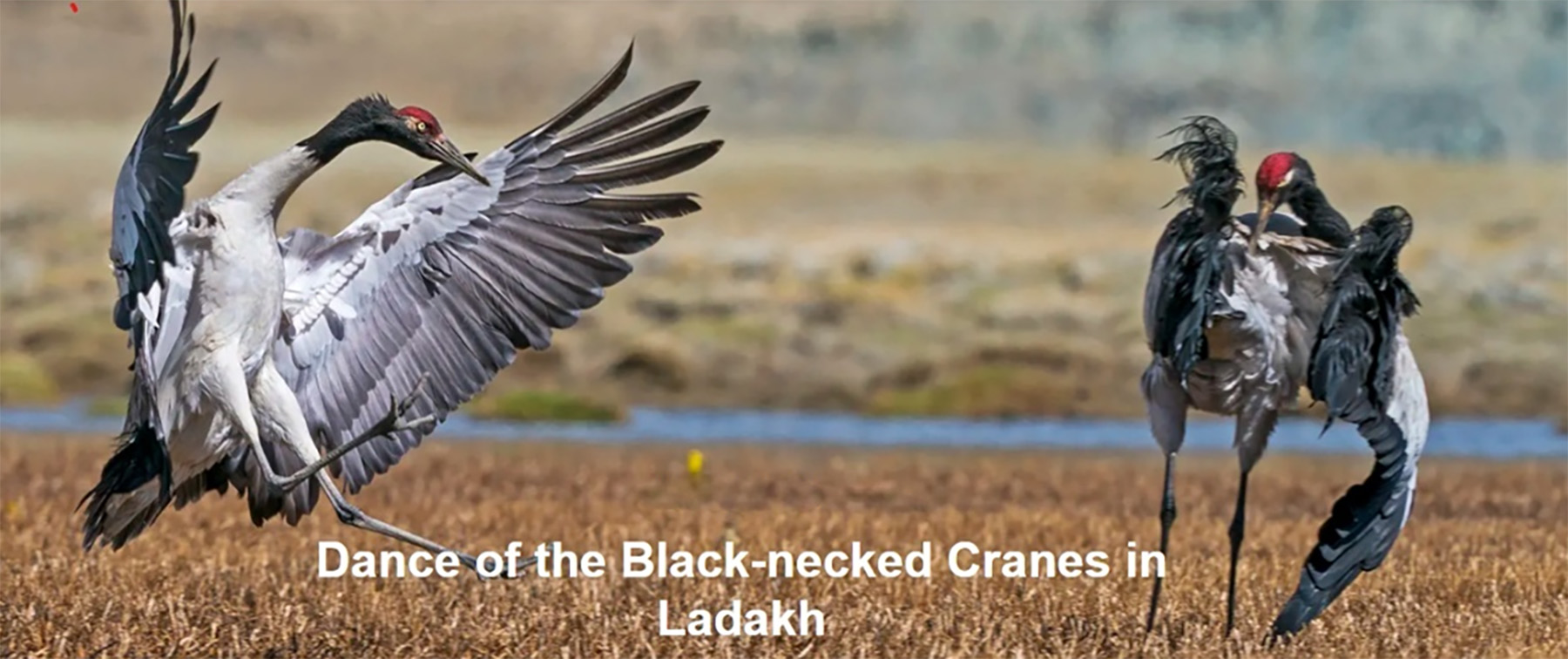
One of the reasons this species is so venerated is because of its spectacular rituals. The BNCs engage in wonderful courting displays involving song and dance before breeding season. Considering adult birds are over a metre tall, it is quite a sight to witness. The sense of awe they evoke may be magnified by their migratory nature. Black-necked cranes travel annually between their breeding habitat, and non-breeding (or wintering) habitat, spending around six months in each location.
Shortly after their arrival, the birds establish territories, and courtship spectacle begins. The cranes flap their wings, make vocal sounds, and move in a manner that resembles a dance. “It is a wonderful sight to observe,” says Dr Pankaj Chandan, wildlife biologist and an expert on Himalayan ecology who has been studying these cranes for over two decades. “Sometimes, the male will throw small bits of yak dung into the air, when the female approaches.”
During this delicate time, both partners share domestic duties. At night, females incubate the eggs, while males watch for predators. When dawn breaks, the males take foraging trips. Upon their return they switch places, and the males incubate the eggs, while females forage for fish, lizards, and vegetation in the vicinity of the nest. Females do not let the nest out of their sight during this phase. Once the chick hatches, generally in June, both parents hunt for their young, “cutting the food into small pieces, so it’s easier to eat,” says Dr Pankaj. “A lot like human parents, actually.” On cold windy nights, mothers hide the chicks in their feathers for warmth. Interestingly, the chicks are expert swimmers, though parents do not swim at all.
At two months of age, flight school begins. Days are spent teaching the young to take-off and land safely. Lessons are arduous for the young fledglings, but a joy to watch as nesting sights are filled with parents teaching their fuzzy, gangly chicks how to fly. This continues until September, with birds taking short foraging trips nearby, and eventually, longer flights to other valleys. Practice is crucial, for by October the young ones must migrate with the parents to their wintering grounds. “When we see the birds flying high in the sky, we know that they will be leaving soon,” says Dr Pankaj.
Six months later, when summer is around the corner, the birds begin their annual migration back to Ladakh and parts of China. They return as family units, but upon arrival, the parents cease caring for the young. “In some cases, they push them out of their territory,” Dr Pankaj says. The young adults must fend for themselves now. They begin their own courtship dances to find a mate, territory, and eventually to build a family of their own, like this solitary crane perched on his nest at Tso Kar. (Continues)


 20

