
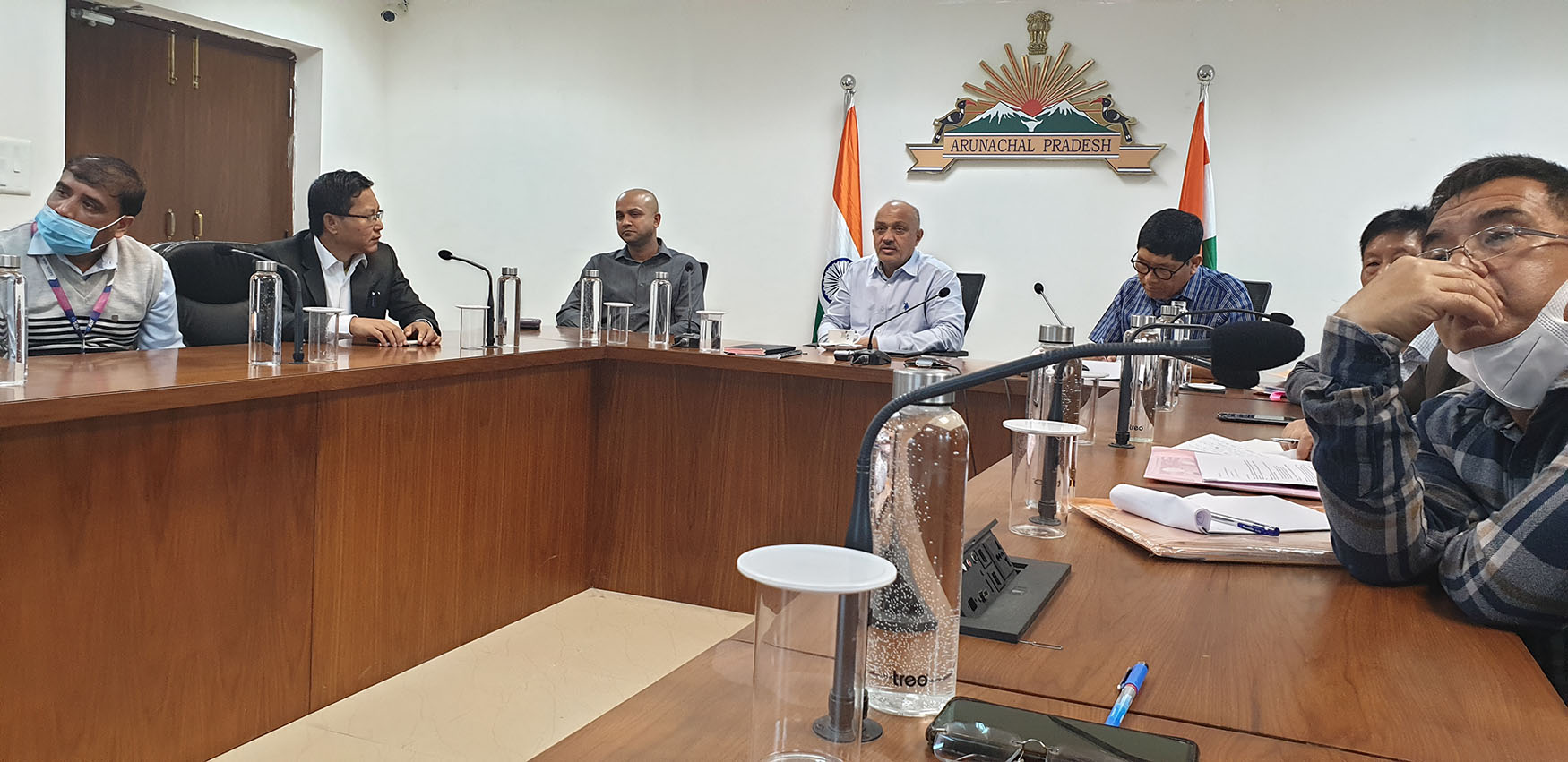
- CS convenes meet on Jal Jeevan Mission
ITANAGAR, Mar 31: The state government has decided to make the lone process for the Atma Nirbhar Krishi Yojana (ANKY) and Atma Nirbhar Bagwani Yojana (ANBY), online, from next financial year onwards, to facilitate the beneficiaries including financial institutions involved in implementation of the schemes.
A meeting in this regard was convened by state Chief Secretary Naresh Kumar on Thursday, in presence of the Agriculture and Horticulture Secretary Bidol Tayeng, IT Secretary Anirudh Singh and others to discuss the modalities, officials informed.
From the financial year 2022-23, the eligible beneficiaries for both the schemes would be able to submit their applications online and avail government subsidy, the officials said.
The government has asked a vendor to develop the software who would present the prototype of the software on April 11 next and the final launch of the online portal has been fixed on April 15 this year.
The chief secretary said that with the launch of the software, the delays and confusions in the loan process would be minimise and subsidies would be credited to the accounts of the beneficiaries on time.
A group of senior officers from NIC, IT, Agriculture and Horticulture along with senior consultant of CM Dashboard N Yadav will oversee the operation of the software on daily basis.
Once such digital platform is developed and commissioned, it would be used for such front end subsidy schemes including in the sectors of fisheries, animal husbandry & veterinary and plantation, the officials added.
The state government had on September last year, launched the two ambitious schemes, ‘Atma Nirbhar Krishi Yojna’ for the agriculture sector and ‘Atma Nirbhar Bagwani Yojna’.
Both ANKY and ANBY are credit-linked schemes to boost agriculture and horticulture sectors and to ensure doubling of farmers’ income, with a plan outlay of Rs 60 crore each for both the schemes during the 2021-22 Budget.
The schemes are unique as both are based on front-ended subsidies with components of 45 per cent government subsidy, 45 per cent bank loan and ten per cent to be borne by the beneficiary.
The credit link for the schemes would be provided to the beneficiaries by SBI, Arunachal Pradesh Rural Bank and Arunachal Pradesh Cooperative Apex Bank.
In this year’s Budget, the state government had announced to extend the scheme to fisheries, animal husbandry & veterinary and plantation sectors with adequate funding.
Meanwhile, the 16th apex committee on State Water & Sanitation Mission (SWSM) meeting under the Jal Jeevan Mission (JJM) was held under the chairmanship of Kumar on Thursday.
Manoj Kumar Sahoo Director (JJM-I), under union Jal Shakti ministry, participated in the meeting virtually.
Jal Jeevan Mission is one of the most ambitious programmes of the Centre envisioned to provide safe and adequate drinking water through individual household tap connections by 2024 to all households in rural India.
However, in a major push for the people, the state government has taken it upon the challenge to achieve the target by March 31, next year, a year ahead of the national target of 2024 to provide Functional Household Tap Connection (FHTC) across the state.
Kumar thanked the ministry for its continued support to the state in implementation of the Jal Jeevan Mission which has resulted in the achievement of 38.07 per cent as compared to the national Average of 21.07 per cent (Har Ghar Jal Village) and FHTC coverage of 64.54 per cent as compared to the national Average of 48.40 per cent.
The CS informed the Director that the state government is committed to provide safe and adequate drinking water through individual household tap connections by March 31, 2023.
Going by the pace of the current coverage of the Jal Jeevan Mission, Kumar suggested that the PHE & WS department should set December 31 this year as the new target for achieving 100 per cent coverage under the JJM in Arunachal Pradesh.
It was decided that the members will meet every 45 days to review the status of the JJM.
The CS while reviewing the physical plan and achievement of 2021-22 of the Jal Jeevan Mission felt that there is a dire need of a serious action plan with regard to drinking water supply connections at schools and Anganwadi centres.
Total number of Schools to be connected with wWater supply is 697, and 2277 Anganwadi Centres are yet to be connected with drinking water supply.
Kumar further directed the PHE & WS and PRI departments to explore the possibility of adopting similar projects like that of the Egam Basar Nature Project on source rejuvenation in the districts. (PRO)


 20
