

Beyond the Horizon
By Pradeep Kumar
Field Marshal Sam Hormusji Framji Jamshedji Manekshaw, widely known as Sam Manekshaw or Sam Bahadur, was Chief of Army Staff (CoAS) during 1971 Indo-Pak War, had visited North East India.
“Gen Manekshaw in 1971 had visited 3 JAK Rifles at Jalep La Pass in Chumbi valley that connects Sikkim with Tibet capital Lhasa. However, as 4 Corps General Officer Commanding (GOC) in 1963, he had visited my independent company post at Taliha in Subansari sector. I was the youngest officer in my unit of 2 JAK Rifles as I was commissioned on 10.06.1962 and commanded the company as 2/Lt in 1962 War due to shortage of officers,” recalls Col (Retd) Amar Patil.
“Gen Manekshaw was visiting Subansari sector after taking over 4 Corps and landed at my post. I was asked by commanding officer to stay away from him. But as he was visiting my post, I decided to receive him. He arrived by chopper and was to stay for 15 minutes. However, he spent more than an hour at the post, shook hand with me, talked to me on various matters making me totally easy. My Company had Gorkhas for which I served him with Gorkha special snacks with tea. He was quite happy when he left the post.
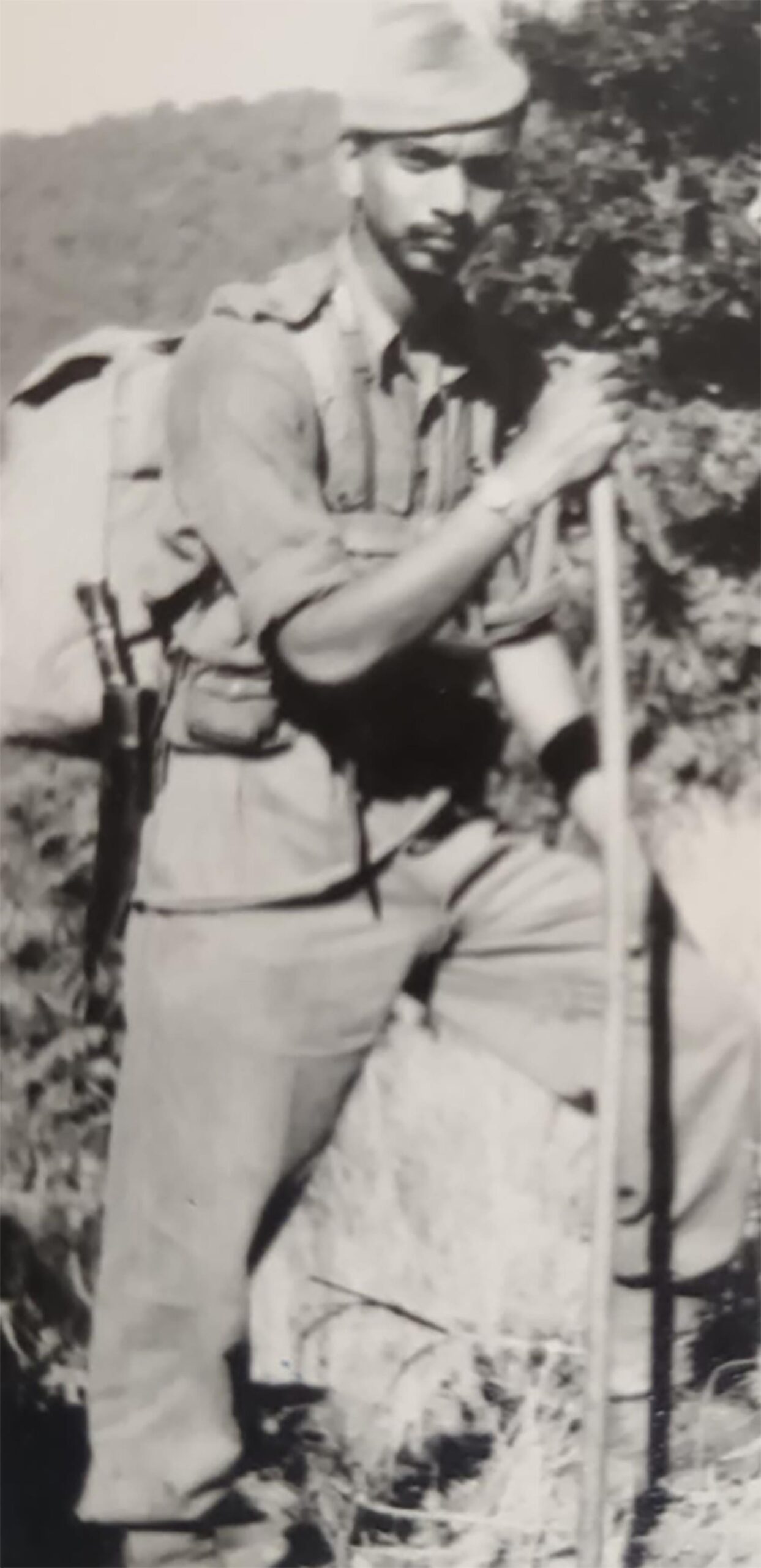
2/Lt Patil in Subansiri sector during 1962 War
“Later I met him at Lucknow after 1971 War when he came to HQ Central Command along with PM Indira Gandhi to celebrate Bangladesh Liberation War victory. He attended the party in the mess. After arrival he left all VIPs and spent time mingling and talking with young officers,” added Col (Retd) Patil, the officer under whose command rifleman Shere Thapa of 2 JAK Rifles had killed 155 PLA jawans in Tama Chung ridge of Arunachal Pradesh on 18.10. 1962.
Manekshaw’s active military career spanned four decades and five wars, beginning with service in British Indian Army in World War-II. He had joined Indian Military Academy, Dehradun in first batch in 1932 and commissioned into 4th Battalion of 12th Frontier Force Regiment.
In World War II, he was awarded the Military Cross for gallantry. Following partition of India in 1947, he was reassigned to 8th Gorkha. He was given a vital role to plan during 1947 Indo-Pak War and Hyderabad Crisis, as a result, he never commanded an infantry battalion. He was promoted to the rank of brigadier while serving in military operations directorate. He became commander of 167 Infantry Brigade in 1952 and served till 1954 before taking over as Director of Military Training of Army Headquarters.
After completing the higher command course at Imperial Defence College, he was appointed 26th Infantry Division GOC. He also served as commandant of Defence Services Staff College, among various other postings.
Former lieutenant general J.F.R. Jacob writes in his book An Odyssey in War and Peace that “the principal movers in the campaign against Manekshaw then were Defence Minister V K Krishna Menon and his protégé Lt Gen. B M Kaul. Kaul considered Manekshaw to be a potential rival”.
Manekshaw had a habit of being overly critical of the Govt, which irked the political brass. Three charges were levied against him. First, that he was disloyal to the country because he had hung pictures of British viceroys and governor generals in his office, instead of Indian leaders.
Second, he had failed to take action against a military instructor who had made disparaging remarks against Indians. Even though Manekshaw had told the instructor to be more careful, it was argued that he should have taken a more serious approach.
Third, Manekshaw had made certain derogatory remarks himself about fellow officers’ wives. The officer who had made the allegations, however, told the court of enquiry that he had neither heard Manekshaw make the remark nor could he recall who had told him about it.
After being exonerated by court of inquiry, he took command of IV Corps in November 1962. Indian debacle that followed in the 1962 War against China, however, saved Manekshaw, to speak. Menon and Kaul had to resign, and Manekshaw was given command of 4 Corps.
In 1963, he was promoted to commander rank and took over Western Command and transferred to Eastern Command in 1964. He had commanded troops at divisions, corps and regional levels smoothly till appointed as 7th CoAS by PM Indira Gandhi in July 1969. Under his command, Indian forces conducted victorious campaigns against Pakistan in 1971 Indo-Pak War, which led to creation of Bangladesh in December 1971.
In his role as CoAS, Manekshaw made history not only by guiding India to victory in Bangladesh Liberation War, but also by resisting the political pressure to intervene at an inopportune time, going even to the extent of offering to resign.
Despite his differences with him, J.F.R. Jacob writes, “He did more than any other CoAS to maintain the dignity of the army” and always stood up against the bureaucracy when necessary.
Field Marshal: In January 1973, the month of his retirement, Manekshaw was appointed as Field Marshal — a largely ceremonial rank, but reflective of his stature in Indian armed forces history.
He was first to be promoted to this rank and other Field Marshal is General Kodandera Cariappa, who received it in 1986.
He was awarded Padma Vibhushan and Padma Bhushan, the 2nd and 3rd highest civilian awards of India. Born on 3rd April 1914, he passed away on 27th June 2008.


 20

