

- 63 million poor and 119 billionaires in most unequal nation
By Pradeep Kumar
Beyond the Horizon
“India, one of the most unequal countries in the world, stands out as a “poor and very unequal country, with an affluent elite”, where the top 10% holds 57% of the total national income, including 22% held by the top 1%, while the bottom 50% holds just 13% in 2021, according to World Inequality Report 2022 of 10th December, 2021.
Inequality has been rising sharply for the last three decades. The richest have cornered a huge part of the wealth created through crony capitalism and inheritance. They are getting richer at a much faster pace while the poor are still struggling to earn a minimum wage and access quality education and healthcare services, which continue to suffer from chronic under-investment. These widening gaps and rising inequalities affect women and children the most.
Extreme inequality: “What is particularly worrying in India’s case is that economic inequality is being added to a society that is already fractured along the line of castes, religion and gender,” say Jawaharlal Nehru University Prof Himanshu.
Eight inequalities beat poverty
1%: The top 10% of Indian population holds 57% of total national wealth. According to OXFAM International, 73% of wealth generated in 2017 went to the richest 1%, while 67 million Indians comprising the poorest half of the population saw only a 1%.
70 millionaires: There are 119 billionaires in India, whose number increased from only 9 in 2000 to 101 in 2017. Between 2018 and 2022, India is estimated to produce 70 new millionaires daily.
10 times: Billionaires’ fortunes increased by almost 10 times over a decade and their total wealth is higher than the entire Union budget of India of Rs 24,422 billion for 2018-19 fiscal year.
63 million: Many ordinary Indians are not able to access the health care they need. 63 million of them are pushed into poverty every year because of healthcare costs, almost two people every second.
941 years: It would take 941 years for a minimum wage earner in rural India to earn what the top paid executive at a leading Indian garment company earns in a year.
Healthcare as luxury: While Indian Govt barely taxes its wealthiest citizens, it’s spending on public healthcare ranks among the lowest in the world. In place of a well-funded health service, it has promoted an increasingly powerful commercial health sector.
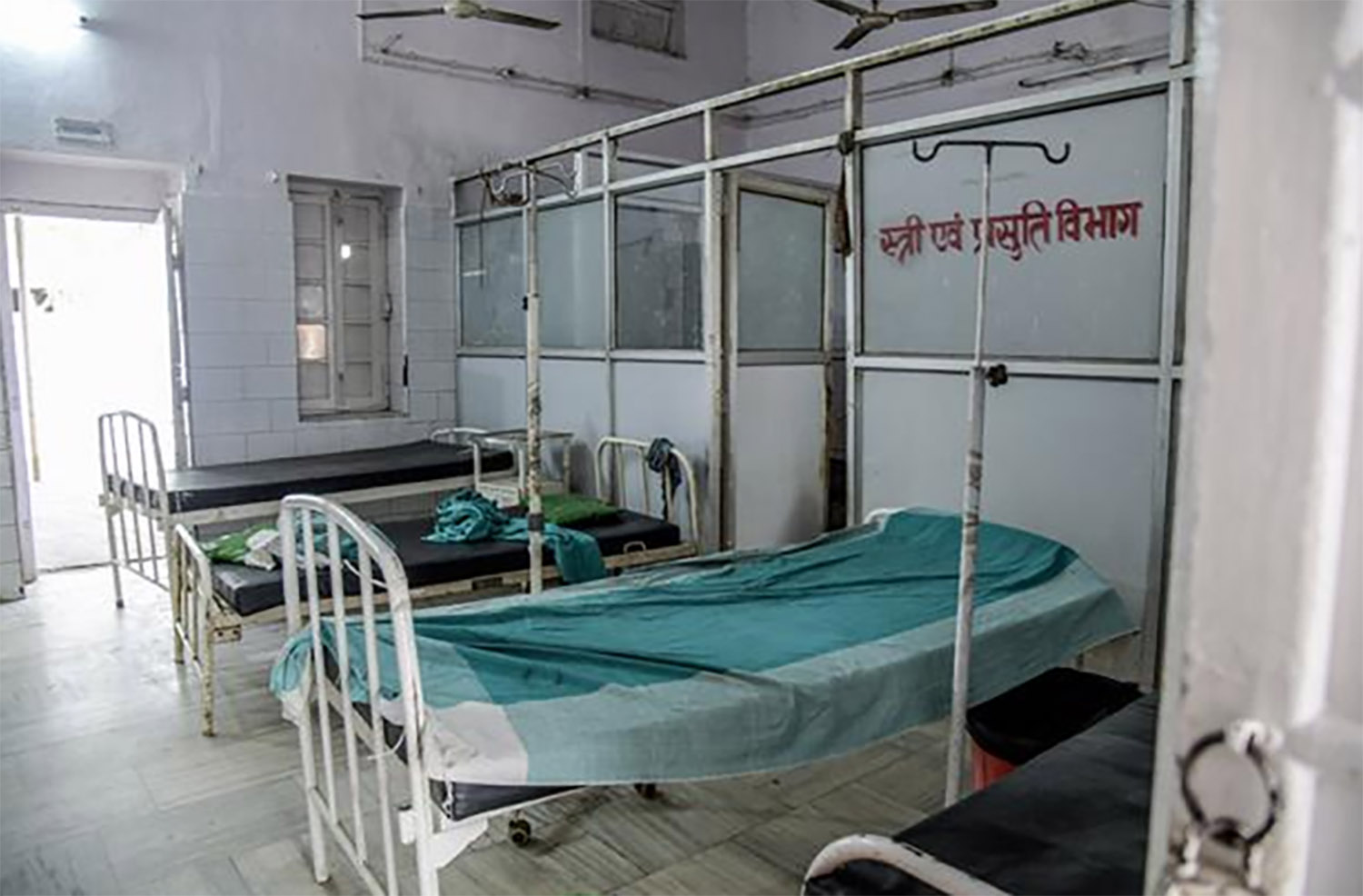
A ward in the department of obstetrics at Gardanibag Hospital in Bihar’s capital Patna is an example. In this deprived, densely populated eastern India state, the public health system is failing the poorest people living in city slums. There aren’t enough health centers to serve everyone and the facilities that exist are ill-equipped and under-staffed. The poorest people have no other option as they cannot afford the private health services available in the area.
Chhatiya is a young mother who lives in an urban slum in Patna. With her husband they were forced into debt to pay private healthcare fees for their new-born son when the public clinic was unable to provide the care he needed.
India is a developing nation with its economy is growing and poverty is still a major challenge but on the decline. According to an International Monetary Fund paper, extreme poverty, defined by the World Bank as living on US$1.9 or less in purchasing power parity (PPP) terms, in India was as low as 0.8% in 2019 and the country managed to keep it at that level in 2020 despite unprecedented COVID-19 outbreak. According to United Nations Development Programme administrator Achim Steiner, India lifted 271 million people out of extreme poverty in a 10-year time period from 2005-2006 to 2015-2016. A 2020 study from World Economic Forum found “Some 220 million Indians sustained on an expenditure level of less than Rs 32/day, poverty line for rural India, by last headcount of the poor in India in 2013.”
The World Bank has been revising its definition and benchmarks to measure poverty since 1990–1991, with a $0.2 per day income on purchasing power parity basis as the definition in use from 2005 to 2013. Some semi-economic and non-economic indices have also been proposed to measure poverty in India. For example, in order to determine whether a person is poor, Multi-dimensional Poverty Index places a 13% weight on the number of years that person spent in school or engaged in education and a 6.25% weight on the financial condition of that person.
Different definitions and underlying small sample surveys used to determine poverty in India have resulted in widely varying estimates of poverty from 1950s to 2010s. In 2019, the Indian Govt stated that 6.7% of its population was below its official poverty limit. 80 million people out of 1.2 billion Indians, roughly equal to 6.7% of total population, lived below the poverty line of $1.25 in 2018–19 based on 2019’s PPPs International Comparison Programme, according to United Nations Millennium Development Goals (MDG).
Since late 19th century through early 20th century, poverty in India intensified under British Raj peaking up in the 1920s. Famines & diseases killed millions in multiple vicious cycles throughout the 19th and early 20th centuries. After India gained its independence in 1947, mass deaths from famines were prevented. Since 1991, rapid economic growth has led to a sharp reduction in extreme poverty. However, those above the poverty line live a fragile economic life. As per methodology of Suresh Tendulkar Committee report, the population below the poverty line 354 million (29.6%) in 2009-2010 and 69 million (21.9%) in 2011–2012. The Rangarajan Committee in 2014 said that the population below the poverty line was 454 million (38.2%) in 2009–2010 and was 363 million (29.5%) in 2011–2012. Deutsche Bank Research estimated that there are nearly 300 million people who are in the middle class. If these previous trends continue, India’s share of world GDP will significantly increase from 7.3% in 2016 to 8.5% by 2020. In 2012, around 170 million people or 12.4% of total population, lived in poverty (with Rs 123.5), an improvement from 29.8% in 2009. In their paper, economists Sandhya Krishnan & Neeraj Hatekar conclude that 600 million people or more than half of total population belong to the middle class.
The Asian Development Bank estimates India’s population to be at 1.28 billion with an average growth rate of 1.3% from 2010 to 2015. In 2014, 9.9% of the population aged 15 years and above were employed. 6.9% of the population still lives below the national poverty line and 63% in extreme poverty (December 2018). The World Poverty Clock shows real-time poverty trends in India, which are based on the latest data, of the World Bank, among others. As per recent estimates, India is well on its way of ending extreme poverty by meeting its sustainable development goals by 2030.


 20
