
Beyond the Horizon
By Pradeep Kumar
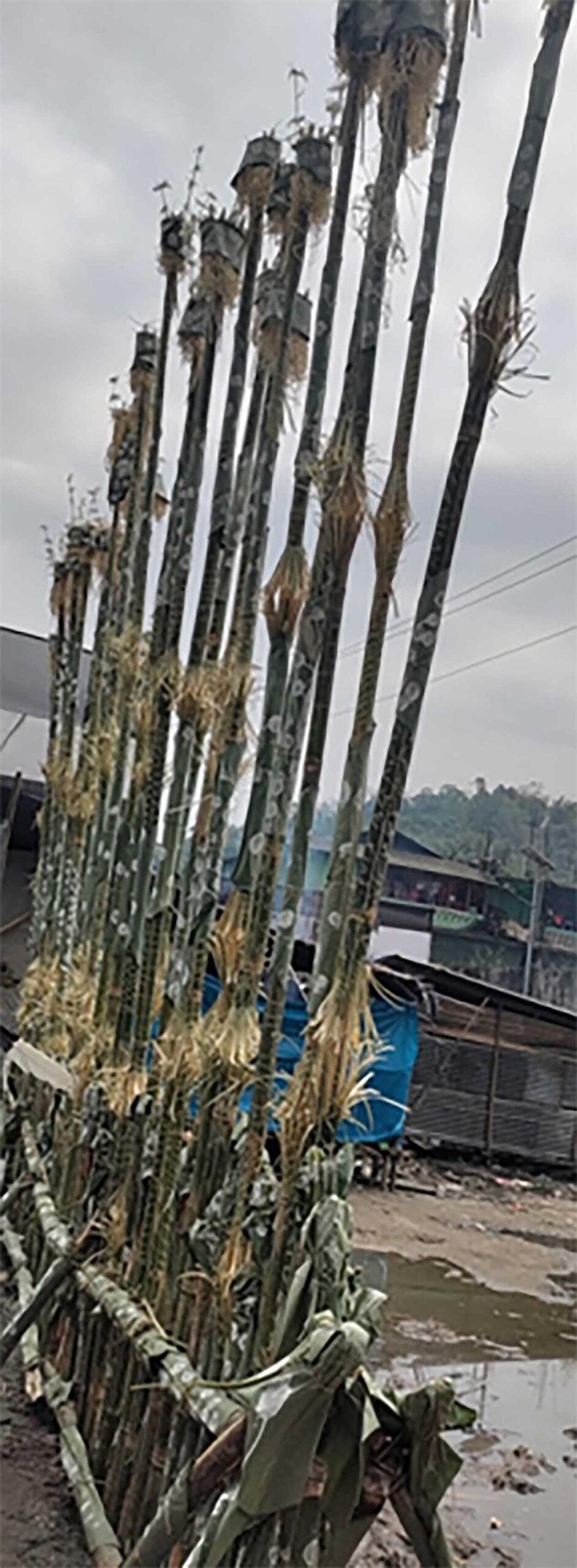
Longte, the unique festival of the ‘Land of Festival’, was celebrated recently across Arunachal Pradesh, particularly in Nyish dominated areas, to install barricades to protect all evil spirits from venturing into human inhabited areas and facilitating bumper crops for them to leave happily.
 The ‘Longte’ concept was born with the birth of human civilization, said social activist Lokam Nai, adding if one watches any dwelling house carefully would realise it.
“The doors and windows of every house mostly have mosquito fencing. The piggery and fishery, common practices of indigenous people, have either fencing or boundary,” he said, adding there is no need to explain the reasons. He was talking to this daily during celebration of the festival at Niakum Niya ground here on April 16.
Agriculture & Horticulture Minister Tage Taki, as chief guest, had recalled that “local tribal people had voluntarily barricaded their villages across the state with only one entry point during severe first and second wave of COVID-19 pandemic. This had intended to ensure that anyone infested by the killer virus never enters the respective village to infect others.”
They both are right as human evolutionary process of primates as recorded in history led to emergence of Homo Sapiens as a distinct species of hominid family, which includes the great apes. Its study involved several scientific disciplines, while genetic studies show that primates diverged from other mammals about 85 million years ago, in late Cretaceous period and the earliest fossils appear in Paleocene, around 55 million years ago. Anatomically modern humans appeared in Africa approximately 3,00,000 years ago.
All life on Earth shared a last universal common ancestor (LUCA) that lived approximately 3.5–3.8 billion years ago. Evolutionarily biologists have continued to study various aspects of evolution by forming and testing hypotheses as well as constructing theories based on evidence from the field or laboratory and on data generated by mathematical and theoretical biology methods. Their discoveries have influenced not just the development of biology but numerous other scientific and industrial fields, including agriculture, medicine and computer science.
However, cultivated lands are without any fencing in Punjab but cattle are strictly prohibited with provision of penalty for violation. State agriculture department offers the best example:
“Siwaliks in Hoshiarpur and Ambala enjoy a collar climate and a more abundant rainfall, but due to destruction by unrestricted and unlimited goat grazing till 1902 in Hosiarpur and till 1915 in Ambala the low hills were totally eroded resulting in thousands of acres in plains below getting reduced to utter sterility.
“Gazing of cattle might be prohibited or regulated, provided that proper grounds for grazing of such cattle be not interfered with. The penalty for a breach of the rules was not exceeding Rs. 100 or in default imprisonment for a term not exceeding three months (Rule 12)”, as per notification No. 816, dated 23.12.1908.
This clearly proves that ‘Longte’ or fencing, physically or imposed by community, is an age-old concept continuing since time immemorial. (Pic: Bamo Sakter)


 20
