
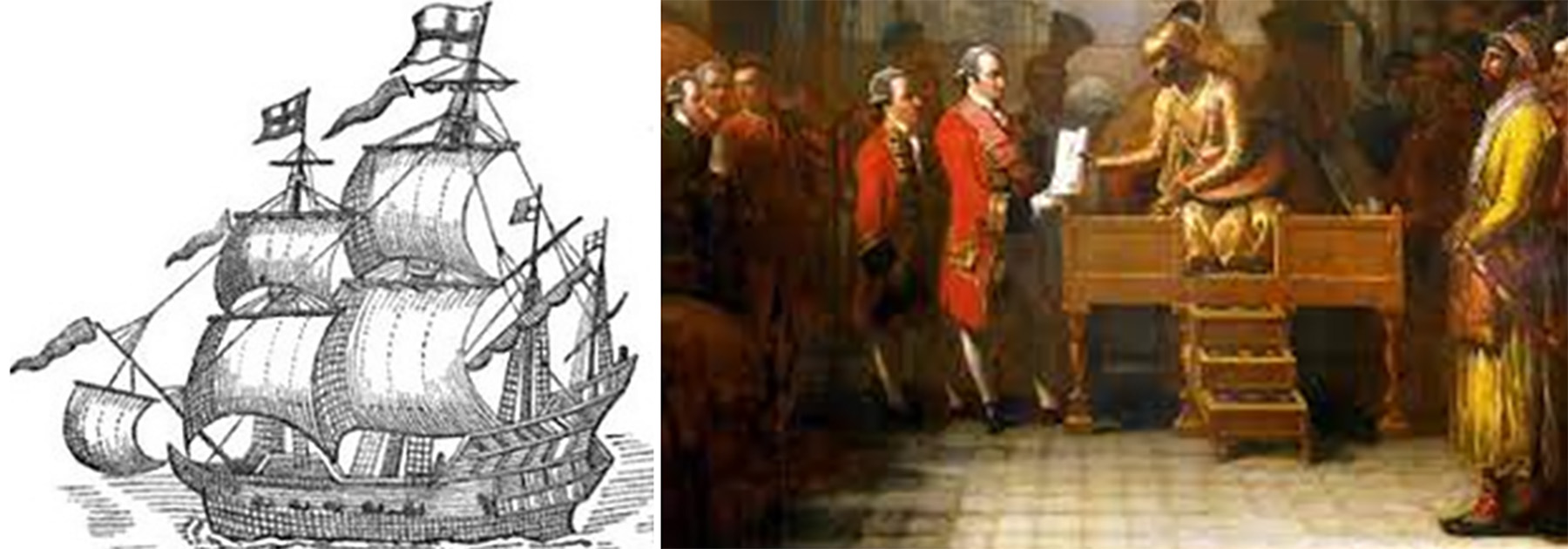
EIC landed at Kolkatta on ship Red Dragon; Shah Alam-II granting Diwanship to Lord Clive
- Traders turn India’s lord & rulers for 190 years
Beyond the Horizon
By Pradeep Kumar
Another record claims that the EIC had reached Balasore and set up a factory there in 1633 while Trieste Company merchants set up a trading post there in 1719. Sea route was prominent transportation mode then, but the EIC soon realized that Chandipur was not navigable as water of the shore recedes up to 5-km twice a day during the ebb tide.
Intelligent Britishers having farsightedness to overcome such situation soon found that Hugli River, an arm of the Ganges (Ganga) River, provides access to Kolkata from the Bay of Bengal. As Calcutta rose in importance, Balasore became the center for river pilot services for vessels seeking to ascend the Hugli River.
Interestingly, the EIC forces had bombarded Balasore during Anglo-Mughal War in 1686 but were repulsed by Mughal forces. The Marathas then occupied this part of Odisha to become part of dominion of Bhonsle Maratha Rajas of Nagpur. They ceded this part under Treaty Deogaon in 1803 to become part of British Bengal Presidency until 1912. Balasore as a separate district was created in October 1828 under Bengal Presidency. On 07.11.1845, all of Danish India was sold to the British to form a part of British India.
However, on 22.09.1599, a group of merchants met and stated their intention “to venture in the pretended voyage to the East Indies (the may please the Lord to prosper)”, and the sums that they will adventure, committing £30,133 (over £4,000,000 now).Two days later, “the Adventurers” reconvened and resolved to apply to the Queen for support of the project. Although their first attempt had not been completely successful, they nonetheless sought the Queen’s unofficial approval to continue. They bought ships for their venture and increased their capital to £68,373.
The Adventurers convened again on 31.12.1600 and succeeded; the Queen granted a Royal Charter to George Earl of Cumberland and 215 Knights, Alderman and Burgesses under the name Governor and Company of Merchants of London trading into the East Indies. For a period of 15 years, the charter awarded the newly formed company a monopoly on English trade with all countries east of the Cape of Good Hope and west of the Straits of Megellan. Any traders in breach of the charter without a licence from the company were liable to forfeiture of their ships and cargo (half of which went to the Crown and the other half to the company), as well as imprisonment at the “royal pleasure”.
Scourge of Malice or Malice Scourge or Mare Scourge, a 38-gun ship ordered by George Clifford, 3rd Earl of Cumberland, built and launched at Deptford Dockyard in 1595, was later renamed Red Dragon. Sir James Lancaster commanded the first EIC voyage in 1601 aboard the Red Dragon. After capturing a rich 1,200 ton Portuguese carrack in Malacca Straits, the trade from the booty enabled the voyagers to set up two “factories” – one at Bantam on Java and another in the Mouluccas (Spice Islands) before leaving. They returned to England in 1603 to learn of Elizabeth’s death but Lancaster was knighted by the new king James-I. Sir Henry Middleton commanded 2nd voyage in March 1604 with General William Keeling as captain. Keeling led the third voyage aboard the Red Dragon from 1607 to 1610 along with Hector under Captain William Hawkins and Consent under Captain David Middleton.
On reaching Kolkata, a Britisher had asked en illiterate Benglai man: What is the name of this place? “The inquisitive man, who had cut a tall tree in his house premises a day earlier (kal), could not understand but guessed the Britisher might have asked about the tree. The man had promptly replied kal kata (means I had cut the tree yesterday). The Britisher thought kal kata (Kolkata). That was how the name of Calcutta or Kolkata had emerged,” a state police personnel serving in Banderdewa Police Training Centre (PTC) said on Monday.
In 1698, the EIC had bought three praganas – Sutanuti, Kolkata and Gobindapur from their landlords and merged them to form Kolkata and set up ECI headquarters there, followed by establishing industrial plants in these villages to transform Kolkata into an industrial city.
Dr Bijay Kumar Chatterjee, grandson of Sutanuti landlord, while serving as music teacher of Donyi-Polo Vidya Bhawan and later principal of a music college at Itanagar, had given the same version, saying the ECI had paid Rs one lakh for each pragana.
But, how did one financially-strained British company with a small office in London and a handful of employees go on to become lord and masters of the entire Indian subcontinent – is an intriguing question? William Dalrymple’s new book – The Anarchy- chronicles the inconvenient bits of our history often swept under the rug. In a freewheeling conversation with Condé Nast Traveller, Dalrymple talks about the pillage of India by the EIC, his Mughal and Bengali connection and romanticised notions of the British Raj back home in the UK.
“This is my fourth book on the EIC and I have been writing about the subject for almost 20 years. The reason I wrote all these books is because this period of Indian history is totally neglected. Ashoka, the Guptas, Shah Jahan and might of the Mughals and then the British Raj and the freedom struggle, they are all widely covered. But between these, you have these periods of fragmentation that no one really talks about. The EIC period is one of those where everything goes to hell in a handcart and there are precious few heroes and certainly nothing in it from a nationalist point of view.
“But it is an incredibly rich period because it is where the foundations of a modern India are laid. It is the first time India comes together as a political unit. The EIC, for all its asset plunders and other ruthless acts, does create a unified political unit that previous dynasties were never able to do. Also, this is where the origins of Indian Army and many of the regiments created back then continue to serve to this day. That’s quite an important legacy that spans about 250 years from 1599 to 1858. When we talk about the period before Indian Independence, we tend to think of the country being ruled by the British, but that wasn’t the case at all. It was one company that worked out of one office, five windows wide; on London’s Leadenhall Street and 100 years into its history astonishingly it only had 35 employees. .
How did the EIC manage it? They grow rich by shipping Mughal textiles, chintz, silks and particularly high-quality cotton around the world and to such a huge scale that by the mid-18th Century you have de-industrialisation in Mexico because of the sheer quantity of exports from India. The British Crown and the Govt gained enormously from the wealth produced directly by the EIC, particularly tax revenue. But beyond fleecing the EIC, British Govt was not interested in what it was doing in India, a nine-month voyage away and took about 1 1/2 years to get messages to the UK and back.
But Lord Robert Clive, astute in corporate affairs, was first to benefit from insider trading. He docked in Madras to hear about British victory in Battle of Buxar & knew EIC shares would soar because it had essentially taken over all of northern India. He instantly sent coded message to his business agent in London to mortgage everything he owns to buy EIC shares. Shah Alam-II at Benares on 12.08.1765 had granted role of Diwan (revenue collector) of Bengal, Behar and Orissa to Lord Robert Clive to yield revenue of four millions sterling that made the EIC real sovereign rulers of 30 million people. Clive was as shady as the EIC and in 1698 he was first to be caught offering share options to MPs if they vote to extend its monopoly & 40% MPs owned EIC shares so they won’t be voting against their own interests.
There was no looking as for the Britishers to rule India for 190 years (ECI from 1757 to 1858 and British Crown from1858 to 1947) till India gained freedom. The British then partitioned India into India and Pakistan, leaving all princely states to choose between them. Most of the princely states decided to join either India or Pakistan, except Jammu & Kashmir. But at the last moment, J-K agreed to sign the “Instrument of Accession” to join with India. (Concludes)


 20

