
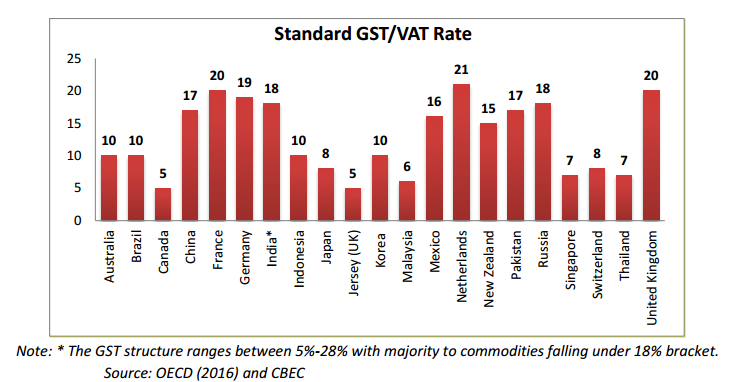
The GST was implementation on June 30 that had impressed the world as to how a vast nation India could do it so quickly, but its implementation process had started 17 years ago. After 17 tumultuous years, a nationwide Goods and Services Tax (GST) will rollout from midnight on June 30 last, overhauling India’s convoluted indirect taxation system, unifying the $2-trillion economy with 1.3 billion people into a single market, wrote Business Line.
The GST, which will replace more than a dozen central and state levies including factory-gate, excise duty, service tax and local sales tax or VAT, is India’s biggest tax reform in 70 years of independence and will help modernise Asia’s third largest economy.
Here is a look at the timelines that shaped the ‘one nation, one tax’ system:
* In February 1986: Finance Minister Vishwanath Pratap Singh had proposed a major overhaul of the excise taxation structure in the budget for 1986-87.
* In 2000: Prime Minister Atal Bihari Vajpyee introduced the concept, sets up a committee headed by the then West Bengal Finance Minister Asim Dasgupta to design a GST model.
* In 2003: The Vajpayee Govt forms a task force under Vijay Kelkar to recommend tax reforms.
*In 2004: Vijay Kelkar, then advisor to the Finance Ministry, recommends GST to replace the existing tax regime.
* On 28.02.06: GST appears in the Budget speech for the first time; Finance Minister P Chidambaram sets an ambitious 01.04.10 as deadline for GST implementation. He says the empowered committee of finance ministers (ECFMs) will prepare a road map for GST.
* In 2008: The ECFMs constituted.
* On 30.04.08: The ECFMs submits a report titled ‘A Model and Roadmap Goods and Services Tax (GST) in India’ to the Govt
* On 10.11.09: The ECFMs submits a discussion paper in the public domain on GST welcoming debate.
* In 2009: Finance Minister Pranab Mukherjee announces basic structure of GST as designed by Dasgupta committee; retains 2010 deadline.
* BJP opposes GST basic structure.
* In February 2010: Finance Ministry starts mission-mode computerisation of commercial taxes in states, to lay the foundation for GST rollout.
* Pranab Mukherjee defers GST to o1.04.11.
* On 22.03.11: UPA-II tables 115th Constitution Amendment Bill in Lok Sabha for bringing GST.
* On 29.03.11: GST Bill referred to Parliamentary Standing Committee on Finance led by Yashwant Sinha.
* Asim Dasgupta resigns, replaced by the then Kerala Finance Minister KM Mani.
* In November 2012: Finance Minister P Chidambaram holds meetings with state FMs; decides to resolve all issues by 31.12.12 for GST rollout.
* In February 2013: Declaring UPA Govt’s resolve to introducing GST, Chidambaram in his Budget speech makes provision for Rs 9,000 crore to compensate states for losses incurred because of GST.
* In August 2013: Parliamentary standing committee submits report to Parliament suggesting improvements on GST. GST Bill gets ready for introduction in Parliament.
* In October 2013: Gujarat CM Narendra Modi opposes GST Bill saying state would incur losses worth Rs 14,000 crore every year due to GST.
* In 2014: GST Bill cleared by Standing Committee lapses as Lok Sabha dissolves; BJP-led NDA Govt comes to power.
* On 18.12.14: Cabinet approves 122nd Constitution Amendment Bill to GST.
* On 19.12.14: Finance Minister Arun Jaitley introduces the Constitution (122nd) Amendment Bill in the Lok Sabha; Congress objects.
* In February 2015: Jaitley sets 01.04.16 as deadline for GST rollout.
* On 06.05.15: Lok Sabha passes GST Constitutional Amendment Bill.
* On 12.05.15: The Amendment Bill presented in the Rajya Sabha.
* Congress demands the Bill be sent to Select Committee of Rajya Sabha; demands capping GST rate at 18%.
* On 14.05.15: The GST Bill forwarded to joint committee of Rajya Sabha and Lok Sabha.
* In August 2015: GoI fails to win the support of Opposition to pass the bill in Rajya Sabha where it lacks sufficient numbers.
* In July 2016: Centre opposes capping GST rate at 18%; gets states around.
* In August 2016: Congress, BJP agree to pass the Constitution Amendment Bill.
* On 03.08.16: Rajya Sabha passes the Constitution Amendment Bill by two-thirds majority.
* Sept 2, 2016: 16 states ratify GST Bill; President Pranab Mukherjee gives assent to the Bill.
* In September 12: Union Cabinet clears formation of GST Council
* On Sept 22-23: Council meets for first time.
* On Nov 03: GST Council agrees on four slab tax structure of 5, 12, 18 and 28 % along with an additional cess on luxury and sin goods.
* On 16.01.17: Jaitley announces July 1 as GST rollout deadline. Centre, states agree on contentious issue of dual control and taxing rights on goods at high sea.
* On Feb 18: GST Council finalises draft compensation bill providing to make good any revenue loss to states in first five years of GST rollout.
* On Mar 4: GST Council approves CGST and Integrated-GST bills.
* On Mar 20: Cabinet approved CGST, IGST and UT GST and Compensation bills.
* On Mar 27: Jaitley tables CGST, IGST, UT GST and Compensation bills in Parliament. Lok Sabha and Rajya Sabha pass all the four key GST Bills — Central GST (CGST), Integrated GST (IGST), State GST (SGST) and Union Territory GST (UTGST).
* On May 18: GST Council fits over 1,200 goods in one of the four tax slabs of 5, 12, 18 and 28%. Over 80% of goods of mass consumption either exempted or taxed under 5% slab.
* GST Council fixes cess on luxury and sin goods to create kitty for compensating states.
* On May 19: GST Council decides on 5, 12, 18 and 28% as service tax slabs.
* On June 21: All states except Jammu and Kashmir pass SGST law.
* On June 28: Mamata Banerjee announces her party’s decision to skip midnight launch of GST.
* On June 29: Cong, Left too decide to skip launch.
* On June 30 midnight: GST was rolled out.
The GST council has set tax rates for goods and services under five brackets of 0%, 5%, 12% and 28%. The concept of GST is not new to the world as nearly 160 countries as on 2016, have opted this mode for bringing individually tax rates into a single tax. India has highest 18% rate of GST compared to emerging market economics, but two types of GST, hence called as duel GST.
In most countries value added tax (VAT) is taken as a substitute for GST. Presently, countries like Australia, Canada, Singapore, New Zealand, Jersey (UK), Malaysia, Indonesia and Pakistan have a GST system while remaining follow a VAT system.
EY India tax partner Vivek Pachisia writes in Financial Express: The India GST regime places the small and medium enterprises (SMEs) on the same footing as large-scale industries by keeping the exemption threshold very competitive (proposed at Rs 1 million) without any tax differentiation. This poses daunting task ahead for SMEs to be ready to invest, read and change in the same way as any large-scale player, without appreciating the limited resources available with them. Some post-implementation truths from the GST in Malaysia includes wide-spread unrest and anti-GST street protests by small & medium businesses in Kuala Lumpur for few months after implementation even with a simpler systemic requirements and much higher level of exemption threshold.
From this lesson learnt, there is no denying that acceptance of GST by general public, businesses and firms would not be an easy task, with advance planning and extending adequate time to industry, continued dialogues between businesses and administrators, engaging with industry on the implementation planning, a reasonable tax-rate, timely release of the legislative documents, has proven to aid in smooth GST implementation in many countries. Of course, GST is proven to be an efficient tax collection system despite teething problems in the initial implementation period.
Analysis of GST by leading journalist Vinod Dua, who has been a popular face of Indian television since 1974, was educative.


 20