

- China & India top global greening mission
RONO HILLS, Sept 09: Realizing the rising impacts of climate change globally due to massive deforestation, MA III semester students of Rajiv Gandhi University’s education department conducted an environmental awareness, themed ‘Plant a tree for the future, contribute to our environment’.
Students and faculty members joined the event to bring mass awareness among school students of Doimukh block, particularly in campus Govt. secondary school and Govt. primary school, about importance of plantations to create a clean and green environment for present and future generations.
The MA students, shouting slogans on maintaining ecological balance to conserve state’s rich flora and fauna displayed colorful placards with messages to save the environment, organized quiz competitions among school students and tree plantation drive in school campus as part of the event.
Enlisting current ecological challenges, education assistant professor Tage Monju Burman suggested solutions to the participants, while HoD Prof. P.K Acharya, event coordinators Dr. Anamika Yadav and Dr. Anga Padu also a spoke, according to a RGU release.
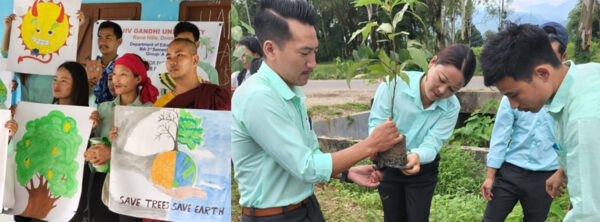
AONS adds: Though the initiative is a drop in the ocean but would make a difference. How?
The world is a greener place today than it was 20 years ago, according to NASA’s 2019 data. What prompted the change? Well, it appears China and India can take the majority of the credit.
In contrast to the perception of China and India’s willingness to overexploit land, water and resources for economic gain, the countries are responsible for the largest greening of the planet in the past two decades. The two most populous countries have implemented ambitious tree planting programmes and scaled up their implementation and technology around agriculture.
India continues to break world records in tree planting, with 8,00,000 Indians planting 50 million trees in just 24 hours. The recent finding by NASA and published in the journal Nature Sustainability, compared satellite data from the mid-1990s to today using high-resolution imagery. Initially, the researchers were unsure what caused the significant uptick in greening around the planet. It was unclear whether a warming planet, increased carbon dioxide (CO2) or a wetter climate could have caused more plants to grow.
After further investigation of the satellite imagery, the researchers found that greening was disproportionately located in China and India. If the greening was primarily a response from climate change and a warming planet, the increased vegetation shouldn’t be limited to country borders.


 20
