
By Pradeep Kumar
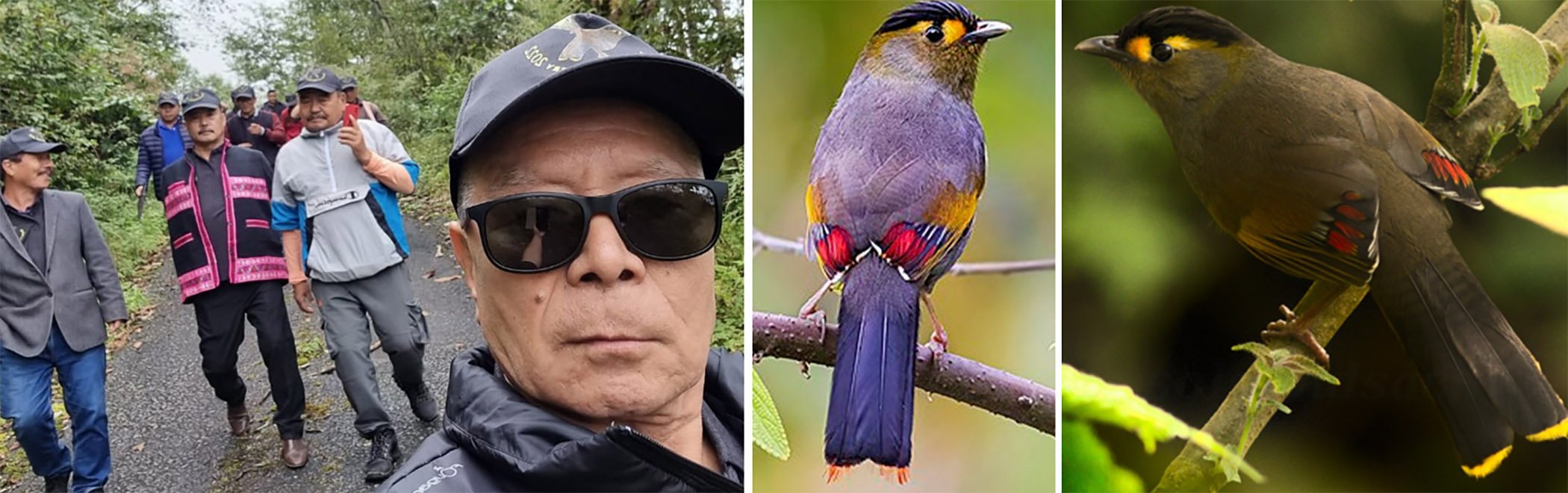
ITANAGAR, Oct 13: Bugun Liochchla, a rare bird, was sighted in Eaglenest Pass in West Kameng district during day-long Bugun Liochchla Festival on Wednesday, chief organiser-cum-former lawmaker Naresh Glow said, adding a male (red tailed) and a female (yellow tailed) pair was sighted (in pic) in the bushes.
Reportedly, there are only 14-20 such birds in the state. They occupy 3-4 square kilometre area in the temperate forest, within the traditional lands of Singchung village. The International Union for the Conservation of Nature has classified this species as critically endangered.
The range officer of Singchung Bugun Village Community Reserve (SBVCR), many social activists and civilians who attended the festival were happy to see the bird, glow told this daily.
Interestingly, the bird has been named after Bugun tribe, the local inhabitants, who have their own folklores, songs, dances, music and rituals. They protect this majestic bird is found only in Eagle Next Sanctuary.
The bird was first discovered by astrophysicist Ramana Athreya in 1995 and again in 2006 in (SBVCR), a biodiversity hotspot spread in 234 square kilometres. About 27 local people look after the SBVCR for which they had won the India Biodiversity Award 2018 in the ‘Conservation of wildlife species’ category for its efforts to conserve Bugun Liocichla.
Arunachal Pradesh is still an undiscovered land true to what I have oft-repeatedly been writing for no survey conducted so far but one stumbles upon and discovers one or other mysteries in this enigmatic land.
Indigenous experts albeit whimsically decide to document some unique social, cultural, natural aspects of this Himalayan state that fascinates the humanity. Social activist turned film maker Naresh Glow, is one among them, who in collaboration with his friend noted film maker Dorjee K Thongun have made many films. His first documentary – The Incredible Buguns – with Thungon as director had won NE best film award and best Tribal Film award of Madhya Pradesh government. His second, a 29-minute documentary film – Wildlife-Our Lifeblood – broke many a records.
It highlights contributions of Bugun community to wildlife conservation by setting up of Singchung Bugun Village Community Reserve (SBVCR), a 17-sqkm biodiversity hotspot in 2017, next to the Eaglenest Wildlife Sanctuary, home to rare species of bird Bugun Liocichla.
The Bugun Liocichla, a small babbler (20 cm (7.9 in) with olive-grey plumage, a black cap, face marked with prominent orange-yellow lores, wings have yellow, red and white patches, with fluty and distinctive voice, is found only in Arunachal Pradesh with small population. It is capable of living in degraded forests, and possibility of its discovery in other areas of Arunachal or neighbouring Bhutan cannot be ruled out.
The 15th edition of International Wildlife Conservation Documentary Film Festival (IWCDFF) 2020 was held during December 1 to 7, 2020 at Café de la Gare in Paris in association with European Film Council (EFC), World Documentary Forum (WDF) and Cultural affairs of Paris, he said, adding the KLEFF 2020, which had screened 53 films, including The Incredible Buguns via its digital screening platform, KLEFF during the virtual festival week, he disclosed.
His first feature film The Land of Bugun Liocichla (LoBL) was released in 2019 and also made another film Molan reflecting life of monks and nuns of Mahayana Buddhism.
“Shooting documentaries was quite simple process since all Buguns took active part. The Incredible GUGUNs, is based entirely on this tribe, – from their historical migration from central Asia to their present dwellings, their culture and traditions. However, covering all major nine scattered Bugun villages poised tough challenges for lack of road communication and hostile climatic conditions besides few less enthusiastic villagers. The Buguns divide their community land among individual members. A piece of land, called Lama Camp, as HH Dalai Lama’s entourage had stopped for a night there while fleeing from Tibet in 1959, was used to set up basic tourism infrastructure,” Thougun said responding to questions.
“The documentary on SBVCR showcases conservation efforts of an NGO of villagers to protect and preserve wildlife, spearheaded by Glow. Covering the idea from the village to famous Eaglenest Wildlife Sanctuary was a hard work as the wildlife and forest pose difficulties along with bad weather but their efforts won award. Shooting solely depends on weather conditions and dense fog takes the toll on time.
“Making feature film is far more tedious and problematic than the documentaries. From technical, technicians to actors, I have to handle everyone. And during shooting of LoGL, I had to change few actors mostly because of their personal and domestic issues. The shooting continued for six months as I had to wait for a particular festival that was to be celebrated few months later. After that I did face few problems from my actors during dubbing of their dialogue and the COVID-19 pandemic has also taken a toll,” he said.
In Monlan, “my technical team left before shooting I could be completed. I managed to shoot last few scenes but again remaining actors were in a hurry to go home. This is quite common since we lack professionalism. The film was given to en editor in Itanagar who took a long time and didn’t finish the editing due to his personal reasons.
“One more problem was hiring equipments from within my state. That had forced me to hire hands from outside. During my almost 30 years of film making experience, I always faced these problems. Until we have professionals in every department of film making all film makers will face these short comings,” he said.
However, I have never come across a producer, like Glow, who was very clear that his objective was not profit but conservation and highlighting our rich cultural heritage. His responsible attitude as a public leader would be cherished by the Buguns for generations, he said with conviction.


 20

