
Beyond the Horizon
By Pradeep Kumar
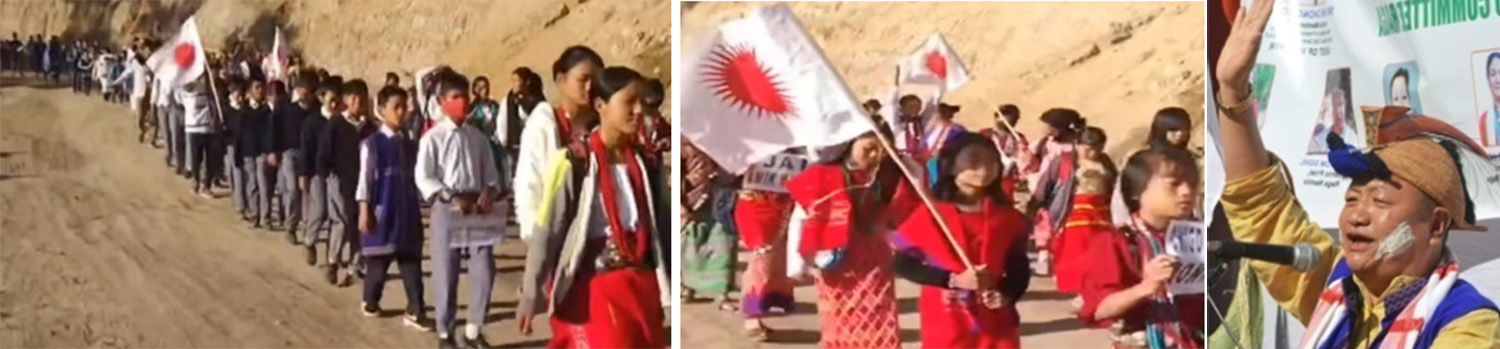
The age-old cultural heritage and traditions handed down by our forefathers, but not the dresses and languages only, are identity of indigenous people of Arunachal Pradesh, said CM’s advisor Tai Tagak while addressing revellers of Indigenous Faith Day celebration at Kamle district HQs Raga recently.
Hinting that this Himalayan state is an ethnic hub inhabited by 26 major tribes, like Adi, Nyishi, Galo, Apatani and more than 100 sub-tribes, belonging to various clans, races and speaking multiple languages, he said that “there are no Arunachalee Christians and no Arunachalee Muslims but we all are only indigenous Arunachalees”.
“We worship jal, jamin and ashman, (water, earth and sky), the life giver with infinite energy, whose exhaustion ends life on earth,” he said, adding there has been imbalance in nature for which Prime Minister Naredra Mdoi recently announced to import 300 cheetahs from foreign country phase-wise in next five years to be released into 300 forests to maintain balance of the nature, which was imbalanced in 75 years.
In fact, many promises made and foundations were laid by past governments, but the BJP Govt only turned those promises into realities, like creation of Kamle district, he said with conviction.
However, it was first Prime Minister Pandit Jawaharlal Nehru, who, in his foreword to ‘A Philosophy for NEFA, by Verrier Elwin’, wrote: “People should develop along the lines of their own genius and we should avoid imposing anything on them. We should try to encourage in every way their own traditional arts and culture”.
Thus, the Unity Festival by Rajiv Gandhi University held in March 2006—aptly called Arunachal Panorama to showcase the rich cultural diversity of this tribal land was a unique attempt that had showcased:
Better with the learned dwell,
Even though it be in hell
Than with the vulgar spirits roam
Palaces that gods call home – Panchatantra
The very concept, thanks to then RGU Vice Chancellor Prof. Atul Sarma, had pricked the psyche of all those who matter and desired such a move to develop a pan-Arunachalee identity for the people, who should have deep-rooted link with their cultures while flying across the globe.
Then state chief secretary Tabom Bam had given a momentum to this concept by his clarion call at Palin on 26.02.06 for unification of all Abo-Tani descendants having same cultural affinities in all respects, but geographically separated.
Such a novel idea propagated by then chief minister Gegong Apang, who had stressed the importance of “Roots and Wings”, while addressing the 63rd annual conference of Indian Public Schools’ Conference (IPSC) at Dehradun in 2002. Apang’s visionary deliberation had resulted in “Blossom & Fruits”, the theme for the next IPSC conference in Rajasthan.
It was a matter of sheer coincidence that 250 delegates from 42 countries spread over five continents representing 257 traditions met at Jaipur (Feb. 5-10, 2006) at the International Conference of World Elders of Ancient Traditions and Culture and proved beyond doubt that peoples irrespective of their caste, creed, religion and region were one as they represented one race—human. Striking similarities in designs and patterns on dresses and ornaments worn by people of different traditions in the world and their Sun and fire centric rituals for the welfare of humanity convinced the Arunachal delegates that they were not living in isolation.
It was befitting for a cultural ambassador of India that too of Sangeet Natak Academy Chairman Ram Niwas Mirdha’s stature to not only inaugurate the Unity Festival but to go back overwhelmed to spread the message all over the country – India has lots to learn from Arunachal. For, the event was exemplary in reflecting the uniqueness and ethno-cultural diversity symbolising ‘unity in diversity’. “Do not detract from your objectives, which you have reflected through your consensus desire and you would succeed”, Mirdha had exhorted RGU students’ body, while appreciating their praise-worthy move.
I was bewildered as similar voices echoed from not only Rono Hills but also Pasighat and Palin preceded by Jaipur that had convinced me that culture alone could unify the globe.
As multi-colour flowers with sweet fragrance make a beautiful garden, the innumerable ethnic groups with their ek se bad kar riti, riwaj aur parampara and harmonious lifestyles in the lap of nature have made Arunachal Pradesh a unique cultural garden of India.
This state is also known as a “Land of Festivals,” but celebration of Indigenous Faith Day, I believe, is reflection of Unity Festival that helped the flowers blossom and spread its aroma in all directions for the indigenous people to feel proud of it.


 20

