
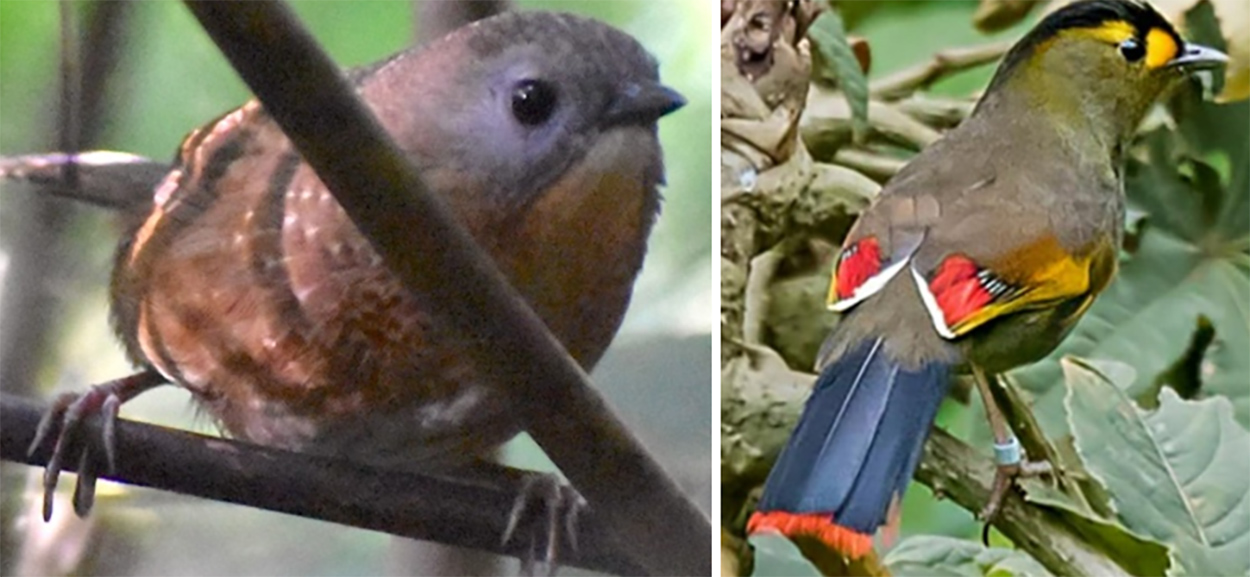
Lisu Wren Babbler Bugun liocichla
- 2nd songbird named after Arunachal tribe Lisu
By Pradeep Kumar
ITANAGAR, Dec 11: True to its distinction as nature’s trove, Arunachal Pradesh, one of the 12 bio-diversity hotspots in the world, has surprised ornithologists again with the discovery of a rare but songbird Grey-bellied Wren Babbler by six birdwatchers from Bengaluru, Chennai, and Thiruvananthapuram (in picture below) in state’s Mugaphi peak in Changlang district in March 2022.
The team named the bird as Lisu Wren Babbler, after local Lisu community, which was recently published by Indian BIRDS, a peer-reviewed journal of south Asian ornithology.
This state has been drawing nature lovers, adventurers, ornithologists and researchers since decades for giving one after another new species of butterflies and birds. And this citing has put this Himalayan state in global ornithology map that too second Arunachal bird to be named after a local tribe.
Lisu tribe, also called Yobin in India, live in Shidi Valley, officially known as Gandhiram village, one of the largest Lisu villages, surrounded by Namdapha National Park, and they are considered as ‘encroachers’ of forests under Wildlife Protection Act, 1972.
The tribe, which used to live in Yunnan region in North-Western Tibet in 18th century and were traditionally slash and burn farmers. In 19th century, they migrated towards south and reached what is now China, India, Myanmar, Laos and Thailand. They have the largest population in South-West China.
About 5,000 Lisu people live in India. The 7th Assam Rifles regiment reached Gandhiram village on 07.05.1961 to become first outsiders to have entered Lisu tribal area after independence. The unit helped draw the international borderlines, working alongside the Lisus. They also informed the tribe that their land was now a part of Indian Territory.
In the 1980s, the Lisu tribe in India was not given the privilege of Indian citizenship, and they were considered refugees from Myanmar and China. By 1994, India granted them citizenship, and in 1950, they were included in the Scheduled Tribes list. However, there was some ambiguity on their status.
First bird named after Arunachal tribe: Professional astronomer Ramana Athreya, working for his PhD thesis, accompanying his wife, a wildlife biologist doing research in Arunachal Pradesh and some forest officers, during a month-long vacation In January 1995, had stumbled upon a pair of birds in Eaglenest Wildlife Sanctuary (EWS) in West Kameng district,
An avid birdwatcher, Athreya was eager to explore the state during the holiday and spotted a pair of birds that didn’t fit any description in bird book he was carrying.
Bugun liocichla or Liocichla bugunorum, is a critically endangered species, with only 14 to 20 individuals believed to exist in the world. Nearly all of the birds live within a tiny area just outside the sanctuary – with one pair having been spotted inside the sanctuary in 1995 – sharing their home, and name, with a local indigenous tribe. The bird was recognized as a new species in 2006 while International Union for the Conservation of Nature (IUCN) classified it as Critically Endangered.
Bugun Liocichla, a small babbler 20 cm (7.9 in) with olive-grey plumage, a black cap, face marked with prominent orange-yellow lores, wings have yellow, red and white patches, with fluty and distinctive voice. It is capable of living in degraded forests, and possibility of its discovery in other areas of Arunachal or neighbouring Bhutan cannot be ruled out.
The Buguns, also known as Khowa, are proud of Bugun liocichla: it was one of the first bird species to be discovered in India since independence in 1947 and found only in Buguns’ community lands.
“Lots of researchers name species after someone else’s name, but we were very happy that the bird was named after the tribe,” says Bugun head Indi Glow of a bird tourism enterprise close to the sanctuary.
Formally described in 2006, the bird brought fame to the small tribe of around 1,500 Buguns. India even launched a 25-rupee postage stamp, featuring Bugun liocichla in 2012.
More importantly, the bird’s discovery kick-started a cascade of conservation activities, culminating in declaration of a brand-new community reserve in 2017 – one that is already winning awards. Bugun Liocichla Utsav is celebrated not only to honour the rare bird but also to salute the Buguns as torch bearer of community conservation. Many locals have become bird guide in EWS, like Phurpa Tsering, a self-taught and highly sought-after.
However, the bird turned politician-cum-social activist Naresh Glow of Tenga, who had served as MLA of Thrizino-Buragaon Assembly seat, into a film maker in collaboration with his friend noted film maker Dorjee K Thongun.
His first documentary – The Incredible Buguns – with Thungon as director had won NE best film award and best Tribal Film award of MP Govt. His second, a 29-minute documentary film –Wildlife-Our Lifeblood – broke many a records.
It highlights contributions of Bugun tribe to wildlife conservation by establishing Singchung Bugun Village Community Reserve (SBVCR), a 17-sqkm biodiversity hotspot in 2017, next to the EWS, home to rare species Bugun Liocichla.
“As the bird derives its name from Bugun community, efforts to protect it are on and I decided to make this film within only one week as a producer,” said Glow, who is also one of the founders and chief patrons of SBVRC who tried to capture the entire process in his documentary film.
The 15th edition of International Wildlife Conservation Documentary Film Festival (IWCDFF) 2020 was conducted during December 1 to 7, 2021 at Café de la Gare in Paris in association with European Film Council (EFC), World Documentary Forum (WDF) and Cultural affairs of Paris, he said, adding the KLEFF 2020 during October 8 to 11, 200 had screened 53 films via its digital screening platform, including his films.
His first feature film The Land of Bugun Liocichla (LoBL) was released in 2019 while Molan reflecting life of monks and nuns of Mahayana Buddhism was complete in 2020.
“Shooting documentaries was quite simple process since all Buguns took active part. The Incredible Buguns, is based entirely on this tribe, – from their historical migration from central Asia to their present dwellings, their culture and traditions. However, covering all major nine scattered Bugun villages poised tough challenges for lack of road communication and hostile climatic conditions besides few less enthusiastic villagers. The Buguns divide their community land among individual members. A piece of land, called Lama Camp, as HH Dalai Lama’s entourage had stopped for a night there while fleeing from Tibet in 1959, was used to set up basic tourism infrastructure,” Thougun said responding to questions.
“The documentary on SBVCR showcases conservation efforts of an NGO of villagers to protect and preserve wildlife, spearheaded by Naresh Glow. Covering the idea from the village to famous Eaglenest Wildlife Sanctuary was a hard work as the wildlife and forest pose difficulties along with bad weather but their efforts won award. Shooting solely depends on weather conditions and dense fog takes the toll on time.
“I have never come across a producer, like Glow, who was very clear that his objective was not profit but conservation and highlighting our rich cultural heritage. His responsible attitude as a public leader would be cherished by the Buguns for generations”, Thongun said with conviction.
Glow, among few others, is visibly emerging as a trend setting film maker to document most unique aspects of this ‘Land of Culture’.
Interestingly, Pakke Wildlife Sanctuary, in state’s East Kameng district, a dense terrain hilly forest with plenty wildlife, also a tiger reserve, is famous for its sanctuary of great hornbill (Buceros bicornis), also known as concave-casqued hornbill, great Indian hornbill or great pied hornbill. It is one of the larger members of hornbill family.
Though found in Indian subcontinent and South East Asia, it is predominantly frugivorous, but also preys on small mammals, reptiles and birds. It has been listed as Vulnerable on ICUN Red List since 2018. It is known to 50-year life span in captivity. It is state bird of Kerala Govt. Due to its large size and colour, it is important in many tribal cultures and rituals. Nagaland’s annual tourism festival during December 1 to 10 is called Hornbill Festival or Festival of Festivals.
The great hornbill was formally described by Swedish naturalist Carl Linnaeus in 1758 in 10th edition of his Systema Naturae. He had placed it with rhinocerous hornbill in the genus Buceros and coined binomialname Buceros bicornis. Linnaeus specified location as China. The genus name is from Latin becerus meaning “horned like an ox” which in turn is from ancient Greek boukerōs which combines bous meaning “ox” with kerōs meaning “horn”. The specific bicornis is Latin and means “two-horned”.


 20

