
By Pradeep Kumar
NAHARLAGUN | Sep 10| Electricity plays hide and seek in state Capital Complex though Arunachal Pradesh is considered the future power house of India with 58,000-mw hydropower potentials to meet 1/3rd power requirements of India.
Pioneer: Former union minister, late K R Kumaramanaglam is credited with forming India’s hydropower policy, which was launched in 2003 by then state CM Mukut Mithi in presence of then PM Atal Behari Vajpayee at Delhi to generate 50,000 MW, with major share of Arunachal including 27,000-MW Siang dam, the largest in India. Late M Kumaramangalam, who deserves kudos for initiating the first major policy to this effect. His must be a satiated soul in heavenly abode today.
Siang was divided into three project later – 2,700 MW Siang Lower, 6,000 MW Siang Upper stage-I and 3,750-MW Siang Upper stage-II to be executed by the NEEPCO and NHPC. But there are many a ifs and buts for tortoise speed in execution of power projects by the power developers.
Where lies the fault?: The government channel has surpassed English Channel to become the longest channel in the world. Funds are sanctioned at the fag-end of March which hardly get spent while huge funds are surrendered to the GoI. The huge surrender of funds this fiscal is the best example. While a lawmaker reacted against the news – Arunachal & J&K fastest growing economies – saying this would prevent the GoI to grant fund. This clearly indicates poor ability of Arunachal in spending even whatever granted by the GoI.
Power consumption development criteria: “One intuitively feels that the amount of energy that a nation uses is related to its productivity, as expressed in its GDP and its population, which of course drives its GDP. Therefore, in order to compare nations with different outputs and populations, it seems wise to divide both consumed energy and GDP by population,” John writes in Energy Consumption and GDP.
Power-starved consumers ghearoed Nirjuli power house on August 29 last reflecting the present state of affairs.
Rich to poor: The United Nations report — “In 1950, Assam (which included Arunachal Pradesh), NE India’s largest state, was more than 4% richer than the rest of India. Isolated and often ignored, by 1999 it was more than 45 per cent poorer, with the gap steadily widening” — was eye opening. It would be prudent for the New Delhi mandarins to take note of it and act more pragmatically.
Though, Chief Minister Pema Khandu reviewed on 31.08.17 ongoing status of power transmission and distribution lines being executed by PGCIL. Their completion would undoubtedly improve the power scenario, but why not maintain the existing system? Who knows, history may repeat soon with generation of additional hydropower to enrich the state coffer with ‘hydro-dollar’.
Hurdles: Naharagun is the highest electricity revenue earner of the state. But little introspection would leave any right thinking person in quandary as to what the ruling state Govts have been doing so far? The power house daily earns about Rs four lakh revenue to become the highest earner of the state but regrettably it has the obnoxious distinction of having highest outstanding bills of the consumers running into crores. When the consumers crave for electricity every movement, why should they fail to pay? Why the defaulters’ supply line have not been disconnected, like the telephone lines?
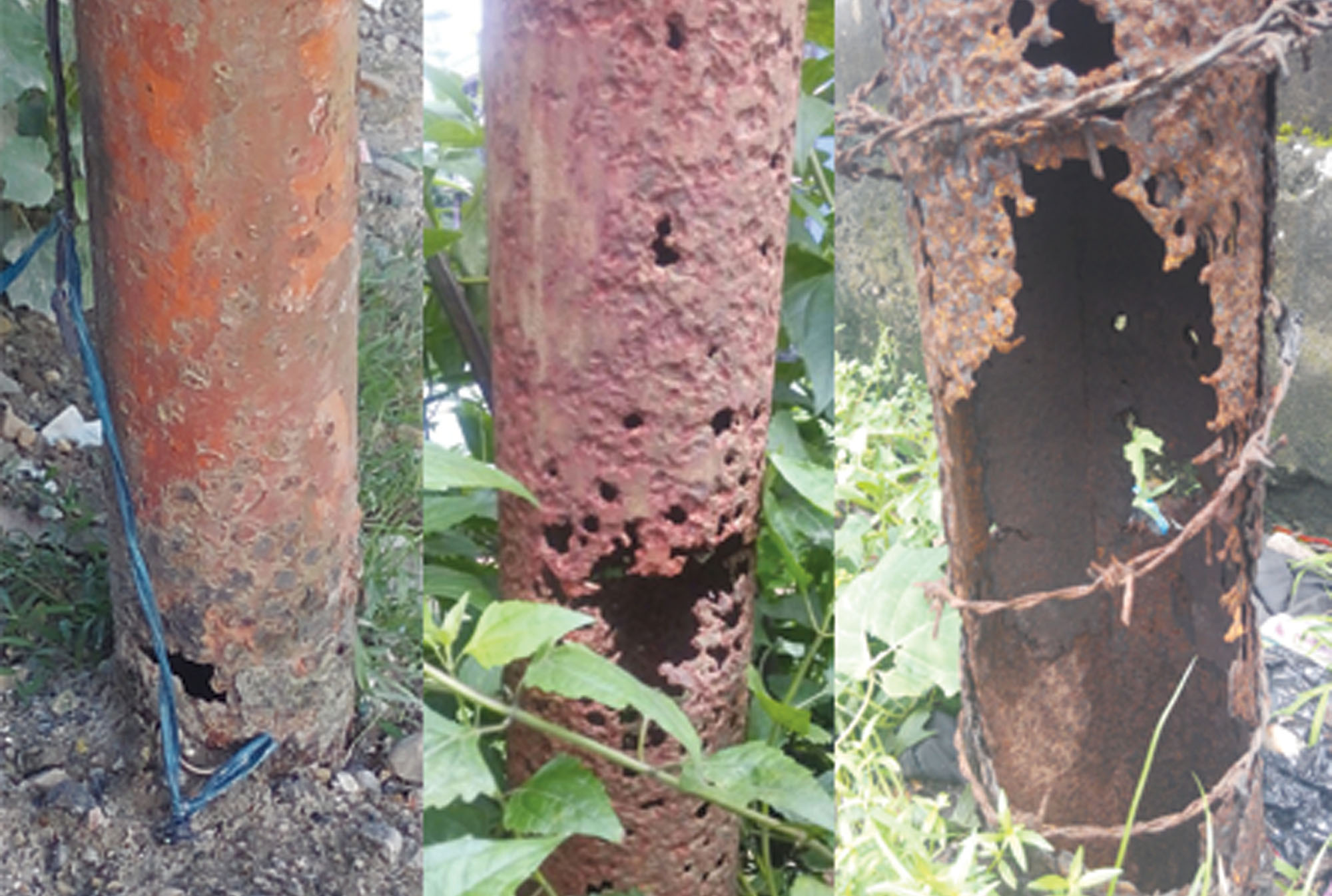
Why: 1) Most of the electric poles installed in around 1975 are outdated, rusted and junk. This daily even has reported that bamboos have replaced poles in many places. The poles near Barpani bridge here were no exception either as it was hanging with wire atop without any base.
2) The power house here, inaugurated by then chief minister Mukut Mithi in 18.03.01, feeding around 12,000 consumers has been facing acute shortage of manpower. Of the total staff, 192 are casuals including around 80% women though the power house works 24X7, particularly for maintenance of emergency services to the hospital and even public calls are numerous.
3) The totally rusted conductors caused major problems recently with the live wire falling near the power house. It was repeated the next day again but luckily no one was hurt as reported by this daily.
4) The massive population growth and unplanned construction of houses in Capital Complex have left hardly any space to draw power line, what to talk of high voltage 11 kv line.
When asked about problems, JE Tana Tokur Tara with remorse said that “We have to work round the clock and mange things of our own without hardly and support. The area is too vast spreading from SMS factory near Lekhi village here to Dree ground (NH-415), Sood village and Paga Tara village along Jully road. How to take up maintenance without required manpower poses greatest challenge regularly. We are left in a ‘what to do and what not situation’ but without any escape route, he said without mincing any words.
If the GoAP is earning revenue, it should take up basic requirements of replacing outdated electric poles and conductors to avoid accidents, which could be fatal too. Moreover, this could be done only by providing required manpower. The sooner the GoAP act, the better it is in larger interest.
Electricity Act, 2003 was UPA Govt to consolidate laws relating to generation, transmission, distribution, trading and use of electricity and generally for taking measures conducive to development of electricity industry, promoting competition therein, protecting interest of consumers and supply of electricity to all areas, rationalization of electricity tariff, ensuring transparent policies regarding subsidies, promotion of efficient and environmentally benign policies, constitution of Central Electricity Authority, Regulatory Commissions and establishment of appellate tribunal and for matters connected therewith or incidental thereto.
It was a trend setting Act that facilitated division of transmission and distribution. Why Arunachal Govt has failed to follow it?
India’s per capital electricity consumption (PCEC) among the lowest in the world. Around 280 million people do not have access to electricity, contrary to China whose PCEC stood at 4,000kWh, with developed nations averaging around 15,000kWh per capita.
NE India: “PCEC crossing 1,000 units is certainly a milestone, but without much significance. One-fourth of India’s households still have no access to electricity, with some states in East and North East having less than even 30% households with (electricity) access. Most significant milestone India should achieve is 100% households having 24×7 quality supply of electricity,” Deloitte Touche Tohmatsu India Pvt Ltd’s senior consulting director Debasish Mishra had said, as livemint reported on 20.05.15
The present BJP had made energy security a part of its election campaign for 2014 general election. After assuming office in May, the BJP-led NDA Govt had launched a scheme aimed at ensuring about eight hours of quality power supply to agricultural consumers and 24-hour electricity to households. Will Arunachal Pradesh come under that schemes , if yes, when?


 20
