
Beyond the Horizon
By Pradeep Kumar
A high magnitude earthquake 7.8 on the Richter scale before sunrise on Monday followed by two strong quakes including one 7.5 magnitude that devastated wide swaths of Turkey and Syria nine hours later in which over 4500 people have been confirmed dead in one of the worst earthquakes to hit parts of Turkey, Syria, and the neighboring region of Cyprus, Egypt, Israel and Lebanon.
The quake hit at a depth of 18-km and was centered in southern Turkey, near the northern border of Syria, according to the U.S. Geological Survey (USGS).
The quake, which was centered in Turkey’s southeastern province of Kahramanmaras, sent residents of Damascus and Beirut rushing into the street and was felt as far away as Cairo.
About 3,400 structures including multi-storied apartment buildings were reduced to rubbles in Turkey, so also dozens collapsed in Syria including damages to archaeological site at Allepo, initial report said, adding Turkey declared seven-day mourning. While the US, the European Union, Russia, India and several other nations immediately sent offers of help.
Earth’s crust: The Earth’s crust is composed of three layers- the crust, mantle, and core. The planet is divided among pieces and where these pieces meet are called fault lines. This is where the layers grind and rub against each other.
Researchers have said that these plates keep trying to move but are bound together by the friction of rubbing up against an adjoining one. But, on certain occasions, when the tension builds up, they can snap past each other quickly, releasing a large amount of energy.
What happened underneath the surface of Turkey was that one plate moved west while the other moved east — jerking past each other to create the devastating quake. Researchers said the earthquake was a strike-slip quake, where two tectonic plates slide past each other horizontally.
The earthquake that hit Turkey and Syria was a strike-slip quake where two tectonic plates slide past each other horizontally, instead of moving up and down. In this case, one block moved east – grinding past each other to create the powerful quake, said USGS research geologist Alex Hatem.
Why the earthquake was so deadly? The quake hit near heavily populated areas. The epicentre was near Gaziantep, a major city and provincial capital in Turkey. The affected regions were also home to vulnerable buildings.
Since the area was not hit by a major quake for over a century, the preparedness was low and so was the structural integrity of the high-rise buildings. Officials reported thousands of buildings collapsed in the wake of the earthquake. They included “pancake” collapses, where upper floors of a building fall straight down onto the lower floors — a sign that the buildings couldn’t absorb the shaking.
Turkey has had many earthquakes. This list includes any notable historical earthquakes that have epicenters within the current boundaries of Turkey, or which caused significant effects in this area. Overall, the population in major cities, like Istanbul in structures that are a mix of vulnerable and earthquake resistant construction.
Meanwhile, with the fault lines remaining quiet, there is no way to predict these quakes. Researchers have long warned that predicting when a fault line will become active is extremely difficult.
The region has been susceptible to such quakes over the centuries due to the fault lines underneath. Monday’s quake occurred in a seismically active area known as East Anatolian fault zone, which has produced damaging earthquakes in the past.
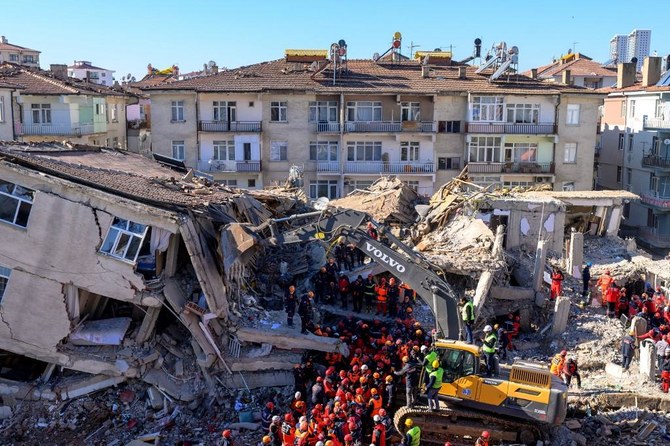
Rescuers search for survivors under rubble following a 6.7 magnitude earthquake in Diyarbakir, Turkey in January 2020 that had caused significant damages.
- Estimated 18,000 killed in a powerful 7.4 magnitude earthquake that hit near Istanbul in north-west Turkey in 1999.
- Estimated 33,000 died in eastern Erzincan province in 7.8 magnitude earthquake that shook Turkey in 1939.
A five-day trip to Turkey during November 21 to 24, 2022, was educative, particularly Istanbul’s Grand Bazaar located in Faith district with same name Kapalıçarşı, one of the largest and oldest covered markets in the world, with 61 covered streets and over 4,000 shops spread in 30,700 m2 area that attracts between 2.5 lakh to 4 lakh visitors daily.
Turkey is a transcontinental country located mainly on Anatolian Peninsula in Western Asia, with a small portion on Balkan Peninsula in Southeast Europe. One of the earliest permanently settled regions of the world, has gone down to history for many reasons, including as centre of the earth and new link between Asia with Europe by a 1.4-km long and 59-meter wide mega bridge across the Bosphorus Straits with eight-vehicle lanes and two high-speed rail lines that tripled the length of the mega metro.
Turkey, a charter member of the UN, the IMF, and the world Bank; a founding member of the OSCE, OIC, BSEC, ECO, MIKTA, TURKSOY & OTS, is ruled by an executive presidential system. It is home to 19 UNESCO World Heritage Sites and among the most visited countries in the world making it a hotspot for global tourists. Istanbul has two bridges across the Bosporus River, with a third underway, that connect the smaller European part of Turkey to the larger Asian part, from East to West and vice versa. The country serves a bridge, between Europe and the Middle East.


 20

