
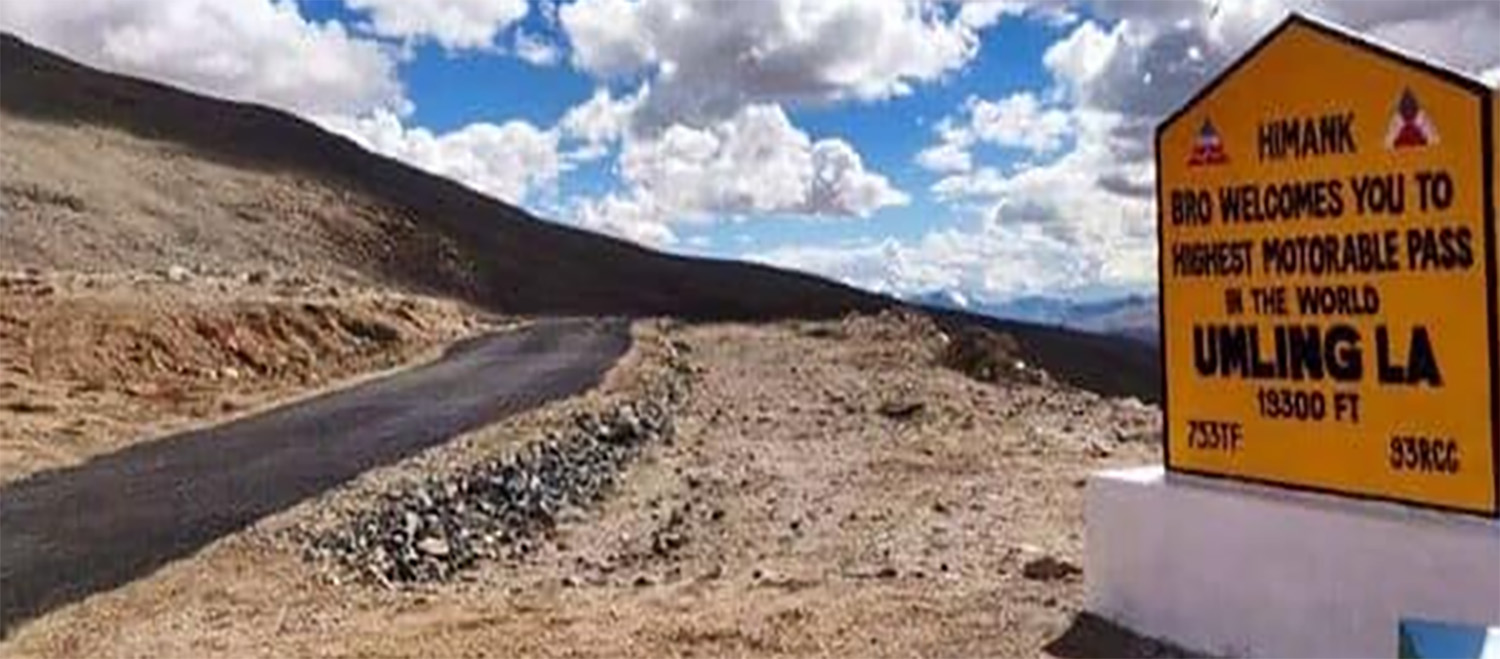
Motorable road at Umling La Pass
By Pradeep Kumar
ITANAGAR, June 16: Three years since the deadly clash in Galwan Valley, India has doubled the pace of border road development with the Border Roads Organisation’s (BRO). The BRO, which in 2021 had created a world record by building and black-topping the world’s highest motorable road at Umling La Pass in Ladakh at an altitude of 19,024 feet, higher than Siachen Glacier, to be congratulated by Union Minister of Road Transport and Highways Nitin Gadkari, is on the challenging task.
On the accelerated works, BRO Director General Lt Gen Rajeev Chaudhry says that there was strategic compulsion to reduce the infrastructures gap in border areas, according to BRO twitter handle. It is needless to say that the BRO, set up on 07.05.60 with Shramena Sarvam Sadhyam (everything is achievable through hardwork) as its motto, has been rendering yeoman service to the nation.
The BRO’s budget for road development has seen a 100% rise in the last two years, proof of India’s strong belief in the need for infrastructure improvement to help our soldiers manning the borders. Since Galwan, the BRO has built 3,200-km of roads linking forward areas. Construction of bridges and tunnels is also on the rise to reduce distance and travel time between strategically important locations.
There are many braveheart engineers of the BRO who have been giving shape to the plans to keep the Dragon at bay; a senior BRO officer told this daily on condition of anonymity while citing few examples.
At Shinkula top, Himachal Pradesh, located at an altitude of 16,000 ft, walking is tough and breathing even more difficult. Posted in such challenging terrain, Captain Aviral Tripathi is involved in construction of world’s highest tunnel. Connecting Himachal Pradesh to Ladakh’s Zanskar region, Shinkula Tunnel will facilitate movement of India’s Armed Forces and defence equipment, vital for protecting the country’s territory from hostile neighbours.
The ambitious project, one among India’s many infrastructure projects, was triggered by June 2020 face-off between Indian and Chinese troops at Galwan valley in Ladakh resulting in martyred of 20 Indian soldiers in the deadliest skirmish in 45 years between the two troops on June 15-16, 2020.
Three years since the Galwan skirmish, India’s infrastructure has grown at a frantic pace along the Line of Actual Control (LAC). And captain Tripathi is not the only hero of this infrastructural expansion tale at dangerous altitudes amid inhospitable terrain.
At locations as high as 19,024 ft, even breathing is a challenge. But for bravehearts such as Colonel Ponung Doming, patrolling the glacial peaks of Leh is all in a day’s work. Col Doming commands Border Roads Task Force (BRTF) at the world’s highest border roads outpost at Hanle in Ladakh.
Daughter of a farmer in Arunachal Pradesh, Col Doming is the pride of her state as India’s first woman officer to command the BRTF. Even as temperatures plummet to minus 20, she fights the elements to look after the world’s highest motorable road at Umling La (19,024 ft), among other projects.
In the last three years, India has doubled the pace of border road development to protect the country’s territory against China. Almost 50,000 troops have been deployed in eastern Ladakh. Since Galwan, the BRO has built 3,200-km of roads linking forward areas. Construction of bridges and tunnels is also on the rise to reduce distance and travel time between strategically important locations.
The Siyom bridge in Arunachal Pradesh, about 35-km away from the LAC, eases movement of heavy military vehicles and equipment to Tuting. The Sela tunnel in the state will provide all-weather connectivity to Tawang and forward areas, and cut down the distance to China border by 10-km as the world’s longest bi-lane tunnel at 13,000 ft.
Continuing with aggressive military infra thrust, last three months have seen several developments, including a 20-km stretch of Karzok-Kiato Road being sanctioned, fourth access to Ladakh with no major passes en route and completion of Nechipu tunnel, which cuts down travel time towards forward base near China border.
“These are but a few of the many impressive strategic infrastructure projects to help our border forces stave off attempts by our foes across the Himalayas to change status quo at the LAC,” an keen observer said.
These ambitious projects are also changing the lives of villagers in India’s last villages. Huri village in Arunachal Pradesh is the best example of reverse migration. Its population of 200, which had reduced to just 49 two years ago, has now crossed 300. No doubt these connectivity projects are a lifeline for improving the quality of life and economic opportunities for such villages as reported by this daily in the past.
At the pace these projects are progressing, one can hope that in the next five years, India’s border villages and outposts will witness a revolutionary upgrade in terms of connectivity.


 20

