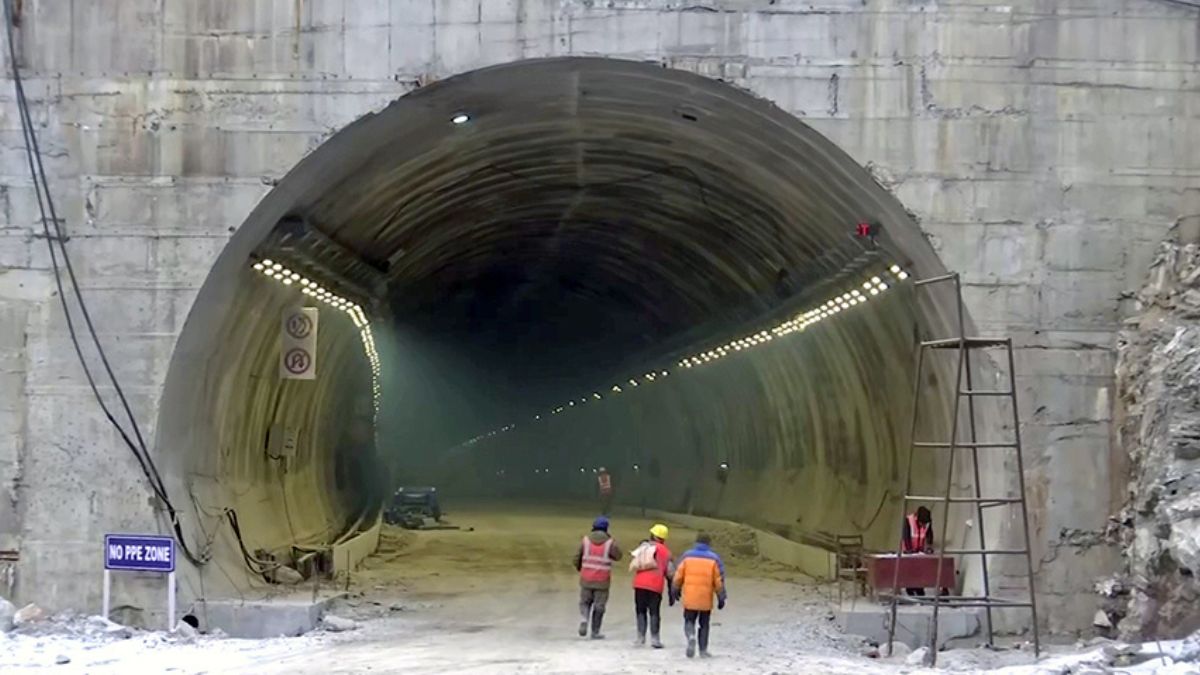
Main Tunnel 2
Cloudburst caused the delay
It is well neigh impossible to fight against the nature, a BRO’s Project Vartak top engineer told this daily on Friday, adding the project was on completion stage, but cloudburst on July 21 last upset the target.
A 400-metre stretch of approach of the tunnel was washed away besides landslides at many locations. The renovation of the road, including clearance of landslides has caused the delay, but hopefully the tunnel would be completed by October end.
By Pradeep Kumar
ITANAGAR, Sept 15: The Sela Tunnel project along the China border in Arunachal Pradesh will be completed by October next. The project was supposed to have been completed by April last while the original deadline for completion of the Rs 700-crore project was June 2022, which was revised to November 2022 and then to April 2023.
The strategically important tunnel would facilitate rapid deployment of troops and weapons to forward areas in Tawang sector and also provide all-weather connectivity to local people, besides tourists. It will also cut the travel time by over an hour to Tawang. It has been designed for traffic density of 3,000 petrol cars per day and 2,000 diesel trucks per day, with max speed of 80 kmph. On completion, this would be the longest bi-lane road tunnel in the world at an altitude above 13,000 feet
However, Defence Minister Rajnath Singh on September 12 had inaugurated 90 projects worth ₹2,900 crore, including Nechifu Tunnel on the same axis ahead of the Sela Tunnel in Arunachal Pradesh, at a pace to match that of Chinese across the LAC. In 2022, 103 projects worth approximately ₹2,900 crore were inaugurated; while in 2021, 102 projects at a cost of over ₹2,200 crore were dedicated to the nation. A record 295 infrastructure projects of the BRO at an overall cost of about ₹8,000 crore have been dedicated to the nation since 2021, according to the MoD.
Sela Tunnel: Drill and blast technique for excavation as part of New Austrian Tunneling Method (NATM) is being used by the BRO for the construction of the tunnels.
The two tunnels and the 9.075 km approach road is being constructed in Sela Tunnel on the boundary of West Kameng and Tawang districts.The lengths of the tunnels and approach roads were subsequently changed based on site conditions.
The current configuration of the project is that Tunnel-1 (T1) is planned for 993 m length; it was previously 475 m and it is a single tube tunnel.
The Tunnel-2 (T2) is now 1,591 m, which was conceived to be 1,790 m — the T2 tunnel is a twin tube tunnel, with one main and one escape tube.
The main tubes of both T1 and T2 are 12 m wide with overhead clearance of 5.5 m. The escape tube with T2 is 7.26 m wide with an overhead clearance of 4 m, being built parallel to the main tunnel at a distance of 20 m and is connected with five cross passages.
The tunnels are being built with a state-of-the-art electromechanical system, including jet fan based longitudinal ventilation system, firefighting devices, CIE norms based illumination system and SCADA controlled monitoring systems.
The sanctioned cost for the project is Rs 687 crore including pre-construction cost of Rs 10 crore and four years maintenance cost of Rs 15.63 crore.
Though the project had witnessed significant delays in the days of commencement due to COVID conditions, it has picked up pace and is one of the fastest progressing tunnel works in the Himalayan region, considering the terrain and remoteness.
According to the BRO, the project will go down in the annals of history as one of the most difficult projects executed in the country.
Arunachal Pradesh has a hydroelectric potential exceeding 50,000 MW. In order to tap the electric power generation potential of Tawang Chu River, National Hydroelectric Power Corporation (NHPC) had proposed two mega projects Tawang-I and Tawang-II with a combined potential of 1,400 MW in Tawang region.
Sela Pass, which is the only access to Tawang region, remains closed for heavy traffic during winters due to heavy snowfall for considerable time every year.
The NHPC had planned to bypass this formidable obstacle by constructing a tunnel under the Sela Pass and proposed a 12.57-km-long tunnel, along with an escape tunnel of the same length.
However, the cost of the tunnel project was very high and added significantly to the overall cost of the power projects. There were other local and environmental concerns as well. Thus, the projects were not cleared.
Consequently, no work on the tunnel was taken up and Sela remained an obstacle for all weather connectivity on this axis.
In 2010, Director General Military Operations (DGMO) proposed tunnels along important areas in the Eastern Theatre to provide all weather connectivity to the border areas, which would enhance operational capability as well as provide succour to local population.
Eastern Command was asked to undertake the feasibility studies for tunnels at Sela, Bomdila and Nechiphu.
Since Sela remained snowbound for about eight weeks in a year, being the highest pass at 13,700 feet on the axis, it was decided to take up work on Sela tunnel at the earliest.
The tunnel was to be built in a strategically acceptable time frame, to offer all weather connectivity to Tawang.
The earlier proposal of 12.57 km tunnel by NHPC, was not only cost prohibitive but also posed serious technical challenges for ventilation and safety, besides the fact that it would require many years for construction.
Keeping in mind the above factors, pre-feasibility for the tunnel across Sela was carried out by BRO in October 2013.
Approval in principle for consultancy service, for the detailed feasibility study and framing up of DPR for construction of two tunnels across Sela Pass on Balipara-Chariduar-Tawang (BCT) road, was given by Defence Ministry on 12.07.17 — after a lapse of four years. A detailed geotechnical assessment of the proposed tunnel area was carried out by GSI in August 2017.
On 14.06.18, the DPR was submitted by the consultant for further tender action by BRO. Through the DPR, BRO proposed two tunnels of 475 m and 1,790 m length with approach roads length aggregating to 9.075 km.
This alignment was decided in such a fashion that the alignment remained below the snow line and allowed for all-weather passage of vehicles without major challenges of snow clearance.
The alignment saves a distance of more than 8 km and cuts down the travelling time by an hour, while obviating the treacherous Sela Pass climb — which is prone to many accidents due to the peculiar topography. (With inputs from Swaraya)


 20