
Beyond the Horizon
By Pradeep Kumar
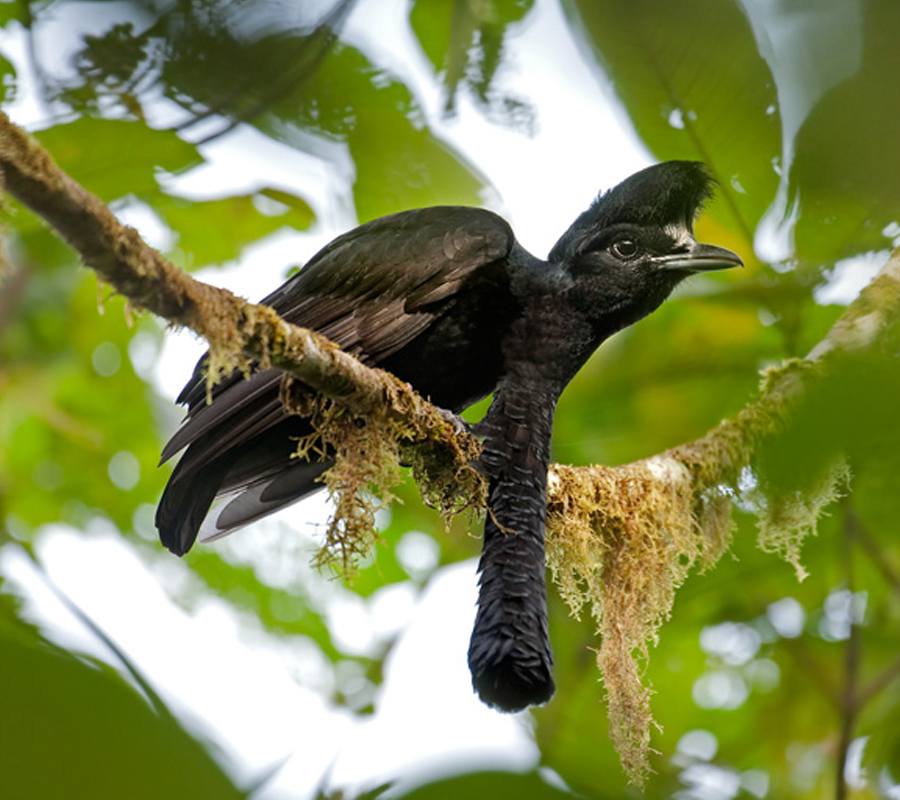
The elegant long-wattled umbrella bird, in action, received through WahtSaap recently left me bewildered. Neither it could be identified not internet helped.
I recalled poem of John Keats (1795-1821), UK’s famous romantic poet, that explains the beauty of nature lucidly.

Elegant long-wattled umbrella Arunachal state bird Hornbill
A thing of beauty if joy forever:
“A thing of beauty is a joy for ever:
Its loveliness increases; it will never
Pass into nothingness;……
Therefore, on every morrow, are we wreathing
A flowery band to bind us to the earth,
Spite of despondence, of the inhuman dearth
Of noble natures, of the gloomy days,
Of all the unhealthy and o’er-darkened ways
Made for our searching: yes, in spite of all,
Some shape of beauty moves away the pall…
We have imagined for the mighty dead;
All lovely tales that we have heard or read:
An endless fountain of immortal drink,
Pouring unto us from the heaven’s brink.
That for themselves a cooling covert make
‘Gainst the hot season; the mid-forest brake,
Rich with a sprinkling of fair musk-rose blooms:
And such too is the grandeur of the dooms…
And now at once, adventuresome, I send
My herald thought into a wilderness:
ll lovely tales that we have heard or rea”
As I failed to identify the elegant bird though internet, earth scientist K D Singh, whose in-depth knowledge on environment and nature was known to me came to my mind. The WahtSaap on being forwarded to him with no alternative, he with the help of ornithologist Pratap Singh, informed that the bird is a resident of Colombia and Equator. .
The long-wattled umbrellabird (Cephalopterus penduliger) is an umbrella bird of Cotinga family. Its common names include ‘Pájaro Bolsón’, ‘Pájaro Toro’, ‘Dungali’ and ‘Vaca de Monte’. Its specific name penduliger is derived from Latin ‘pendulus’, hanging, and refers to the wattle.
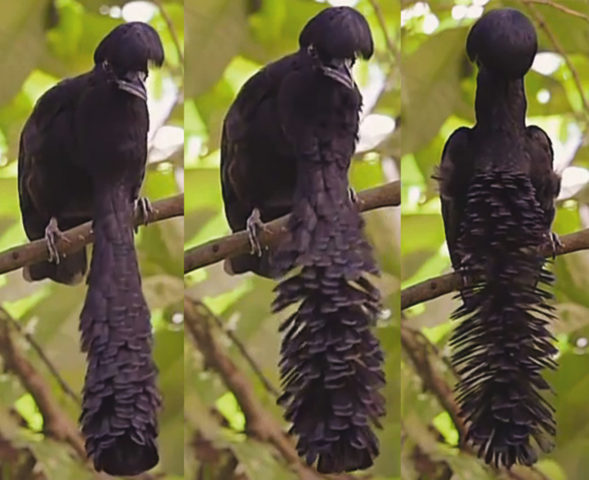
The male is 40-42 cm in height, with the female being slightly smaller at 35-37 cm. Both sexes are short-tailed and carry an erectile head crest; that of the male is slightly longer at 20-30 cm. The male is distinguished by a large throat wattle of feathers, while females and juveniles have no or a much smaller wattle. The length of the wattle can be controlled, and it is always retracted in flight. The male generally has black colored shafts in its feathers.
The species shows a high level of endemism and is found from the southwestern part of Colombia to the province of El Oro in Ecuador, in the bioregion of Tumbes-Chocó-Magdalena. It inhabits humid montane forests at 1,500-1,800 m above sea level on the ridges and sides of the Andes range. The species is mostly furgivorous and feeds on large fruit. The fruits of arecacea, lauraceae & myrtaccea are preferred.
The bird engages in lek mating, where the males congregate in common areas (leks) for display, which are visited by the solitary females. Females select a male with prominent secondary traits such as aggression and territorial behavior. Nests are built in trees or treeferns, and have been recorded at heights of 4.5-5 m above ground. Incubation lasts 27 or 28 days. Only the female incubates and cares for the nestling. She provides food for the nestling on average once per hour and includes invertebrates, vertebrates and regurgitated material.
The species has been classified as vulnerable by the IUCN. A total population of 6,000-15,000 mature individuals was estimated in 2012. It is thought to be under pressure from habitat destruction through deforestation and from hunting. The easy-to-locate lek mating areas make it particularly susceptible to trapping.
It is present in several protected areas. It has been suggested that the consolidation of existing scattered reserves as well as the nomination of several existing protected areas as biosphere reserves, would be very beneficial for the species. The curating of forest composition and reforestation have been pointed out as important approaches.
Why to ponder over wonderful creatures of Colombia and Ecuador without realising what are in store in this Himalayan state of Arunachal Pradesh! What about state bird Hornbills.
(Bucerotidae) are a family of bird found in tropical and subtropical Africa, Asia and Melanesia. They are characterized by a long, down-curved bill which is frequently brightly colored and sometimes has a casque on the upper mandible. Both the common English and the scientific name of the family refer to the shape of the bill, ‘buceros’ being ‘cow horn’ in Greek. Hornbills have a two-lobed kidney. They are the only birds in which the first and second neck vertebrae (the atlas and axis respectively) are fused together; this probably provides a more stable platform for carrying the bill. The family is omnivorous, feeding on fruit and small animals. They are monogamous breeders nesting in natural cavities in trees and sometimes cliffs. A number of species of hornbill are threatened with extinction, mostly insular species with small ranges.
Arunachal boasts of a rare bird Rufous-necked Hornbill (Aceros nipalensis), which has been classified as vulnerable by IUCN. Populations of this species have already been exterminated from east Nepal and large parts of Vietnam. One of the primary causes of its population decline is hunting. Logging large trees – like this – for timber and agriculture is another major threat.
However, the Nyishi community which use head gear (bopiya) fitted with Hornbill beak, resulting in their killing. To conserve the species, Pakke Tiger Reserve & Wildlife Sanctuary (PTRWS) DFO Chukhu Loma, in-charge of PTRWS), in East Kameng district, where aspects of hornbill biology were studied in PTR during 1995-2000, initiated to replace the original beak with artificial fiber in 2002 in collaboration with Wildlife Trust of India (WTI). This sanctuary is the only hornbill sanctuary in India. And a mass people’s movement began with the formation of Village Forest Development Committee (VFDC) the same year. A joint project of state’s department of environment and forest (DoEF) and the VFDC protected the hornbill, through strict vigil which led to the growth of its population.
The Hornbill Nest Adoption Programme (HNAP), a novel idea of DFO Tana Tapi to conserve and protect Hornbill nests in the fringe forest PTRWS is an added endevaour of DoEF, was taken up at the imitative of PCCF (wildlife & biodiversity) JL Singh in 2012.
DFO Tapi, a highly decorated forest officer, had initiated a tripartite agreement between Ghora-Aabhe Council (GAC) of Seijosa circle headed by chairman Takum Nabum, Mysore-based Nature Conservation Foundation (NCF) and DoEF/DFO enlisting the principles, terms of agreements and the roles and responsibilities of all three partners top conserve the rare bird.
Pakke is the only Hornbill sanctuary in India.


 20
