
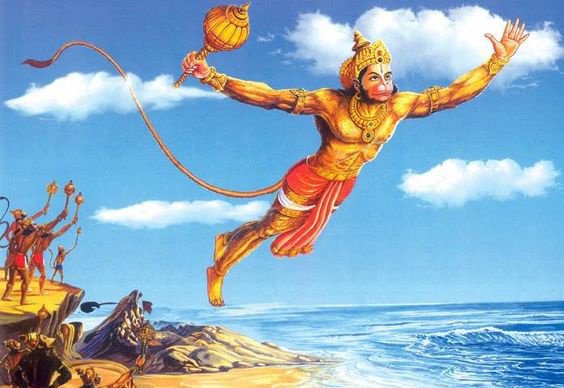
- Vayujat visits Lord Jagannath daily
By Pradeep Kumar
NAHARLAGUN, Apr 20: Devotees of Lord Hanuman under the banner of Shri Hanuman Janmostasva Celebration Committee would organize a three-day celebration at Shiv temple here from Sunday.
The celebration would begin with a procession with the image of Lord Hanuman from 2 pm on Sunday which would be taken along the main thoroughfare of this township by male and female devotees.
The prayers would be offered to Sankantmochan in the evening for three days for which special artists, including Sanjay Shama, Ayushman and Sharad Aanad from Kolkata, Surjit Agarwal and Kanchan Trivedi from Kanpur and Subham Bhaskar Goswami from Bokaro, have been invited, said noted trader Kamal Bajaj, instrumental in organizing the annual event.
Hanuman, in Hindu mythology, a deity in Hinduism, revered as a divine vanara, and a devoted companion of the deity Rama. Central to the Ramayana, Hanuman is celebrated for his unwavering devotion to Rama and is considered a chiranjivi.
According to the Ramayana, Hanuman was born when Wind God Vayu, took a spoonful of pudding from Anjana and gave it to her. Vayu delivered the payasam to Anjana, who ate it and thanked the gods. This spoonful of pudding caused Anjana to give birth to a baby boy, Hanuman. Hanuman had the shape of a monkey like his mother Anjana, but Vayu took the young boy to be his own son, and so Hanuman is considered to be a God, specifically 11th Rudravatar, incarnation of Lord Shiva.
Lord Hanuman was born on the full moon of the Chaitra month (April), approximately one crore and 85 lakhs years ago. The exact day of Hanuman Jayanti, which celebrates the birth of Lord Hanuman, varies depending on regional beliefs:
While still a baby, Hanuman tried to fly up and grab the Sun, which he mistook as a fruit. The king of the gods Indra struck Hanuman with a thunderbolt on the jaw (hanu) for which he is known as Hanuman. When Hanuman continued to misbehave, powerful sages cursed him to forget his magic powers, such as the ability to fly or to become infinitely large, until he was reminded of them.
Hanuman led the monkeys to help Rama, an incarnation) of god Vishnu, to rescue his wife Sita from demon king Ravana, king of Lanka. Having been reminded of his powers by Jambavan, the king of the bears, Hanuman crossed the strait between India and Lanka in one leap, despite the efforts of watery demines to stop him by swallowing him or his shadow.
In Lanka, he destroyed Padma Vana, part of Ashoka Vatika and was captured by taken before Ravana by his son youngest Meghnad. Ravana ordered to set Hanuman tail on fire, but he used that fire to burn down Lanka. He met Sita in captivity in Ashoka garden and conveyed Rama’s message and assured of her rescue by Lord Ram. Sita gave him her pearl necklace and he returned and gave it to Lord Ram as a proof of her captivity by Ravana.
This led to war between demons of Lanka led by Ravana and Vanara Sena led by Hanuman of Rama. Many warriors of Rama, particularly his younger brother Laxman was hurt and senseless by an arrow of Meghnad. The priest had sought four herbs, including Vishalyakarani, found only in Mount Dronagiri in the Himalayas within 24 hours to save Laxman.
Hanuman also flew to the Himalayas and could not recognize Visalyakarani or Sanjeevani and picked up a mountain full of medicinal herbs, including Visalyakarani and returned on time even after he fought with demon Kalnemi for 30 minutes and or so in his conversation with Shri Ram’s brother Bharat was brought down by an arrow by Ram’s younger brother Bharat at Ayodhya in night before he flew again.
The distance of Dronagiri mountain from Sri Lanka is about 2,500-km, which means that Hanuman covered a total distance of 5,000-km in about two hours. This suggests that Hanuman’s flying speed could have been as high as 2,500-km per hour, only a fraction of his divine powers, as mentioned in Times of India, to justify that he was Pawan Putra. He is known for his intelligence, indefatigable, marvelous and adventurous deeds and identical with the speed of Garuda, the divine eagle vehicle of Vishnu as mentioned in Valmiki Ramayana Bala Kanda Sarga 17. Hanuman is the greatest example and model of devotion to be blessed by Lord Ram to be chiranajivi or amar (immortal).
Lord Krishna is worshipped in Jagannath Temple in Odisha’a Puri as Lord Jagannath. King Indrayumna, nephew of Lord Ram wanted to build a temple for Lord Jagannath. The temple’s main shrine was built by Anantavarman of the Chodaganga dynasty in the 10th century, but the deities within the shrine are believed to be much older. According to mythological belief, Lord Krishna’s heart still beats within the walls of the temple. Devotees replace the heart of Lord Krishna, now called brahma-padhaar, every 12 to 19 years when the full moon appears twice during the month of ashad. The replacement is due to astronomical and astrological considerations.
The temple is also known for several unexplained mysteries, like the direction of the flag, the wooden idols, absence of a shadow and the sound of waves. The flag is always noted to fly in the opposite direction of the wind, and a priest changes it each day by climbing a height of 45 storeys. It is believed that Lord Hanuman visits Jagannath Temple daily to pay obeisance to Lord Krishna or Lord Ram.
Hanuman is also a popular figure among Buddhists in Central, Southeast, East Asia, and across these areas many temples have been erected for his worship. Outside India, however, rather different tales are told of him. He was steadfastly chaste and identified as the inspiration for the monkey hero of the great Chinese poem Xiyouji (Journey to the West).
Lord Hanuman, one of the seven immortals, master of Ashta Siddhis or eight powers (Anima, Mahima, Garima, Laghima, Prapti, Prakamya, Isitva & Vasitva), is very compassionate to his devotees. He is worshipped in 150 names, including Aabhaan, Aanjaya, Aashu, Abhayram, Abhyant, Adhilesh, Ajesh, Akshhantre, Amit Vikram, Vatatmaj, Vayujat, Vayunandan, Vijitendriya, Vishvesh, Vajranaka, Vardhimainakapujita, Vayusut, Veerendra, Vritik, Writam, Yogi, Yogine and last but not the least Yunay (means expression of a divine connection and reverence to the deity known for strength and devotion).


 20
