
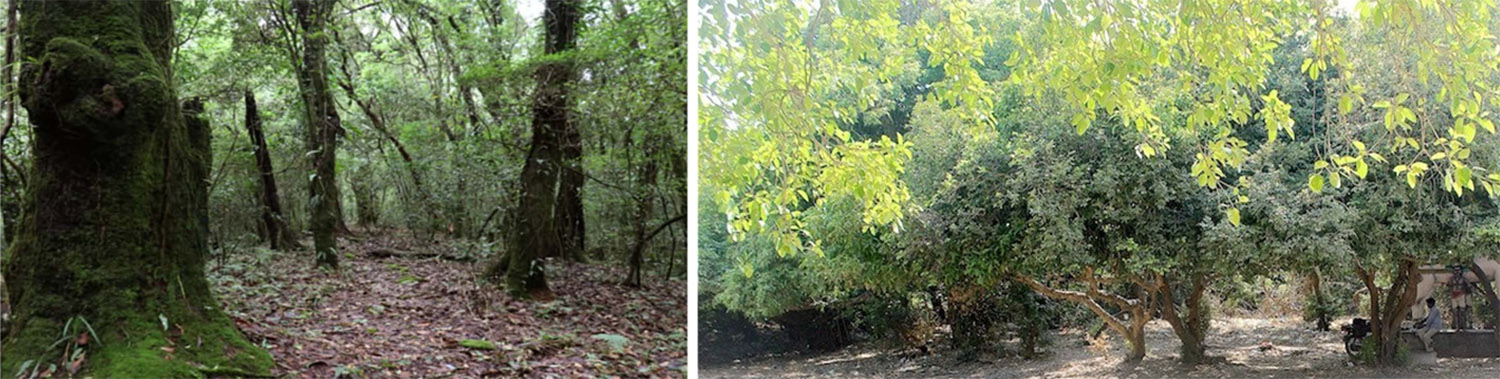
Sacred groves of Meghalaya and Puthupet
Will Woody Wonder Arunachal wake up?
Arunachal Pradesh spread in 83,743 km2 area with forest cover of estimated 66,430.67 sqkm (India State of Forest Report 2021), 79.33% of total geographical area, is known as a Woody Wonder being a treasure trove on flora and fauna. Some of the identified herbs and birds are not found in the country in this Himalayan state with many unidentified abhayaranyas (sanctuaries).
The state has Pakhui, Eaglenest, Kane, Dr, D. Ering Memorial, Mehao & Namdapha Wildlife Sanctuaries, Dihang-Debang Biosphere Reserve, Mouling National Park . & few Tiger Reserves, but many are still hidden.
Eight days after a Pawan Hans helicopter went missing with Tirap DC Kamlesh Kumar Joshi, pilots MS Brar and Rajeev Hoskote were by High Altitude Warfare School commandos from J-K in the district on 12.08.15. It was one of the abhayaranyas as the choppers went down on being stuck by strong cane jungle of about one-feet width, a GoAP employee, who had accompanied the team had said. He is an acquaintance of present Minister Gabriel D Wansu. Asked about a picture, he had quipped own security was a challenge what to talk of taking picture.
A scientific survey of state forest is the need of the hour, which, I am confident, would surprise India, about the number of sacred groves the state has hidden in its womb. If present Environment & Forest Minister Wangki Lowang takes steps in this direction, the outcome would be greatest gift to the humanity!
Beyond the Horizon
By Pradeep Kumar
India has a rich tradition in conserving non-forest patches known as sacred groves, through cultural and religious beliefs. Sacred groves not only preserve the indigenous biodiversity, it also mitigates the effects of climate change.
Most of the tropical dry evergreen forest (TDEF) patches are sacred groves, forests that local communities conserved for religious, social and cultural reasons. Almost always, these had temples inside. Now the temples have become bigger and the number of visitors has increased, but the tree cover has gone down, indicating a weakening of the beliefs that led to conservation.
“When I first saw Puthupet forest, it was taller and denser,” said Pondicherry University researcher C. Muthumperumal, but “The gaps in the forest are increasing with the cutting of trees. While the forest compensates for some level of disturbance with increased liana growth, at Puthupet this ability to regenerate is getting lost.”
While the impact of human disturbance is quick, the impact of climate change has been gradual, says Muthumperumal. Increasing temperature and erratic monsoons have disturbed the forest. Native tree cover has gone down. The effect is a decrease in the ability of the forest to store carbon. Trees combat climate change by storing carbon that would otherwise be in the earth’s atmosphere.
Local communities 10-km north of Puducherry on the east coast of India have for centuries preserved an anthill (puthu in Tamil) in a 17-hectare forest because they believed it was the abode of their snake god. Today the deity of Puthupet has a bigger, permanent abode in a temple.
But the forest, permanent abode of the trees, has no such refuge. The number of trees in Puthupet forest is falling. The number of invasive liana vines is increasing exponentially. Researchers of Ecology & Environmental Sciences department of Pondicherry University say increased human disturbance and climate change have caused this.
Whenever evergreen forests of peninsular India are mentioned, it evokes images of mist-laden forests of tall trees, dense canopies and undergrowth in the Western Ghats. Unknown to many that there is a different kind of TDEF. These are in pockets along the east coast, including Puthupet forest.
This is the typical forest type of what is known as the Coromandel Coast, where annual rainfall does not exceed 1,400 mm. The little rain that falls does so in spurts, during the northeast monsoon every winter. The Guindy National Park is one such TDEF patch inside Chennai. It was declared a national park in 1978 to protect the vegetation and also due to its population of black bucks.
Puthupet forest is not the only one facing decline. The researchers, who have been systematically studying 10 TDEF patches over the past 20 years, have realised that while the tree population in these tracts has decreased by 30%, there has been an increase in the liana (woody climbers) population by 30%.
Similarly, the picturesque landscape of Meghalaya is dotted with patches of undisturbed, virgin forests protected by the local tribal communities for centuries for religious and cultural practices, which provide several ecosystem services, like reduction in soil erosion, maintenance of hydrological cycle, ensuring availability of water free from contamination and natural dispersal of seeds. They also help maintain health of the ecosystem, reduce habitat destruction and conserve the viable population of pollinators and predators.
The value of these undisturbed, virgin forest patches for biodiversity conservation and carbon sequestration has gained increasing attention with the rising impacts of climate change.
Meghalaya Forest and Environment Department (FED) has urged the Centre to declare the sacred groves as community reserves and offer assistance of Rs 24.74 crore for conservation to enhance the resilience of sacred groves to climate change.
“Notification of these sacred grove areas as a community reserve will accord legal recognition and protection. It will also make them eligible to receive financial assistance under centrally sponsored scheme of ‘Integrated Development of Wildlife Habitats” a report on Forest Inventory of Sacred Groves in Meghalaya (volume–III) released by Meghalaya Chief Minister Conrad Sangma on Wednesday said.
Praising research efforts particularly of PCCF (working plan, research and training H C Chaudhary, Sangma stressed that research and data-driven decision-making are integral to governance, enabling formulation of informed policies.
“The report recommends registration of these sacred groves under these rules to accord legal recognition and protection from diversion for non-forestry purposes. The boundary of these forests has not been physically demarcated on the ground. This may result in intentional or unintentional encroachments. The publication therefore recommends that the boundary of these groves shall be demarcated with permanent boundary pillars and signages to prevent and to ensure early detection of encroachments. The publication also recommends the promotion of eco-tourism in sacred groves to create awareness about rich biodiversity and also to create livelihood opportunities for local residents.
Section 38C of the Wild Life (Protection) Act, 1972 provides that the state Govt may, where the community or an individual has volunteered to conserve wildlife and its habitat, declare any private or community land not comprised within a National Park, Wildlife Sanctuary or a Conservation Reserve, as a Community Reserve, for protecting fauna, flora and traditional or cultural conservation values and practices.
“Notification of these sacred grove areas as a community reserve will accord legal recognition and protection. It will also make them eligible to receive financial assistance under centrally sponsored scheme of ‘Integrated Development of Wildlife Habitats’. The publication therefore recommends notification of sacred groves as community reserve” the report added.
To facilitate long-term conservation, protection and scientific management of sacred groves, the working plan, research & training and district council affairs wing of FED through forest resources survey division (FRSD) has initiated a survey, mapping and inventory of growing stock in sacred groves in the state. Volume I and Volume II of a report on Forest Inventory of Sacred Groves of Meghalaya, each containing details of 20 sacred groves, were published in 2017 and 2022 respectively. Its volume-III includes details of 24 sacred groves located in East Khasi Hill district for which a field survey was carried out during 2022-23.
The FRSD has also identified an additional 69 sacred groves located in Khasi Hills and Jaintia Hills region for mapping and inventory during 2024-25.
But these sacred groves which provide several ecosystem services are not yet registered with autonomous district councils concerned, as mandated by United Khasi-Jaintia Hills Autonomous District (Management and Control of Forests) Rules, 1960 for which they don’t get legal protection from diversion for non-forestry purposes, the report said. (Agency)


 20
