
Beyond the Horizon
By Pradeep Kumar
Trees since time immemorial are known as life givers for providing numerous benefits for survival of all living beings, including humans, on the earth. That is why tree plantation is indivisible part of any VVIP visit in India.
The best example is the tree planted by His Holiness the 14th Dalai Lama on 31.03.1959 on the sport where he had put his first foot at Khenzamani, a border close to the LAC, under Zimithang circle of Tawang district in Arunachal Pradesh, after fleeing from Tibet. ’A small gate, known as ‘Lhasa Dwar’ built by the Assam Rifles, is marked by this ‘holy tree’, which has grown tall and now worshipped as a relic marking the historic event. It has become cynosure of all eyes in the Centre-sponsored ‘Vibrant Village’. Thus, trees not only are reminders of visit of important persons, but record keepers too.
One Mohana Basu fron Ramghat had reported on 05.06.23 -World’s oldest carbon-dated banyan tree in UP has a structural problem.
“A majestic banyan tree presides over a little ridge on the banks of the Ganga, just a few km away from the smoking towers of the Narora Atomic Power plant in Uttar Pradesh. Priests and guardians of the tree say that the Siddhvari—as they call it—has existed for thousands of years, with its roots going back to the Mahabharata. But recent radiocarbon by researchers of Botanical Survey of India (BSI) with a team from Romania, reveals that the tree is an estimated 400-500 years old.
The study, published in latest edition of journal Current Science may have disappointed the priests, but the Siddhvari is now the oldest banyan tree to have been scientifically dated in the world. Residents say that praying at the sacred grove where the tree lives takes away all their troubles and fulfils their wishes.
“Well, doesn’t sitting here itself make your heart more peaceful?” says Ashokanand, one of the priests who acts as a guardian of the tree.
Similarly, the Great Banyan tree is over 250 years old and covers about 3.5 acres of land in Acharya Jagadish Chandra Bose Botanical Garden near Kolkata (Calcutta), making it the widest tree in the world.
The age of an ancient tree trunk is estimated using radiocarbon dating. If the trunk has a C-14 decay rate (34%) of what it is in living plants.The half-life of C-14 is 5,730 year.
Radiocarbon dating, or carbon-14 dating, is a scientific method that can accurately determine the age of organic materials as old as approximately 60,000 years. First developed in the late 1940s at the University of Chicago by Willard Libby, the technique is based on the decay of the carbon-14 (5730 years) isotope. Radiocarbon dating has been used for historical studies and atmospheric science, and triggered archaeology’s “radiocarbon revolution.”
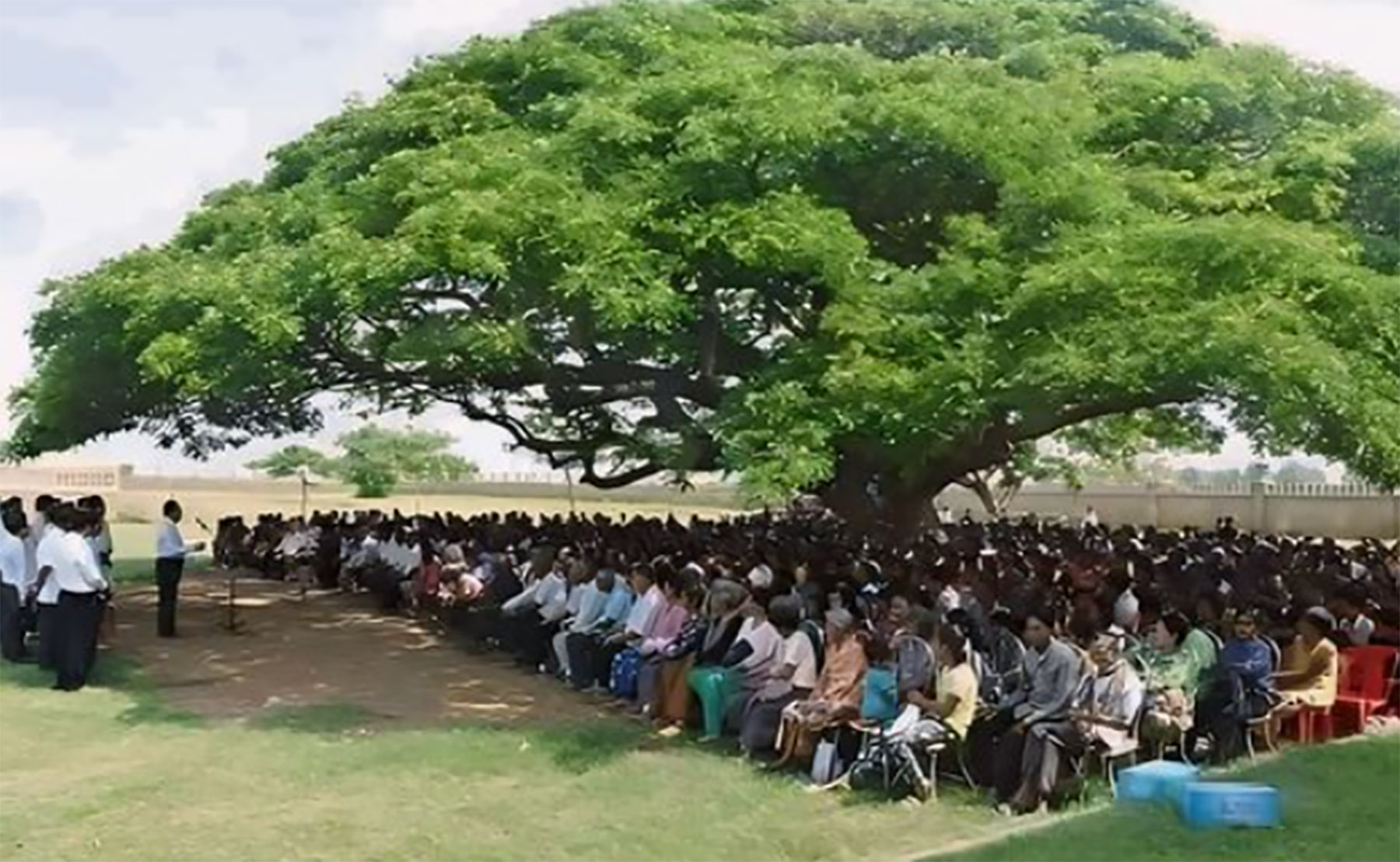
Trees, reminders of visit of important persons, poduce most of the oxygen that humans and wildlife breathe; clean the air and provide clean water to drink; provide fruits as food; offer shade and shelter for humans, animals and plants; serve as habitats for many species of plants and animals; used as firewood for cooking and heating; offer materials for building houses; its shadow help relieve stress and improve mood; its breeze cool during the day and retain heat at night, which conserves energy; roots hold soil tightly to reduce erosion; prevent flooding; increase property values and help beautify the surroundings.
Trees have been revered for their longevity and usefulness throughout history, and they play a role in many of the world’s mythologies.
There are roughly 73,300 tree species on Earth, with about 9,000 species yet to be discovered. This estimate is based on a global dataset of over 38 million trees across 90 countries and 100 territories. But of late wanton and rampant destruction of trees for the sake of development has not only been harming the balance of environment in the nature that has expedited the process of climate change whose impacts are visible across the world now.


 20
