
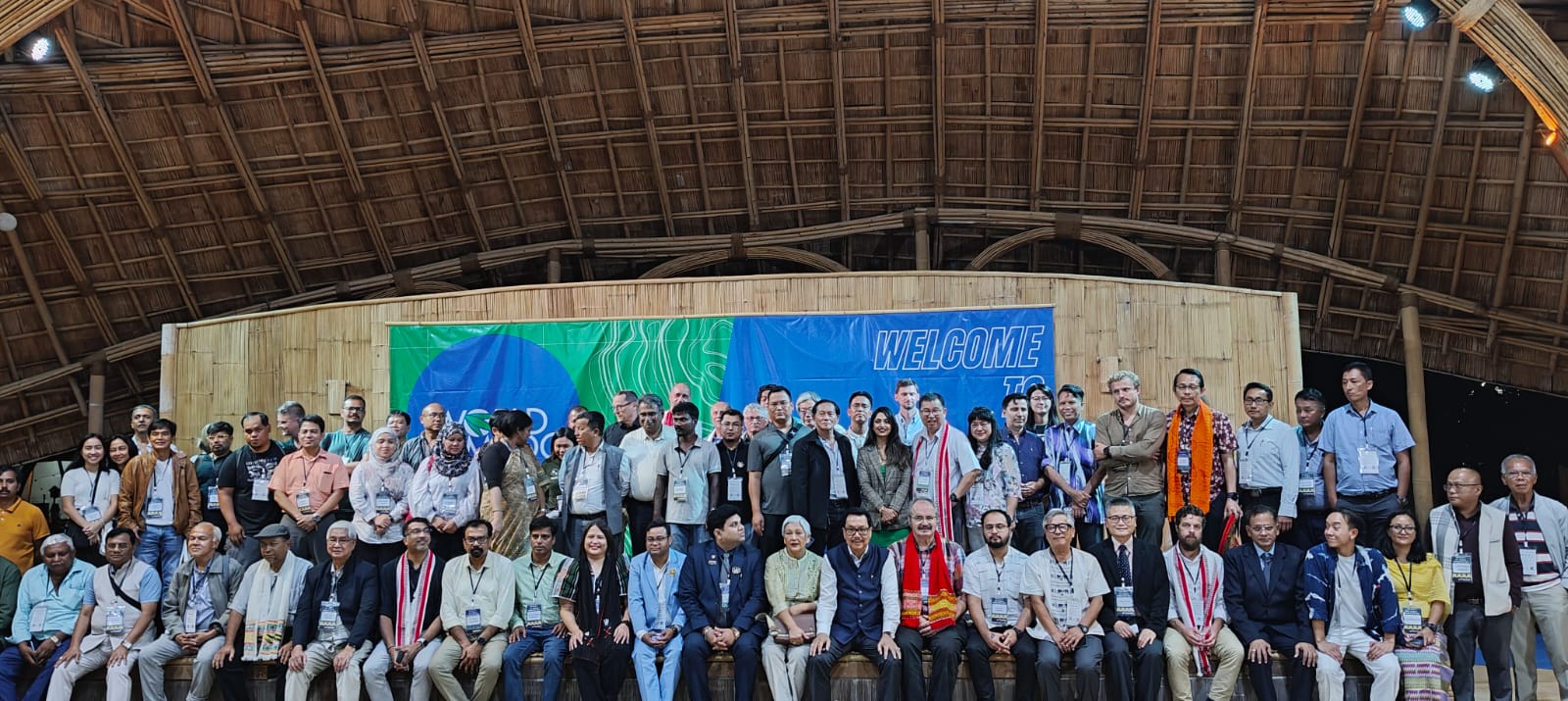
CHIANG MAI, Thailand, Sept 19: Bamboo, inseparable part of life of Arunachal Pradesh people, plays an integral role in socio-cultural lives of the people of NE India, where it is used in traditional tools, intricate baskets and festival decorations while modern technology expanded its potentials leading to creation of high-quality products, like bamboo mat boards, flooring materials and artistic crafts with both domestic and international appeal, said state’s Deputy Chief Minister Chowna Mein.
Addressing 15th World Bamboo Day celebration at Chiang Mai University (CMU) here as chief guest on Wednesday amidst host of dignitaries from across the globe, Mein noted that bamboo, often referred to as the “Poor Man’s Timber,” is not only the tallest grass but also a remarkably versatile and rapidly growing plant, offering a sustainable alternative to traditional timber.
While highlighting global distribution of approximately 1,200 bamboo species, he said that 150 are found in India and 98 in the NE India alone while his state . He added that his state boasts of highest bamboo diversity with 76 species across 19 genera. The NE’s varied altitudes from 150 meters to over 7,000 meters above sea level nurture a wide array of bamboo species, each uniquely adapted to its environment, he informed.
Explaining on its various applications in daily life, he said that bamboo’s myriad uses include construction, agriculture and cultural practices, with every part of the plant serving a purpose. The culms are used in various applications, leaves processed into drugs and fodder and shoots incorporated into local cuisines and beverages, he disclosed.
Mein informed that bamboo is an important ingredients in tribal cuisines of NE India because of its taste, high nutritional values and low-fat content. These shoots provide essential fiber and contribute significantly to local culinary traditions, he said.
Highlighting innovative utilization of bamboo in the region, he cited recent technological advancements that have enabled production of agro-gas (2G Bio CNG) and ethanol. Assam Govt has embarked on a pioneering project in collaboration with international partners to produce ethanol from bamboo, underscoring bamboo’s economic and environmental potential, he informed.
Acknowledging the challenges in sourcing quality bamboo for industrial use, Mein stressed on ongoing efforts to promote commercial cultivation and support farmers in its large-scale production. These initiatives aim to leverage bamboo for watershed management, soil and water conservation and rural development to boost his state’s economy and ensuring nutritional security, he reasoned.
Mein called for collective efforts to champion the development of bamboo for a more sustainable and prosperous future. He also lauded appreciation to World Bamboo Day founder-cum-South Asia Bamboo Foundation executive director Kamesh Salam and Dr.PandinOunchanum, Dean of the Faculty of Architecture, for extending the invitation to this prestigious program and for the warm hospitality extended to him and his entourage.
The event, among others, was attended by Founder of World Bamboo Day and South Asia Bamboo Foundation executive director Kamesh Salam and CMU dean (architecture) Dr. Pandin Ounchanum, Sapol Boonsermsuk & Dr Markus Roselieb of Thailand, Shibita Shozo of Japan, Luc AC Boeraeve of Belgium, Ahmad Mazlan Othman of Malaysia, Marc Peeters of Indonesia, Piazza Marco of Italy, Michel Abadie of France, Dulce Blanca Punzalan of the Philippines, Susanth C.S. of India, Dr Shi-Ming (Jack) Huang of Taiwan and Dr My Hanh Diep of Vietnam .
The United Nations recognized 12 exemplary individuals as “Bamboo Gurus” for their exceptional contributions to the promotion, development and sustainable use of bamboo under the SDGs on the occasion. (PRO)


 20

