
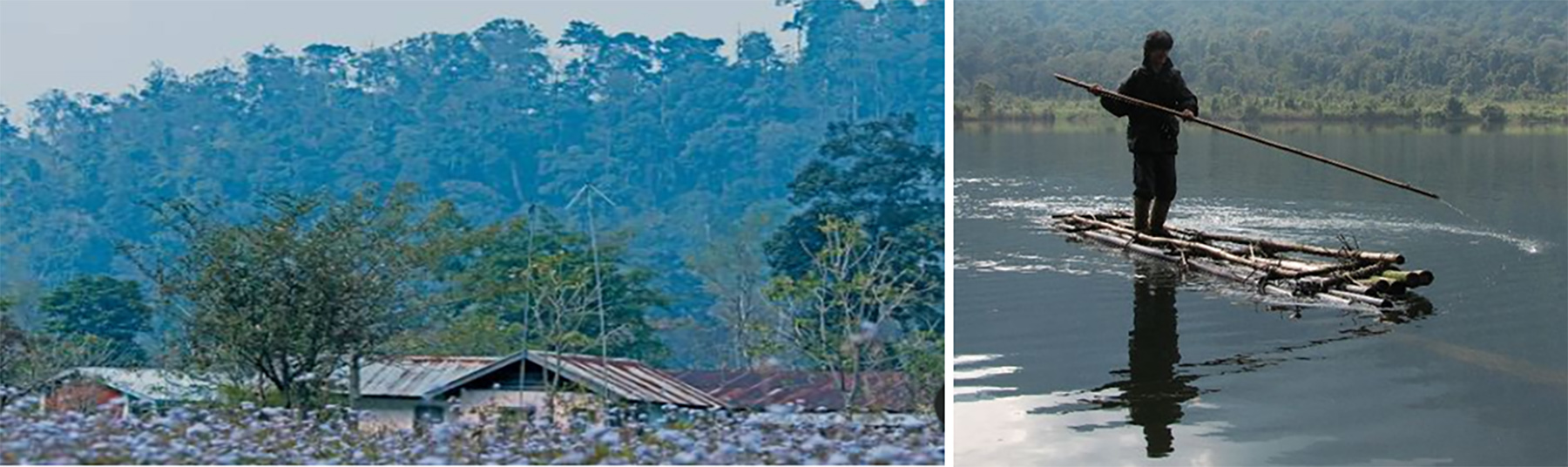
Namdapha National Park & Tiger Reserve Glow Lake
By A O News Service
ITANAGAR, Oct 05: The Union Ministry of Environment, Forest and Climate Change (MoEFCC) has declared Namdapha National Park & Tiger Reserve (NNP&TR) in Changlang district and Kamlang Wildlife Sanctuary & Tiger Reserve (KWS&TR) in Lohit district of Arunachal Pradesh as Eco-Sensitive Zones (ESZs) to protect biodiversity.
The NNP&TR, a biodiversity hotspot in Eastern Himalayas, spread in 1,985 km2 is largest protected area in the state, was originally declared a wildlife sanctuary in 1972, a national park and a tiger reserve under Project Tiger in 1983. It harbours northernmost lowland evergreen rainforest in the world besides extensive dipterocarp forests, comprising the northwestern parts of Mizoram-Manipur-Kachin rain forest eco-region. It is the fourth largest national park in India. Its name was a combination of two Singpho words- ‘nam’ means water and ‘dapha’ means origin; the river originates at the Dapha Bum glaciers. It boasts of more than 1,000 floral and about 1,400 faunal species.
The KWS&TR, set up in 1989 spread in 783 km2, is one of the 12 protected areas of the state and 50th Tiger reserve in India, is rich with flora & fauna. The park, named after Kamlang River which flows through it, located in tropical and sub-tropical climatic zones, is home to four big cat species of India: tiger, leopard, clouded leopard and snow leopard.
The park has a number of water bodies above an elevation of 2,000 ft, including Glow Lake (5,000-ft) covering an area of 8 km2 and a circumference of about 4–5 km; it is accessible only by trekking. Another notable topographic feature within the park is famous pilgrimage Parshuram Kund.
Its upper reaches of have Alpine vegetation and tropical wet evergreen forests in lower reaches and have recorded 150 tree species have been reported in the park besides great variety of herbs, bamboos, grasses, shrubs & and 49 species of orchids.
Faunal species found in the park is somewhat similar to that of Namdapha -– mammals (61), bird (105) and reptiles (20), Royal Beengal tiger, common leopard, clouded leopard, marbled cat, leopard cat, snow leopard, Asian elephant, wild board, sambar, barking deer, black giant squirrel, flying squirrels & 15 primates.
The Mishmi, Digaro Mishmi & Miju Mishmi tribes, who live around the sanctuary periphery, claim to be descents of King Rukmo of Mahabharat.
Taking to the microblogging site X, Chief Minister Pema Khandu exalted the announcement and stated, “Delighted to share that @moefcc has declared Namdapha National Park & Tiger Reserve (Changlang district) and Kamlang Wildlife Sanctuary & Tiger Reserve (Lohit district) as Eco-Sensitive Zone (ESZ).”
CM Khandu also informed that in February 2024, Pakke Tiger Reserve was also included in the ESZ category.
“This further paves the way for focused conservation of endangered wildlife and rare flora found in these reserves, which is essential for environmental sustainability and maintaining a balanced ecosystem,” he reasoned.
The National Environment Policy (2006) had defined the ESZs “as areas/zones with identified environmental resources having incomparable values which require special attention for their conservation” because of its landscape, wildlife, biodiversity, historical and natural values.
The ESZ tag aims to protect the environment and the biological integrity of the area outside the protected areas where an eco-system has been adversely affected due to anthropogenic and climatic factors.


 20
