
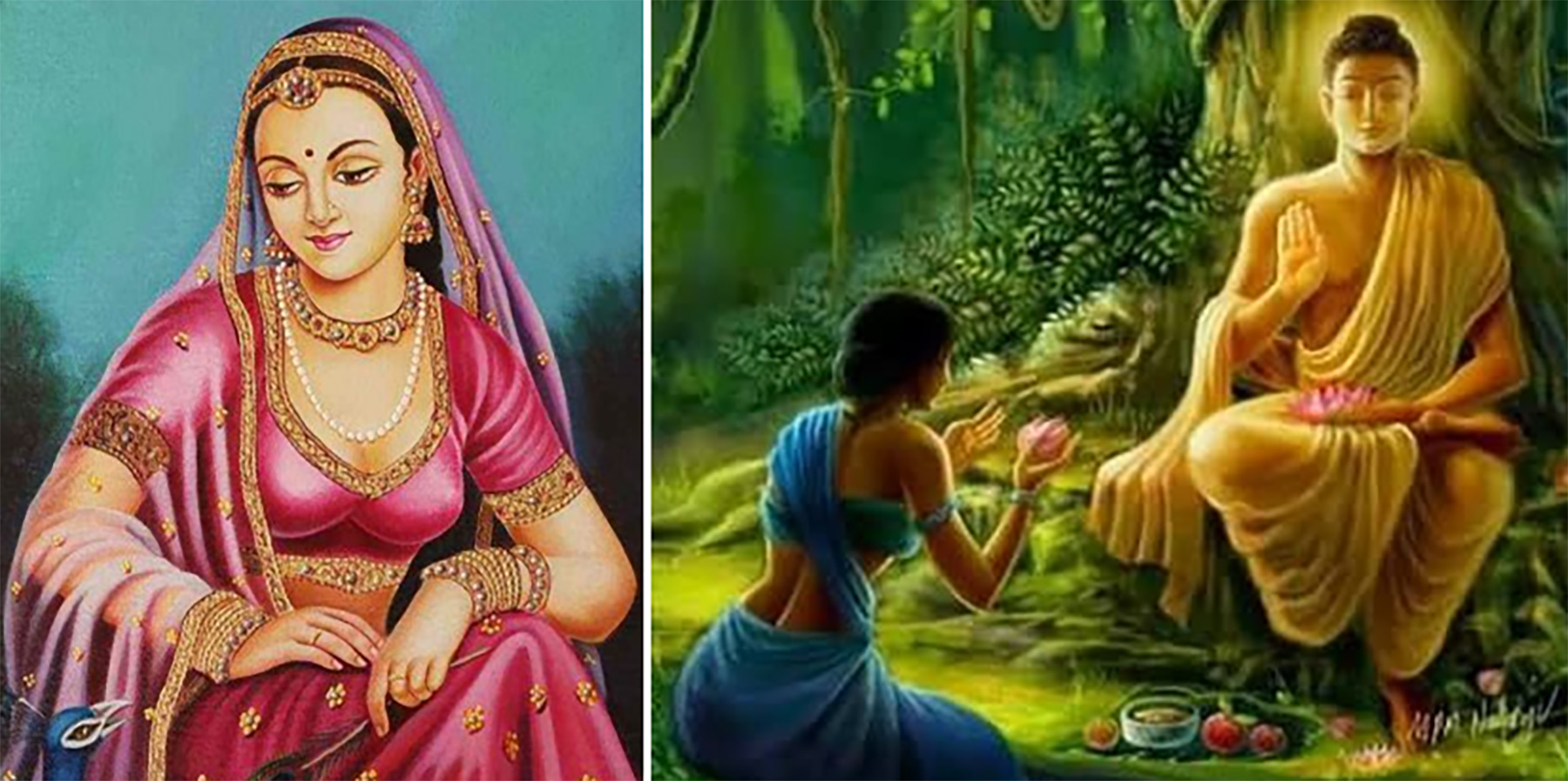
Amrapli renouncing mortal please before Lord Buddha to turn a monk
Beyond the Horizon
By Pradeep Kumar
Āmrapālī, also known as “Ambapālika”, was a celebrated nagarbadhu (royal courtesan) of Republic of Vaishali, located in present-day Bihar, in ancient India around 500 BC. Amrapali also won the title of rajnartaki (court dancer). Following Lord Buddha’s teachings, she became an arahant. She is mentioned in the old Plai texts and Buddhist traditions (agama sutra), particularly in conjunction with the Buddha staying at her mango grove, Ambapali vana, which she later donated to his order and wherein he preached the famous Ambapalika Sutra. The legend of Amrapali originated in the Buddhist Jataka Tales some 1500 years ago.
Amrapali is believed to have been found at the foot of a mango tree in one of the royal gardens of Vaishali by a poor couple around 600-500 BCE, hence her name (amra means mango and pallawa means young leaves).
Vaishali was capital city of Licchavi tribe, one of the eight Kshatriya clans that had united to form the Vajjian confederacy. The king was elected by an electoral college consisting of princes and nobles of Kshatriya clans. It was customary that the most beautiful women in the land, rather than marrying one man, would dedicate themselves to the pleasure of many as nagarabadhu.
Even as a young maiden, Amrapali was exceptionally beautiful and ethereal. It is said that a feudal lord by the name of Mahanaman was so enchanted by the young Amrapali’s beauty that he abandoned his kingdom and moved to Ambara village, a small hamlet in Vaishali presently in Muzaffarpur.
Amrapali was declared “most beautiful” girl at the age of 11 and was later made nagarvadhu. She also is a celebrated rajnartaki (court dancer) as with great love she had earned proficiency in classical music and dance besides known for her hunting, archery and horse riding. She grew up to be a lady of extraordinary charm and grace with talent in many art forms.
Many young nobles desired her company. When Vaishali King Manudev saw Amrapali perform a dance in the city, he plotted to “own” her. He murdered Amrapali’s childhood love and would-be-groom Pushpakumar, on the day of their wedding, and later officially announced Amrapali as Vaishali bride (nagarbadhu). She was also bestowed with the title of Vaishali Janpad Kalayani, given to the most beautiful and talented girl of the kingdom for seven years. Amrapali had the right to choose her lovers, but according to the aforementioned custom, she could not be committed to any one man.
After being declared a nagarvadhu, her talent and beauty attracted so many men and the glory of Vaishali due to her fame. The price to see Amrapali’s dance was 50 karshapanas per night and her treasury grew much larger than the treasuries of some kings.
Stories of her beauty reached Bimbisara, King of hostile neighbouring kingdom Magadha, who attacked Vaishali and took refuge in Amrapali’s house. Bimbisara was a good musician and fell in love with Amrapali. When she learned his true identity, Amrapali asked Bimbisara to cease his war leave. Bimbisara, smitten with love, offered her to be his queen, but she refused anticipating was between two kingdoms. The king ceased was and left. But Amrapali gave birth to his son, named Vimala Kondanna.
Bimbisara’s son born to Queen Chellana (according to Jaina traditions) or Queen Kosala Devi (according to Buddhist traditions), Ajatashatru later invaded Vaishali due to a dispute with his brothers. He was so moved by Amrapali’s beauty when she was imprisoned, so he burnt the whole Vaishali. Almost everyone died except Amrapali, but when she saw the condition of her motherland, she renounced her love for him.
In Buddhist records, Amrapali is known to have seen a Buddhist monk and fell in love with him to ask him to stay in her palace during four-month rainy season. The monk agreed if Lord Buddha permits. And with the Lord’s consent he lived in her place and returned to Lord Budhha with Amrapli.
“I could not move the monk with my beauty, but he impressed me and I relaised that the truth of life is at your feet,” she told Lord Buddha, who was in Vaishali shortly before his death. Amrapali attended his sermon at a nearby grove and so deeply moved by it that she invited him for a meal in her house.
Āmrapālī receives Lord Buddha at her house
Buddha recognised her beauty and accepted her invitation for a meal. Amrapali received Buddha with her retinue in her grand residence which had been specially decorated for the occasion. After the meal, she offered to Buddha and his order her entire property including her groves which became the venue for several sermons on mindfulness. She renounced her position as courtesan accepted the Buddhist order as a monk and dedicated her life to the service of poor and destitute. Amrapali’s son Vimala Kondanna grew up and became a renowned Buddhist monk.
Amrapali story is significant for understanding contemporary attitudes of courtesans. Though she received much fame as a talented artist, she was also berated by the noble princes of Vaishali by calling her ‘ganika’ (prostitute). But, Buddha had no prejudice against her as he had told that she cannot be ganika without the involvement of the royals. He ate at her residence and accepted her grove for the Buddhist order. This is often quoted as an example for his unbiased regard for women. However, with the passage of time and as the Therigatha was collated, this bias also entered the Buddhist fold.
Amrapali’s possible alliance with Bimbisara has also survived mainly through an oral tradition and has not found its way into the Pali canon of Buddhism. This is because Bimbisara was a great royal patron of Buddhism and his links with Amrapali may throw a negative light on him. Amrapali’s mention in the canon also focuses mostly on the later part of her life when she converted to Buddhism.
But, records of Chinese travellers who came to India in search of Buddhist texts have made note of Amrapali’s early life and her relationship with Bimbisara. The latter is found in the Chinese Recension of Buddhist tripitaka. This narrative has been written in Mahayana tradition.
A third set of scriptures which refer to Amrapali story are from Gilgit Manuscripts of Kashmir, the Tibetan-Sanskrit scriptures of Mulasarvastivada branch of Buddhism which hold her in high esteem but with negative connotation of being a courtesan. Thus, the cultural memory of a courtesan shows a complex pattern, varying across time and place.
Amrapali has been the subject of three biographical films: Amrapali (1945), Amrapali (1959) and Amrapali (1966).Bollywood actress Hema Malini produced, directed and starred in a television series called Women of India, which depicted the Amrapali life. A DD National telecast a series Amraplai in 2002.
Amrapali has been subject of various books, including Vaishali Ki Nagarvadhu, a 1948 Hindi novel by Acharya Chautursen and Ambapali, a 1962 novel by Vimala Raina. A recent work in English, The Legend of Amrapali: An Enchanting Saga Buried Within the Sands of Time, was completed by author Anurag Anand in 2012. Amrapali is also mentioned in the book ‘Heroines’ by historian writer Ira Mukhoty.


 20
